
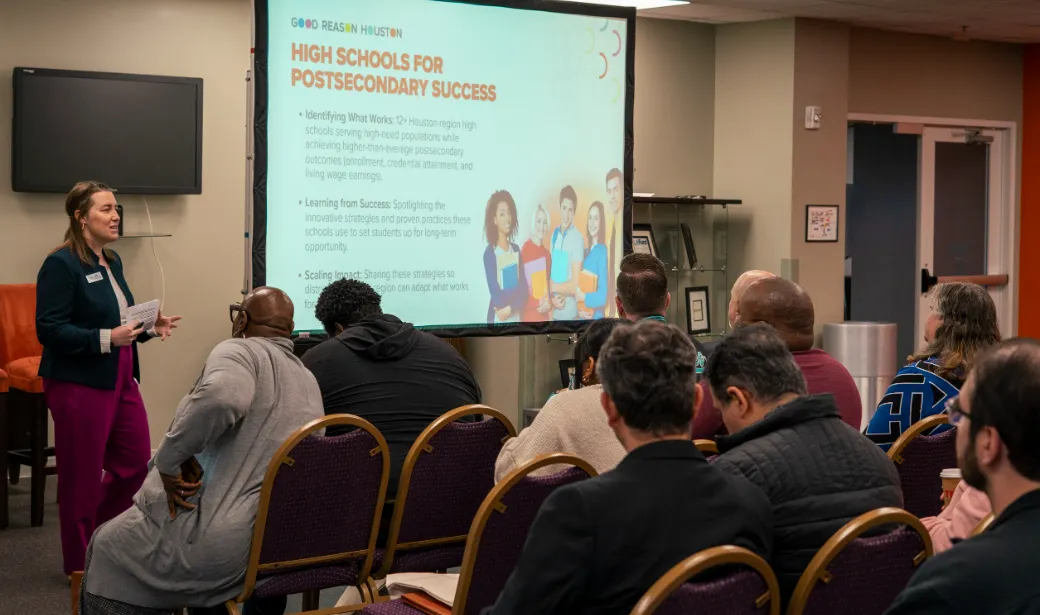
“When Ashley Marroquin, a senior in Houston, Texas, began planning for life after high school, she had already taken rigorous courses and set ambitious goals. But like many students, she found herself navigating key decisions — financial aid, scholarships and course pathways — with limited access to consistent guidance, a challenge she recently shared during a community webinar on college and career readiness . Her experience reflects a broader reality facing school systems nationwide: while most students graduate, far fewer leave high school with a clear, supported path to a life full of choices after they graduate. In Houston, for example, nearly 9 in 10 students earn a diploma, but only about 1 in 5 goes on to earn a living wage within six years , according to research from education nonprofit Good Reason Houston. “Our kids deserve better than that,” said Courtney Isaak Pichon, CEO of Good Reason Houston. “If we want different outcomes, we have to align what students experience from pre-K through graduation with what it will actually take to succeed in a future workforce.” Good Reason Houston and EdTrust in Texas found that research and practice across Houston and similar systems point to a clear set of strategies district leaders can implement now to better align K–12 experiences with postsecondary and workforce success. 1. Redesign advising systems to match the complexity of student pathways In many districts, advising remains episodic and concentrated in high school, often constrained by high counselor-to-student ratios. But today’s pathways — spanning college, workforce training and credentialing — require sustained, individualized guidance. Students like Marroquin often encounter fragmented support, particularly when navigating complex processes like financial aid. Districts can address this by building comprehensive career exploration and advising models that: Begin exposing students to different types of careers in elementary school Start to incorporate individual college and career advising in middle school and continue through graduation Integrate academic planning with postsecondary and career navigation Ensure families receive information in their primary language For families, the gaps are just as real. Many report wanting to support their children but lacking access to clear, consistent information, particularly when language or system complexity creates barriers. Without a coherent advising strategy, even well-designed opportunities remain underutilized. 2. Shift from access to participation in advanced coursework Expanding access to advanced coursework has been a priority for many systems. The next challenge is ensuring students actually enroll and persist. Texas has taken a strong step to support advanced math pathways by requiring school systems to automatically enroll qualified students in advanced math courses in middle school to encourage Algebra I completion by 8th grade. Despite this step forward, across districts, many students who meet readiness benchmarks for AP or dual credit courses in high school or core courses outside of math are never placed in them. Structural barriers — from unclear placement processes to reliance on self-selection — often limit participation. One of the most effective levers is automatic enrollment based on demonstrated readiness, with opt-out provisions, which does not have to be limited to middle school math. This reduces friction and normalizes high expectations. Students who complete multiple advanced courses are significantly more likely to earn a postsecondary credential, improving both access and completion outcomes. 3. Align education pathways with regional labor market demand Career and Technical Education (CTE) has expanded rapidly, but alignment to workforce demand remains uneven. In many regions, students enroll in pathways that do not lead to high-wage, high-demand careers. At the same time, employers report difficulty finding qualified local talent — a disconnect that points to a systems-level misalignment. Leading districts are addressing this by: Using labor market data to prioritize high-value pathways Partnering with employers to co-design programs and align credentials Tracking completion and postsecondary outcomes, not just graduation rates and enrollment Ensuring students can stack credentials or transition into further education 4. Integrate readiness metrics into core accountability and budgeting decisions A persistent barrier to progress is the disconnect between stated priorities and operational systems. Districts that are making meaningful gains are embedding college and career readiness into: Strategic plans and consistently monitored student outcome goals set by the school board Budgeting and resource allocation decisions Public-facing reporting and tracking This often requires elevating indicators such as credential attainment, postsecondary enrollment and financial aid completion alongside academic performance. Transparency also plays a critical role. When districts clearly communicate goals and progress, it builds trust with families and creates internal alignment around outcomes that matter. 5. Create feedback loops that reinvest success into system capacity Texas has a funding stream directly tied to college and career readiness outcomes, but the state only requires 55% of this funding to be reinvested in postsecondary preparation. How districts use those funds can either accelerate progress or dilute impact. High-performing systems are intentionally reinvesting in the drivers of success — advising capacity, advanced coursework expansion and high-quality CTE pathways — beyond what the state requires creating a reinforcing cycle. Moving from completion to coherence The systems making the most progress are doing something different. They are aligning these elements into a coherent strategy, anchored in a clear definition of success and built backward from the outcomes they want students to achieve. Currently, Texas policymakers are examining how to strengthen postsecondary readiness by more closely linking accountability to long-term outcomes like credential attainment and wages, reinforcing the need for proactive planning. “In an era where there are more options for families than ever,” Isaak Pichon said. “School systems really need to make sure they’re offering students a safe, rigorous, relevant learning environment that’s going to actually prepare them to lead meaningful lives beyond high school graduation.
Original story
Continue reading at K-12 Dive Policy
www.k12dive.com
Summary generated from the RSS feed of K-12 Dive Policy. All article rights belong to the original publisher. Click through to read the full piece on www.k12dive.com.
