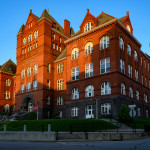
“$85.2 million gift from John and Tashia Morgridge will support Science Hall transformation The historic building will undergo renovation starting in 2027 to restore its iconic exterior and modernize its interior to support learning and research. Tod Pritchard May 21, 2026 For news media More information For News Media Images available by request Share this article With a generous gift from alumni John and Tashia Morgridge, the 137-year-old Science Hall will undergo renovations to restore its exterior and to make interior improvements in support of learning and research. Photo: Bryce Richter / UW–Madison Science Hall, a 137-year-old landmark building in the heart of the University of Wisconsin–Madison campus, will soon undergo a renovation that will transform the iconic red-brick building into a state-of-the-art hub for geography, environmental studies and geospatial science while honoring its historic character. Alumni and philanthropists John and Tashia Morgridge have committed $85.2 million for the renovation, which is set to begin in 2027, making their gift the lead private contribution supporting the $163.2 million project. The five-story, 98,000-square-foot Science Hall was constructed in 1887, following an 1884 fire that destroyed the original building, which had also stood at the corner of Park and Langdon Streets. Science Hall has served as a defining feature of the UW–Madison campus since, and in 1993 it was listed on the National Register of Historic Places. The building contains the oldest lecture hall on campus that is still in active use and today houses the Department of Geography and the Nelson Institute for Environmental Studies. An image of the physics lecture hall inside Science Hall in 1890. Photo: UW Archives The planned renovation will restore Science Hall’s historic exterior, modernize its interior spaces, upgrade mechanical and accessibility systems, and add a rear atrium to create new collaborative and student gathering spaces. “With its iconic views of downtown Madison and Lake Mendota, Science Hall has long offered a unique vantage point at the intersection of our urban and natural worlds,” says Eric Wilcots, UW–Madison interim chancellor. “For decades, the building has helped foster an interdisciplinary community where students, faculty and staff have gathered to explore the complex relationships between people and the world they shape and inhabit. Thanks to the extraordinary generosity of John and Tashia Morgridge, Science Hall will become an even more vibrant home for the curiosity, collaboration and human connection that spark discovery.” Alumni John and Tashia Morgridge are longtime and significant supporters of buildings at UW-Madison. Their latest gift in support of Science Hall represents another significant investment into the infrastructure and educational mission of UW-Madison. Photo: Jeff Miller / UW–Madison For John Morgridge, the gift carries a deeply personal dimension. His brother, Dean Morgridge, was a geology graduate student who spent many hours in Science Hall, and John says it was Dean who insisted he attend UW–Madison. “Science Hall shaped how I think about what UW stands for,” John says. “Tashia and I owe a great deal to this university. Our first check to the UW was for $5. Today we have the means to do more, and it is our duty to do it. We hope this investment honors the past while giving the next generation of students and scholars the tools they need to tackle what comes next.” The renovation will preserve and restore the building’s iconic red-brick exterior, replace the roof, repair masonry and terracotta features, restore original wood doors and stone staircases, and bring windows up to modern energy efficiency standards. Interior work will address safety updates, Americans with Disabilities Act compliance, and HVAC needs, while removing non-historic partitions to restore open, collaborative spaces. A new GIS (Geographic Information System) Learning Lab and educational center will establish a cutting-edge facility for geospatial sciences, remote sensing and environmental informatics. Plans also include repurposing 4,500 square feet of basement space and creating an outdoor courtyard. A rendering of changes proposed for Science Hall. Image courtesy of Facilities Planning & Management, UW–Madison. “We have been partners in everything — in life, in our love for Wisconsin, and in our belief that the more personally involved you become with the places you care about, the more effective you can be,” adds Tashia. “Science Hall has stood at the heart of this campus for more than a century. We want it to stand at the heart of environmental discovery for another century — and we want every student who walks through those doors to feel the full weight of what is possible.” John and Tashia’s philosophy defines decades of transformative giving to UW–Madison. Most recently, the Morgridges led the way for the construction of Morgridge Hall — the building that will house the new College of Computing and Artificial Intelligence — with a $140 million gift that included a $50 million challenge grant to inspire additional donors. They also contributed $25 million to the new College of Engineering building. John and Tashia both graduated from UW–Madison and John later earned a master’s degree at Stanford before leading Cisco Systems from a 34-person startup to a global technology giant. They are signatories to The Giving Pledge, committing to donate the majority of their wealth to philanthropic causes. Students take part in a biology lab in Science Hall in 1900. Photo: UW Archives The Morgridges’ gift will help Science Hall remain a treasured campus cornerstone, honoring its past and preparing students for the future. Paul Robbins, dean of the Nelson Institute for Environmental Studies and a 1989 UW–Madison alumnus, described the significance of Science Hall and the renovation. “Science Hall is the beating heart of geography and environmental study at Wisconsin. It’s where big ideas about how humans and nature intersect have been debated and advanced for generations,” says Robbins. “The building deserves to match the ambition of the work happening inside it. This gift from John and Tashia is transformative not just for our students and faculty, but for the future of environmental science in Wisconsin and beyond. We are going to do things in this building that we cannot yet imagine.” A view of Science Hall in the year 1890, shortly after it was rebuilt following a fire that destroyed the original building in 1884. Photo: UW Archives
Original story
Continue reading at UW-Madison News
news.wisc.edu
Summary generated from the RSS feed of UW-Madison News. All article rights belong to the original publisher. Click through to read the full piece on news.wisc.edu.

