
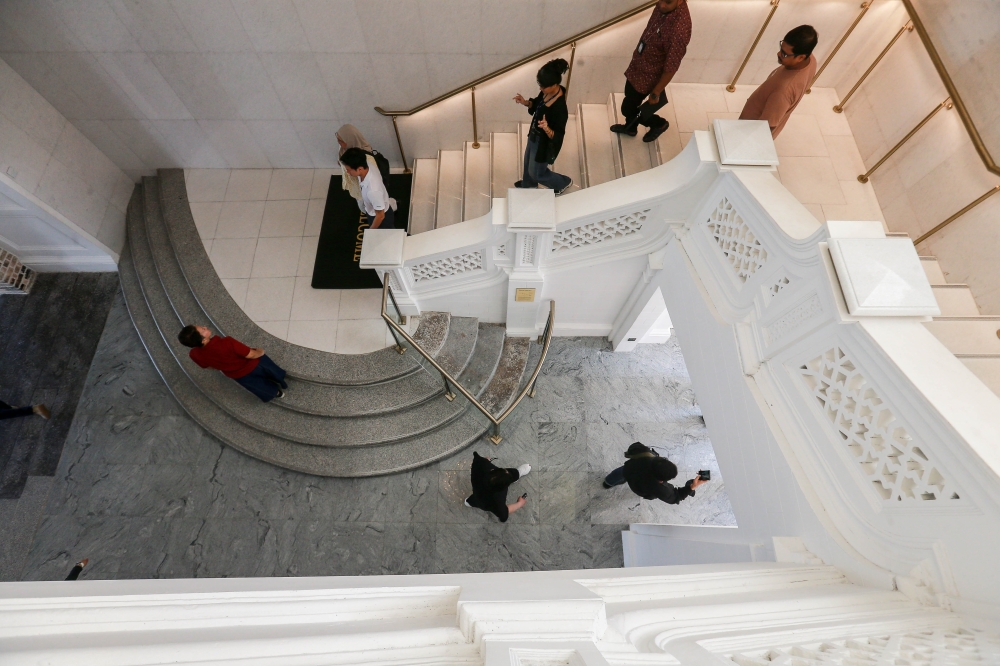
“KUALA LUMPUR, May 4 — Once a colonial administrative building and later home to Malaysia’s highest courts, Bangunan Sultan Abdul Samad has since taken on another interesting incarnation. Overlooking Dataran Merdeka, the building is now a highly sought-after spot for wedding photoshoots and content creators filming Instagram reels. Constructed in 1897, Bangunan Sultan Abdul Samad was built with four million bricks sourced from Brickfields and was named after the then ruler of Selangor. The building recently went through a major restoration under the Warisan KL initiative led by Khazanah Nasional, shortly before it turns 130 years old next year. The goal was simple: to restore the building while retaining as much of its history as possible, from its formative years around 1897 to its time as a functioning court from 1984 to 2003. However, conserving a more than century-old heritage gem comes with challenges — and surprises. One of the most fascinating discoveries was an underground tunnel leading to a former courtroom, which is currently occupied by the Royal Selangor Gallery. ThinkCity’s senior associate in heritage and conservation A’ishah Anam said the tunnel was built when the building went through a major renovation in the 1980s before the courts moved there. The underground tunnel leading to a former courtroom, now occupied by the Royal Selangor Gallery. — Picture by Sayuti Zainudin From 1984, Bangunan Sultan Abdul Samad housed the Supreme Court (which then became the Federal Court) until it was relocated to Putrajaya in 2003. Situated on the left wing of the main building, the tunnel was used by the courts to safely transfer high-profile individuals for trials, via the building’s back road. “When we first found it, the tunnel was very damp because of water retention after heavy rains. “We restored it because it is an integral part of the building’s legacy as a courthouse,” A’ishah told Malay Mail during a media tour around the building recently. The tunnel is currently closed to the public. A’ishah said the conservation work also maintained the grilles that were installed in the building’s interior for security purposes when it was functioning as a court. “The grilles are very sturdy, so we only coated them with anti-rusting agent,” she said. Think City senior associate in heritage and conservation A’ishah Anam. — Picture by Sayuti Zainudin What was kept, removed or left untouched? A’ishah said restoration work went on round-the-clock as the conservation team wanted to complete it before Visit Malaysia 2026 kicks off. The restoration itself took about 11 months, but A’ishah’s team had begun research and planning as early as 2017. The team also had to rework the building’s electrical wiring and plumbing to add more toilets for visitors, but this was not a straightforward task. “The electrical systems and plumbing were not reflected in the earlier drawings. “So, we had to be really careful so that we do not accidentally hit a pipe or beam during restoration,” A’ishah explained. Several mezzanine floors added in the 1980s were removed but the load-bearing walls that were installed to keep the building stable were retained. The granite base of the parabolic staircase at the main entrance has been left cordoned off until specialists are available to restore it. — Picture by Sayuti Zainudin However, A’ishah said the granite base of the parabolic staircase at the main entrance will remain cordoned off until specialists with the required skills are available to restore it. Also refurbished was the copper dome of the 41-metre clock tower — a hallmark feature of Bangunan Sultan Abdul Samad that resembles the Big Ben in London — which was leaking due to prolonged exposure to rain. Installed in 1897, the clock has been ringing punctually for more than a century — stopping only once after it was hit by a Japanese air raid in 1941. The reason for its timeliness? The Survey and Mapping Department sends workers every few days to manually wind the clock, and to clean and oil its mechanism. Still a work in progress The restoration work is still far from complete. Khazanah Nasional expects to reopen the building’s second block, which houses the former post office, in the second quarter of 2026. Installed in 1897, the clock has rung punctually for more than a century, stopping only once after it was hit during a Japanese air raid in 1941. — Picture by Sayuti Zainudin The remaining phases will span a few more years. “Progress will depend on key prerequisites. These include completing Conservation Management Plans for assets that do not yet have them,” Khazanah told Malay Mail in an email reply. “It also depends on permissible space programming and compliance with requirements for National Heritage-listed buildings. “Ultimately, timelines must be guided by conservation discipline and technical complexity, rather than speed alone.”
Original story
Continue reading at Malay Mail Education
www.malaymail.com/news/malaysia
Summary generated from the RSS feed of Malay Mail Education. All article rights belong to the original publisher. Click through to read the full piece on www.malaymail.com/news/malaysia.
