
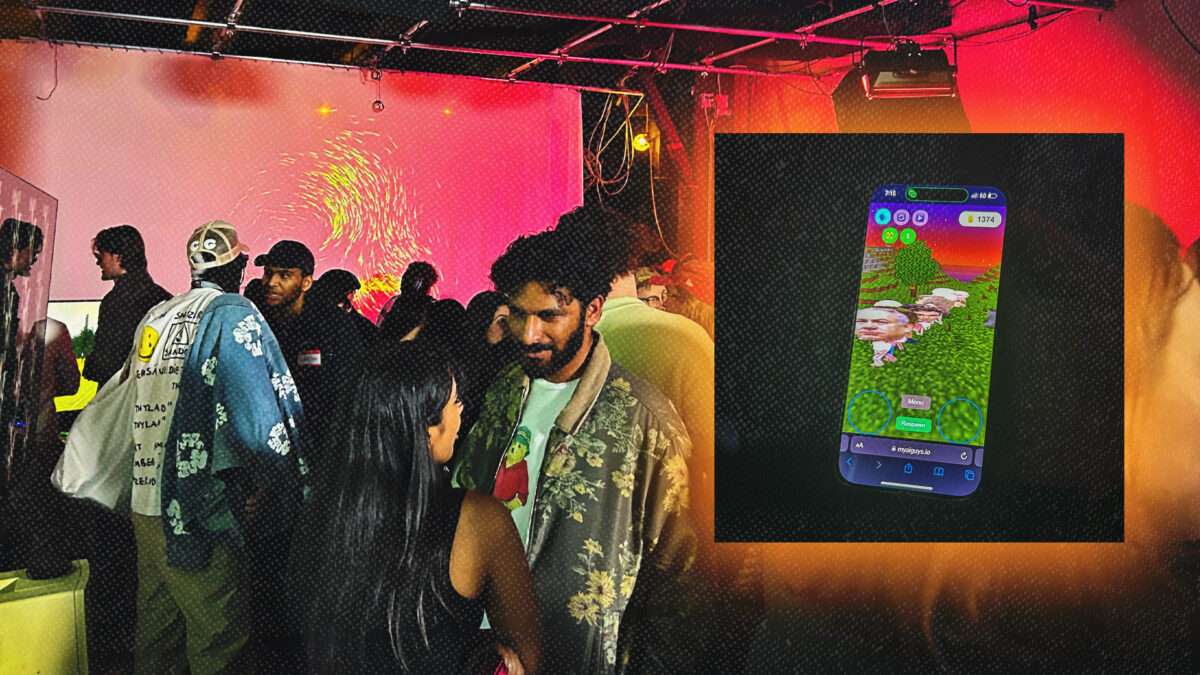
“When I arrived at last week's AI Psychosis Summit in New York City, I found no group therapy sessions or zen gardens, only a DJ, a room full of builders , and a cooler of Diet Cokes. The event was held in the remnants of a shuttered bank in Chinatown. While still outside, I could see through the graffiti-stained window white lines of code projected on a hanging screen. Pasted by the entryway were AI psychosis memes, their connections mapped with red string. AI psychosis memes connected by red string were pasted by the entryway. (Meagan O'Rourke/Reason) Around the edges of the room, vibe coders and builders stood at tables, like eager students ready for show-and-tell. Beside them were computers and TVs displaying their digital creations. The "summit," organized by tech-optimists Macy Gettles, Wesam Jawich, Matt Van Ommeren, and Mauricio Trujillo Ramirez, was intended to showcase AI passion projects. AI psychosis, Van Ommeren told me, "evades definition," but the term is a way to acknowledge being "confused about your relationship with AI." "We can't navigate it, and so we need some very general and jokey way to confront it," he said. "So we just say AI psychosis just [to] dismiss reckoning with it." Event organizer Mauricio Trujillo Ramirez displayed his art installation inspired by a Yousuke Yukimatsu DJ set. (Meagan O'Rourke/Reason) Although San Francisco may seem like the natural place to host an AI Psychosis Summit, Van Ommeren told me he was determined to have the event in New York, at the "intersection of art and technology." "I think some of the impetus behind it is that we were going to AI events that felt really corporate, and people were just showing tooling, and they were talking about optimizing their work stuff," Van Ommeren said. "Honestly, that's not interesting to me. I wanted to find people who are artists or doing something crazy and weird or frivolous." The projects were, in fact, far from corporate productivity tools. One presenter, Joshua Wolk, created a subway map that produces jazz music using the locations of different New York City trains—each train "plays" a different instrument. Another participant, Tanisha Joshi, built a website called The Cosmic Quant , which gives astrology-backed investment advice. Think of it like " Co-Star meets Robinhood," she told me. An attendee shows off his metaverse-inspired creation called "MyAiGuys." (Meagan O'Rourke/Reason) One attendee, who did not have a booth, carried around his tablet and a phone, giving guerrilla presentations of his bespoke metaverse full of AI avatars with celebrity faces on little Sim-like bodies. It looked like a deranged Mii Plaza . The purpose of the program was as silly as the appearance of its characters: content creation in the off-brand metaverse. Another creator, who goes by " yung algorithm ," presented an AI prank calling system. He said he calls people who are "scammers" or "selling stuff online" and livestreams the interactions. "All the frontier AI models are really bad at feeling human. They're only good at booking stuff," he said. "That's why I prank phone call hundreds of people a day, because I want to sharpen my sword on making that interaction feel actually human." AI enthusiasts, vibe coders and Diet Coke drinkers packed the event space in Chinatown. (Meagan O'Rourke/Reason) In the back of the room, two game designers demoed a horror game set in Central Park that drives players into a state of AI psychosis. The game's designers, who introduced themselves as @jacobdotsoul and Josh Wilson, said they built their game in a manic flurry, fueled by "a case of beers" and "a case of Celsius." "It's both a critique of an AI and an example of its worst excesses," Wilson said. Cory Etzkorn, an attendee, told me he went "actually crazy" while working on launching a dating app over the winter. Etzkorn was physically ill, cooped up at home, and surrounded by AI agents conversing with him about his startup and his symptoms. "I kind of forgot how to be in the real world," he said. Etzkorn does not think technology alone causes AI psychosis, but being isolated and only interacting with Large Language Models (LLM) could induce some form of mental illness. "The AI psychosis thing is sort of a joke, but I think a lot of people have actually experienced it to some degree," Etzkorn said. "I feel like every good joke is based on some reality." Was the AI Psychosis Summit a hyper-online stunt or a wholesome vibe coder meetup? It was both. Despite all the supposed atomization brought on by screens, clearly, enough people were able to overcome "AI psychosis" to pack a downtown event space on a weeknight. And for much of the evening, a line stretched out the door. The post A Dispatch From the AI Psychosis Summit appeared first on Reason.com .
Original story
Continue reading at Reason
reason.com
Summary generated from the RSS feed of Reason. All article rights belong to the original publisher. Click through to read the full piece on reason.com.