
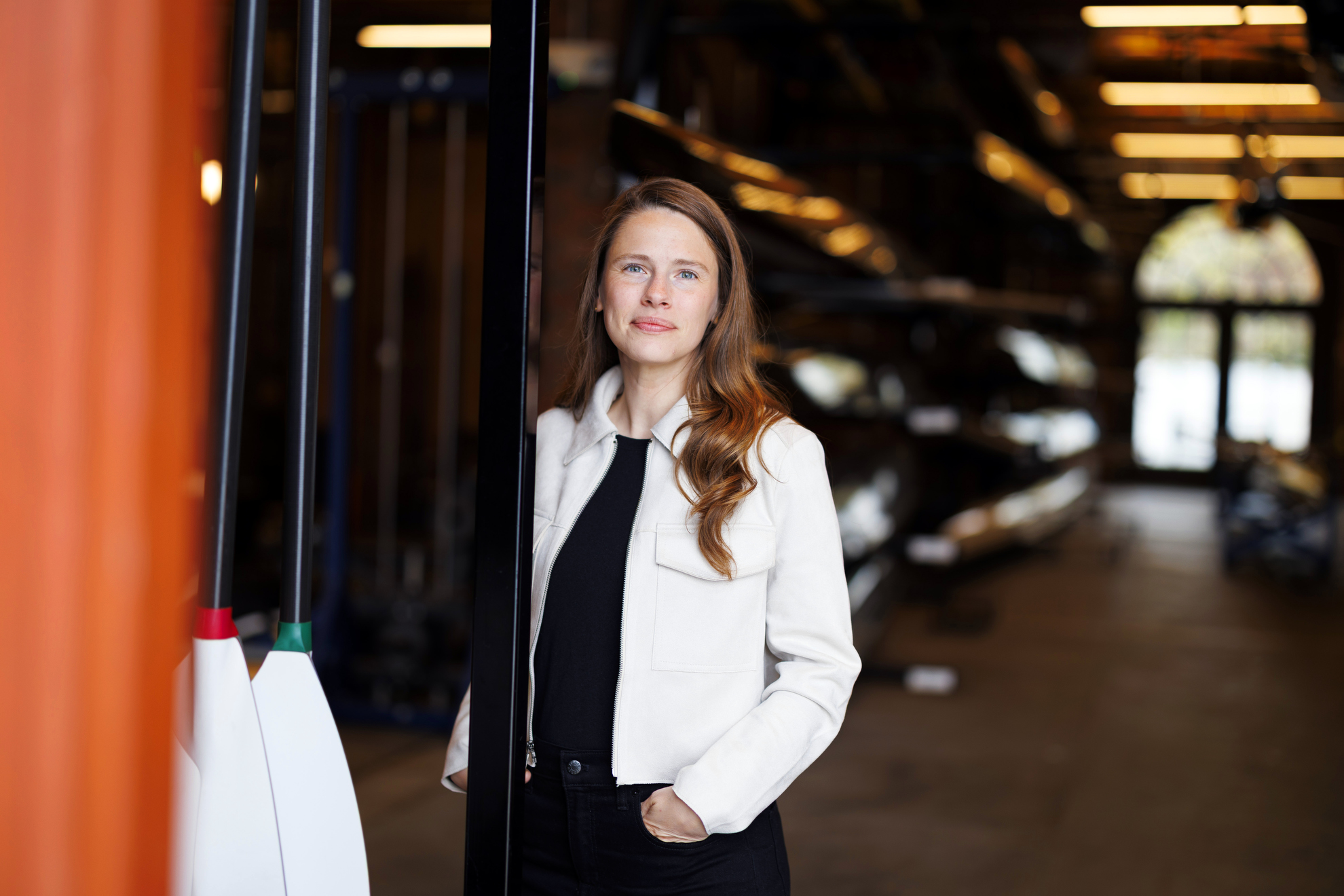
“Outside the classroom, Grier Wilt served as coxswain for the Graduate Student Rowing Team and competed in the Head of the Charles Regatta. Stephanie Mitchell/Harvard Staff Photographer Campus & Community A vital link between astronauts and mission control Max Larkin Harvard Staff Writer May 21, 2026 7 min read After a year at the Kennedy School, Grier Wilt returning to NASA ready for next lunar missions Part of the Commencement 2026 series A collection of features and graduate profiles covering Harvard’s 375th Commencement. On any given day in the past year, Grier Wilt may have been, quietly, the most interesting person in Cambridge. Not yet 40, Wilt has worked and studied on four continents. By now she’s an advanced speaker of French and Russian, and currently studying Arabic and Japanese. She’s certified as both a private pilot and an open-sea diver, with degrees or coursework in mechanical engineering, national security, business, and ethnomusicology. And weeks after Wilt receives her latest diploma — her master’s in public administration, following a whirlwind year at the Harvard Kennedy School — she’ll resume the life-or-death responsibilities she holds at NASA: as a capsule communicator, spacewalk flight controller, and astronaut instructor. You’d never know it, her teachers note. Kessely Hong, who taught Wilt in a class last fall on negotiations, will remember her as “incredible … insightful and generous” — and, for a lifelong space obsessive — “very down to earth.” “She’s just an amazing human with an amazing background,” agreed Eric Rosenbach, who taught Wilt in a survey course on emerging technologies this spring. “And she has this humility, despite all that, that’s unusual at Harvard.” Wilt says she’s just following through on a childhood commitment. Seeing a comet in the skies over her Central Pennsylvania hometown, she asked her father how she could go. “He said, ‘Become an astronaut,’ probably not thinking anything of it,” she said. “And I was like, ‘Oh, OK. Now I know what I’m doing for the rest of my life.’” Wilt’s neighbors still remember her as their town’s “space girl.” She realized only recently that her first contact with NASA came when she was just 7, when she participated in monthly science classes it funded. A first-generation college student, her first official NASA job was a 2004 internship. Taking a year off to study public administration just as human space exploration is reaching new heights, Wilt admitted, may not “seem like a very logical step.” But as Wilt’s responsibilities have grown, she’s realized there’s more to NASA’s work than rocket science. “We’re working in teams, we’re working internationally,” she said. “There’s a lot of decision-making, a lot of leadership involved.” Every launch, for example, involves a difficult negotiation. To reach escape velocity, a spacecraft must strike a delicate balance between its thrust — the power of its engines — and the weight of what’s on board. Inevitably, she said, that means all of the various teams at NASA — among them human health, engineering, safety, and operations — “have to give up something” they had hoped to include to ensure the overall safety or functionality of the final vessel. Classes like Hong’s gave Wilt a new perspective on how to read “the different positions, the overlapping interests … how you can come to a consensus collaboratively.” For over a decade Wilt’s primary NASA role has been as an EVA flight controller and instructor: in short, preparing astronauts for spacewalks. While a given “Extra-Vehicular Activity” is inevitably limited in duration — spacesuits hold only 6½ hours of oxygen — Wilt said her preparation for each one can take as long as two years. She guides astronauts through their tasks, both in “neutral-buoyancy” underwater rehearsals and in virtual reality. The job involves both rote learning and creativity: imagining surprises, including worst-case scenarios. “You’re planning down to every single operation. What happens if a bolt breaks, or if it’s not turning? What contingencies, what tools do you want to have in place?” she said. Unsurprisingly, another favorite course this year was “Thinking Analytically,” taught by Dan Levy. “It’s about what to do when you don’t have all the information — and how to think probabilistically.” Grier Wilt “It’s about what to do when you don’t have all the information — and how to think probabilistically,” Wilt said. “It gave me a different framework to look at the things that I was already doing, and to be more comprehensive.” Finally, her work has come to require precise communications. Wilt became a “capsule communicator,” or CAPCOM, in 2022. In that seat, she serves as the intermediary between a crew in space and mission control at the Johnson Space Center. “If you’ve heard the expression, ‘Houston, we have a problem’? My call sign is Houston,” Wilt said with a smile. When she got the job, she remembers a veteran colleague telling her, “You have to be a sponge”: keeping earthbound anxieties from affecting the astronauts, and vice-versa, “just absorbing the emotion,” and passing along information only when it is practical. The Midcareer M.P.A. aims to build up just that kind of intangible capability, said Hong, who also serves as its faculty chair. “As people rise to higher and higher positions of leadership, it becomes important to go beyond the technical skills — to understand what’s motivating people, to integrate competing priorities, to move forward with everyone’s full support.” Wilt admits she occasionally felt some “internal conflict” sitting next to classmates who run Indian police forces or fight famine in the Horn of Africa, “working on these really important humanitarian issues.” But she came away recommitted to her path: not just as a source of knowledge but as a common cause for a divided planet. Ambitious space exploration has typically been motivated by great-power competition — Wilt noted that it is no coincidence that the Artemis program coincides with the Chinese National Space Administration’s own moon mission. But at Harvard she was impressed anew by a mission’s tendency to escape the terrestrial conflicts that motivated it. As classmates expressed their fondness for her employer, Wilt said, she “realized how much soft power NASA still has abroad. To them, it’s not just the U.S. doing something, it’s, like, humanity … It made me proud to work there.” If it weren’t for her enrollment at the Kennedy School, Wilt might have been a supporting CAPCOM during the recent Artemis II mission, bearing four astronauts she helped train. She didn’t even use a pass to observe the April 1 launch in Florida — she had class. “It was a little bittersweet,” she said, to miss out on the first crewed flight to the moon since 1972. But some 1,100 miles north of the Kennedy Space Center, she and Rosenbach arranged the next-best thing on JFK Street: a launch-night watch party during the middle of his course’s unit on space. “There were, like, 40 students who showed up in their own time, on a Wednesday night,” he said. “And Grier walked us through everything that the astronauts, and that NASA, were doing and thinking … It was one of those totally iconic Kennedy School moments.” After Commencement, Wilt will have a rare break — one she may use to visit the far-flung friends she made in the past year. She’ll also take a couple of weeks, she said, “to let it all settle in, to reflect.” She expects to be back in Houston by early July, where the lengthy preparations for future Artemis missions are already underway. With Artemis IV set to include a crewed return to the moon as early as 2028, Wilt is overseeing a U.S.-Japan effort to develop a pressurized rover to facilitate the first long-distance travel on the lunar surface. Her growing responsibilities leave little free time for Wilt to fulfill her original childhood dream: to go to space herself (though she hasn’t given up on the idea). Rosenbach concluded that it would be unwise to set any limits on Wilt’s future trajectory. “I know she’d like to be up there on a spacewalk herself, and she could certainly do that,” he said. But when he looks at his student from NASA, he comes away “almost certain” that she’ll end up running the place.
Original story
Continue reading at Harvard Gazette
news.harvard.edu
Summary generated from the RSS feed of Harvard Gazette. All article rights belong to the original publisher. Click through to read the full piece on news.harvard.edu.


