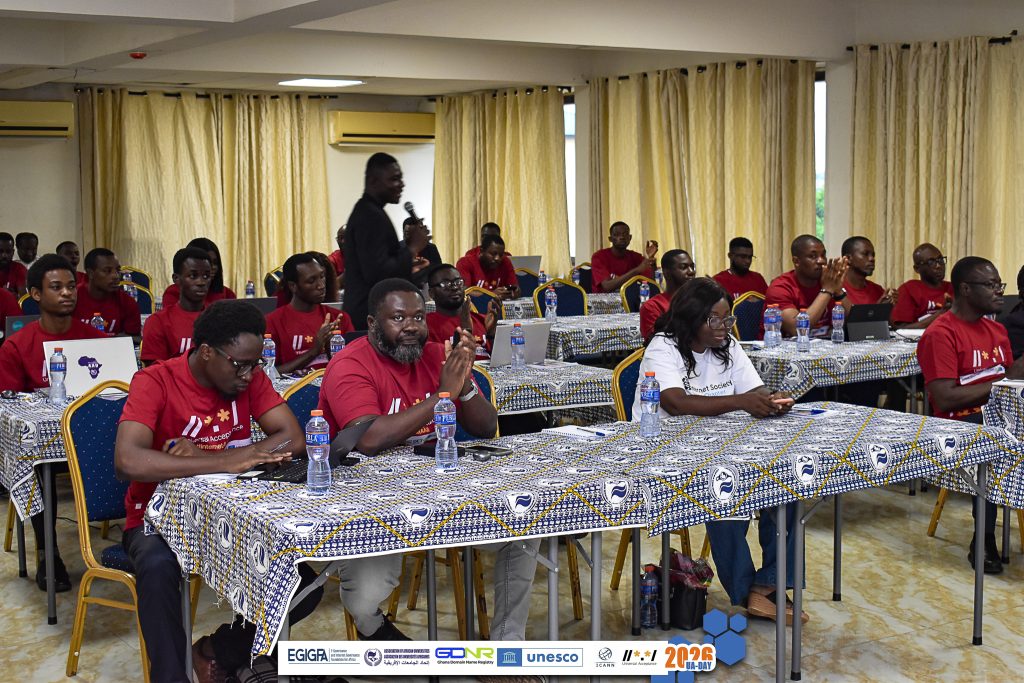
“In an era where digital transformation continues to reshape how societies communicate, learn, and innovate, the need for inclusivity in the online space has never been more urgent. Universal Acceptance (UA) Day 2026, commemorated at the Association of African Universities (AAU) Secretariat in Accra, Ghana, brought this urgency into focus, highlighting the importance of building an Internet that works for everyone, regardless of language or script. Observed annually under the Universal Acceptance Project funded by the Internet Corporation for Assigned Names and Numbers (ICANN) and implemented by AAU, the day serves as a global call to ensure that all valid domain names and email addresses are accepted across digital systems. At its core, Universal Acceptance is not only a technical requirement, but a foundation for digital inclusion, cultural identity, and equitable participation in the global digital ecosystem. Held on May 6, 2026, the 4th edition of UA Day was convened as a hybrid event, bringing together participants at the AAU Secretariat in Accra, Ghana and a wider virtual audience across Africa and beyond. Under the theme. “Your Language, One Internet: Local Scripts, Global Access -UA for Ghana”, the event was organized in collaboration with the E-Governance and Internet Governance Foundation for Africa (EGIGFA), AAU, the Ghana Domain Name Registry (GDNR), UNESCO, and ICANN. Delivering the welcome address on behalf of the Secretary, General of AAU, Dr. Felicia Nkrumah Kuagbedzi, Coordinator for ICT, Communications and Knowledge Management, emphasized that Universal Acceptance is both a technical imperative and a movement toward inclusion, identity, and equal participation in the digital space. She stressed that while Ghana’s linguistic diversity makes the theme especially relevant, the challenge is continental, pointing to Kiswahili in East Africa, Arabic and Tamazight in North Africa, Yoruba and Hausa in West Africa, and Shona and Sesotho in Southern Africa as examples of languages that remain inconsistently supported in global systems “If our systems do not support local languages and scripts, we are digitizing exclusion, simply transferring offline inequalities into the digital space,” she cautioned. Representing over 450 higher education institutions across Africa, Dr. Nkrumah called on African universities to audit their systems for UA readiness, integrate multilingual capabilities into digital platforms, train developers in inclusive design, and lead research on local scripts. Institutional and partner remarks reflected a shared commitment to advancing Universal Acceptance across sectors and regions. Mr. Yaovi Atohoun, Africa Stakeholder Engagement and Operations Director at ICANN, highlighted ICANN’s continued efforts to promote an inclusive and interoperable Internet, emphasizing the importance of stakeholder engagement across Africa. From UNESCO, Mr. Abdul Hamid Yakub, National Programme Officer for Communication and Information emphasized that digital inclusivity is not just a challenge but an opportunity. He noted that while there are over 6 billion internet users worldwide, nearly three‑quarters of humanity remains offline. For UNESCO, he explained, the mission is to ensure freedom of expression both online and offline, and this is why the organization has partnered with ICANN to help put laws and frameworks in place that protect this freedom. Mr. Hamid warned that many languages are slowly disappearing – using Ghana as an example where some mother tongues are fading out of use. He stressed that incorporating these languages into scripts and domain names can help preserve them for future generations. The effect of multilingualism, he argued, is to ensure that all languages are represented online, not just the dominant ones. By embedding linguistic diversity into the very infrastructure of the Internet, UNESCO believes that digital transformation can become a tool for cultural preservation as well as inclusion. Mr. Raymond Mamattah, Founder and President of EGIGFA, emphasized the importance of collaboration and multistakeholder engagement in advancing the UA agenda across Africa. Present at the event were Mr. Kwaku Antwi, Director of Policy and Planning at the Ghana Domain Name Registry, and Mrs. Maud Ayele Ashong Elliot, President of the Internet Society Ghana Chapter who both delivered addresses on behalf of their respective institutions. Their contributions reinforced the central message of the day: that Universal Acceptance is both a technical and cultural imperative, requiring collaboration across registries, civil society, and institutions to ensure Africa’s digital future reflects its full linguistic and cultural richness. Goodwill messages from global leaders further reinforced the importance of Universal Acceptance as a shared global priority. In a recorded message, Tripti Sinha, Chair of the ICANN Board, emphasized the need to ensure that the Internet works seamlessly for everyone, regardless of language or script. Kurtis Lindqvist, President and CEO of ICANN, reaffirmed that the Internet must serve all users equitably, describing Universal Acceptance as a cornerstone for digital diversity and highlighting ICANN’s collaboration with UNESCO. From UNESCO, Guilherme Canela, Director of the Division for Digital Inclusion, Policies and Digital Transformation, emphasized that linguistic diversity is essential for building inclusive knowledge societies and reaffirmed the right of every individual to fully participate in the digital world. A defining feature of UA Day 2026 was its strong emphasis on practical implementation, with technical sessions designed to translate UA principles into actionable solutions. Seda Akbulut, Universal Acceptance Programme Manager at ICANN, delivered a presentation highlighting ongoing global efforts to advance UA adoption, strengthen awareness, and support stakeholders in achieving UA readiness across systems. Mr. Abdul Manaf Sulemana, UA Project Officer at AAU, demonstrated the UA Readiness Self-Checker tool, enabling participants to assess whether their systems are compliant with UA standards, identify gaps, and take steps toward improvement. The technical training continued with a WordPress integration session led by Mr. Frank Asefuah, Senior Web Developer at AAU. His session demonstrated how UA-compliant email systems can be integrated into web platforms, enabling forms and digital services to support internationalized email addresses. Complementing this, Mr. Enoch Kpani, Software Developer at AAU delivered a hands-on demonstration on setting up an Email Address Internationalization (EAI), compliant mail server, guiding participants through domain configuration, DNS setup, and secure email authentication, while illustrating how email systems can support local language addresses in practice. Together, these sessions provided participants with practical tools and insights to move from awareness to implementation, reinforcing that Universal Acceptance is both achievable and measurable. The event concluded with a multi‑stakeholder panel moderated by cybersecurity professional Ms. Faiza Adam, bringing together voices from civil society, the ccTLD/registry community, the technical community, and academia. Representing civil society, Mr. Raymond Mamattah of EGIGFA emphasized that Universal Acceptance is fundamentally about inclusion, enabling communities to recognize and trust domain names in their own scripts and languages. From the ccTLD and registry community, Mr. Francis Acquah highlighted the operational realities of registries, stressing that UA must be embedded into national policy frameworks and technical standards to ensure systems do not exclude non‑ASCII domains. Speaking for the technical community, Mr. Frank Anati, ICANN Fellow and Instructor at the Academy Center for Professional Development, focused on the need for developers and administrators to embrace inclusive design, update applications, and integrate UA into everyday workflows. Finally, Mr. Kwasi Awattey Tetteh, Senior IT Officer from the AAU representing academia, argued that universities must adopt UA in their own systems, integrate it into curricula, and conduct applied research on challenges such as keyboard layouts and browser display of internationalized domain names. The panel was highly interactive, with audience members contributing their perspectives and calling for deliberate, time‑bound plans to make UA adoption a reality. There was broad agreement that Ghana and Africa must move from discussion to action, with clear responsibilities, stronger collaboration, and national frameworks that require UA compliance across government and financial systems. Universal Acceptance Day 2026 was more than a commemoration; it was a call to action. As Africa continues its digital transformation journey, initiatives such as UA Day highlight the importance of ensuring that technology reflects the continent’s linguistic and cultural diversity. From Accra to the broader global community, the message remains clear: Every language counts, Every voice matters, and One Internet must truly serve everyone, everywhere.
Original story
Continue reading at AAU
www.aau.org
Summary generated from the RSS feed of AAU. All article rights belong to the original publisher. Click through to read the full piece on www.aau.org.


