
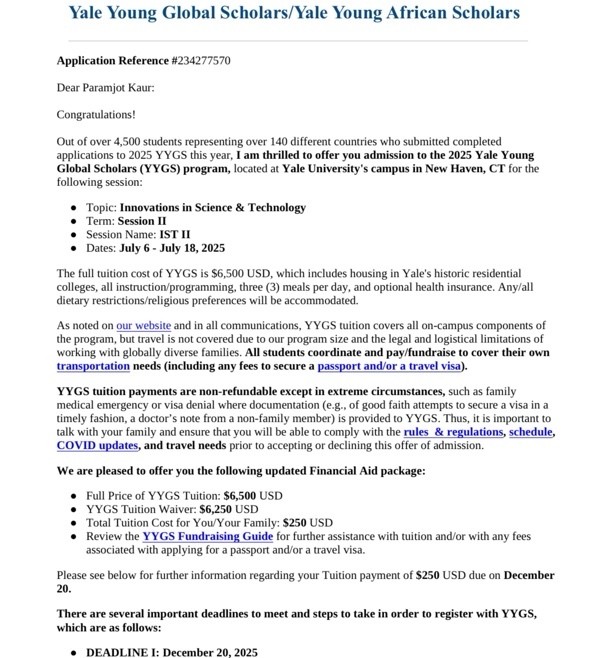
“In March and April, Paramjot Kaur of New Delhi, India, received many emails from highly respectable, top-tier US universities. She’s been accepted by Washington State in St. Louis, Boston University, UT Austin, and UT Dallas, and University of Miami. The first two had acceptance rates of around 12%. Where others would be happy, Kaur isn’t. She can’t attend. Not when she can’t afford tuition. Not when it costs an arm and a leg just to travel to American shores. Education as a way to escape the cycle of poverty Raised by a single mum, Kaur is a 12th grade “pass-out” (which, in Indian English, means a graduate) with dreams of studying abroad. More than her own future, it’s her mum’s that she seems to be more concerned about. “There exists an invisible burden on my shoulders to get her out of this place and to give her a bright life ahead,” she says. And she believes an education abroad is a ticket to that future. “India is equally as good, but where I live, the campuses are not well-oriented with the actual courses I want to do,” she says. “For example, if I wanted to double major in maths and stats plus physics, it’s not allowed here. It’s just vague branches of physics, chemistry and maths.” She’s even heard of a student who never studied biology in high school, but was forced to take — and flunk — a biology course in university. The only school, she believes, that has the research rigour and alignment she wanted, is IISc — the Indian Institute of Science. But the competition is cutthroat. India has a population of 1.5 billion but IISc only has 120 to 150 seats for its Bachelor of Science (Research) programme. “I felt like going to US might be a little better. The ROI, the return of investment would be even greater,” the 18-year-old says. “Personally, what I want to do, the LPA (lakhs, an Indian numbering system meaning one hundred thousand, per annum) we get here is not as in the foreign countries and all.” So, she set her sights on America, the land of opportunity. Scholarships do help students who can’t afford tuition, but oftentimes, they also need aid for travel and living expenses. Source: Paramjot Kaur There are aids for those who can’t afford tuition, but at what cost Knowing that she can’t afford tuition if she were to pay out of pocket, Kaur worked hard on her extracurriculars for five years, hoping she’d get some aid or other from the universities in US. “But it did not happen,” she says. A few US universities did offer aid, but it only ranged from US$5,000 to U$10,000. While helpful, that figure doesn’t make a big-enough dent in a tuition of US$70,000 to US$80,000. And that’s before housing and other living costs. “If I take a loan, it goes on to my mother and I have a little brother as well,” Kaur says. “So I feel it will be kind of overburdening them.” Money has held her back before. Last year, she was accepted into the Yale Young Global Scholars (YYGS) academic enrichment programme for outstanding high school students from around the world. Only 13% to 30% applicants get chosen. They offered her a full scholarship, but the travel and imbursement costs would tally to around five lakh rupees (around US$5,000). “Just three, four days back, I got accepted into the Princeton Math Programme. It’s highly selective, with less than 10% acceptance rate,” she says, referring to the online Princeton STEM Initiative for mathematics programme for talented middle and high school students. “But then I scrolled and I saw US$1,500 and it broke my heart because it happens every time,” she says. “The more I’m trying to expand my education, the more I see that I cannot afford the price. I just feel bad that we have to fight for our educational rights.” She understands that fees are warranted for summer programmes. But she can’t help but feel sour that underprivileged kids are sidelined. “The poor have so many dreams to achieve, goals to achieve, but they don’t have access to these opportunities,” she says. “Or even if they do, education is so expensive these days.” Kaur can’t afford tuition for US institutions, but Australian universities might be a better bet. Source: Paramjot Kaur Crowdfunding to attend University of Melbourne With the US being too expensive, Kaur has chosen to attend the University of Melbourne . It’s a great institute (the top university in Australia and a top-20 institution globally), the courses aligned with her ambitions, and the costs were manageable. But there’s yet another obstacle. The Australian school year begins in February, which is when the residential scholarship begins. But Kaur has opted for a mid-year intake and is not eligible for the aid yet. “And I don’t want to miss this semester because it will be a semester gap,” she says. Not one to give up so easily, Kaur has turned to fundraising on Ketto, a crowdfunding site in India. “I had seen actually people raising money and I think there’s no harm,” Kaur says. “I just wanted to remove the burden from my mother.” Worst case scenario, Kaur is ready to put in the elbow grease and work to pay for her first semester before the residential scholarship kicks in. Some may see her decision to attend the University of Melbourne as “settling” because she can’t afford tuition in the US. But to Kaur, it’s as much of a win as any. “Don’t define yourself based on what college you get into,” she advises. “Because you can define the college by what you choose to do there. Even if I go to Melbourne or any university, I just feel like I have to own that university. I have to create the best out of what it gives me because everyone is not at the same path, right?” Kaur was also accepted into the University of Sydney. Source: Paramjot Kaur When meritocracy has an entry fee As a society, we rant and rave about the importance of education. But if education is meant to be this great equaliser, then why is access to it not even equal? Why are brilliant students edged out just because they can’t afford tuition? Kaur has rightfully secured her spot in top schools of America. In a utopian meritocracy, that would be enough. But meritocracy, as we practise it, is deeply flawed. It assumes a level playing field, which rarely exists, and entrenches privilege rather than promoting fairness. The student who doesn’t have to help her mum with work after school likely has more time to study and perfect her personal essay. And even when her less privileged peer pens just as good an essay, the cost of entering the room is too great to bear. And for schools that know she can’t afford tuition? Don’t even bother. “Needs-aware institutions completely rejected me because I needed aid and can’t afford the tuition,” Kaur comments. Needs-aware, or needs-sensitive, colleges are ones that consider an applicant’s ability to pay tuition when making admission decisions. And oftentimes, a student cannot even attempt to set one foot in the door. Applying to universities can be costly even for locals. For international students, it’s worse. Kaur had wanted to apply to the University of California (UC) system, but the application fees are US$95 per campus for international applicants. “Our application process is hindered itself,” Kaur says. “We are not even allowed to apply at this point because my mother cannot afford to pay US$300 to apply to three UCs.” Is it still worth it to go to university? Given all the challenges, some may think that Kaur is better off giving up altogether. But Kaur actually thinks her journey has given her character. “It’s better if you just start from rock bottom instead of getting a silver spoon in your hand, because that’s what is going to get you through life,” she says. Envisioning the ideal future, she sees herself double-majoring in maths and physics while minoring in international relations or political science. “I mean, it’s kind of a big load for me to take. I know that very well, but pressure is [also] a privilege,” she says. “It’s okay. I’ll try my best, whatever happens.” Speaking about her seemingly endless optimism, Kaur declares: “I just feel like the world hasn’t ended. Melbourne has accepted me. It’s alright and things are going to work out.”
Original story
Continue reading at Study International
www.studyinternational.com
Summary generated from the RSS feed of Study International. All article rights belong to the original publisher. Click through to read the full piece on www.studyinternational.com.

