
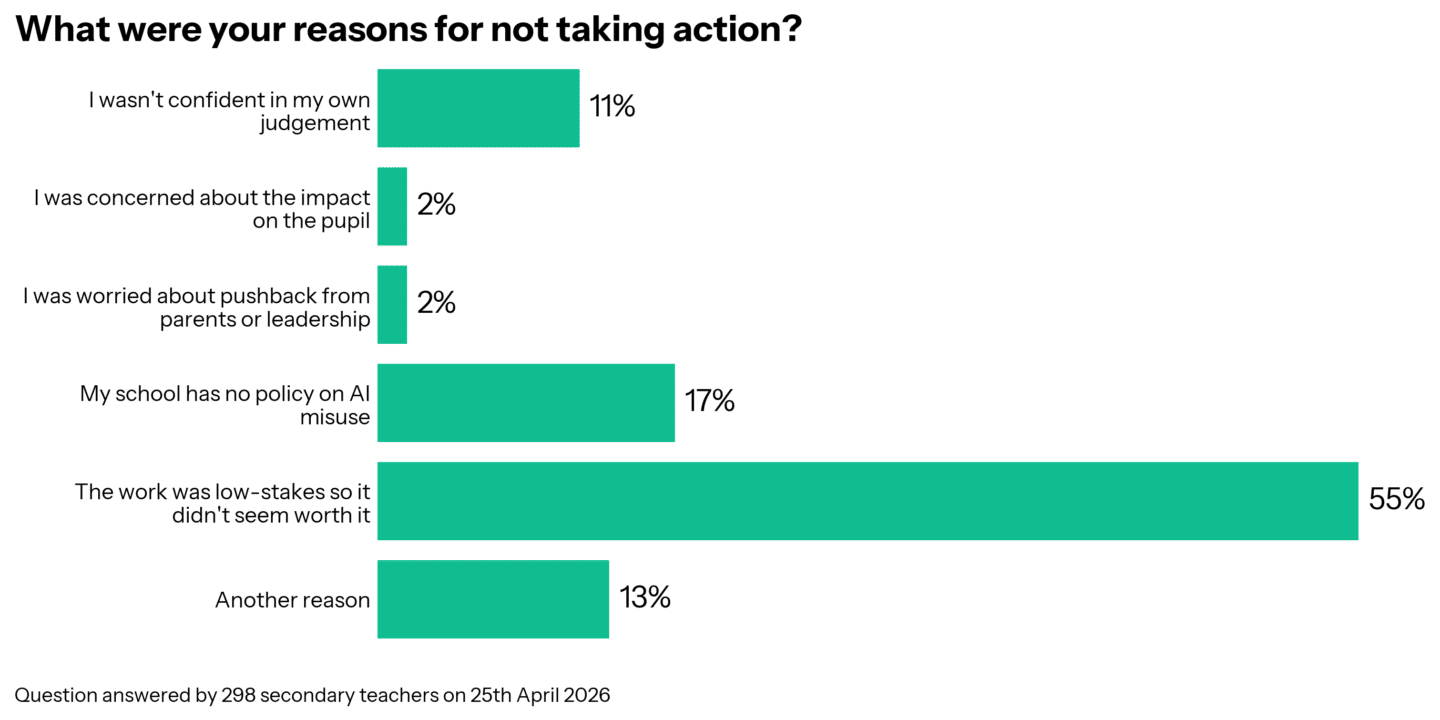
“Hey there Tappers Bad news – this week has FIVE days in it. Good news – this month has a half-term in it! If your PPA was skipped because of the Bank Holiday last week, whether or not you had that time made up depends really on whether you’re primary or secondary: 39% of primary teachers said their school makes sure PPA time is made up, but just 1% of secondary teachers said the same! KS2 Sats are underway. 73% of state-funded schools are putting on SATs breakfasts, 57% will be holding post-SAT parties, 44% are running extra revision sessions, and 39% are giving year sixes longer breaks. But how many are doing ALL of these things? 15% reported doing all four, and 45% said they’re doing three. Return of the prize draw 🤑 🎉 Our prize draw is back for May – and once again, there are no ticket codes to worry about! If you tap at least once between 1 – 31 May , you’ll automatically be entered. The winner will see a message in the app from 2 June . And there’s more: any Teacher Tappers who have the same school listed in their profile as the winner, and who also tapped between 1–31 May , will receive gift cards too. Will we see even more winners this month? You can check the full terms and conditions here . AI cheats – taking action Right – into the edu-data! And a new question for 2026: What did you do when you last suspected a student had cheated using AI? Two-thirds of secondary teachers have found themselves in this position, and by far the most common action to take was speaking to the student directly ( 77% ). Asking students to redo the work ( 35% ) and reporting it to a senior colleague ( 30% ) were also common actions. Only 13% sanctioned the student, and 18% alerted parents. There was a group of teachers who had a different response: 10% said they didn’t take any action. When asked about their reasons for not acting on their suspicions, more than half ( 55% ) said that they saw the work as “low stakes” and it wasn’t worth the time to challenge it. Other reasons were a lack of AI policy ( 17% ) and a lack of confidence in their own judgement ( 11% ). Only a tiny number kept quiet out of worries or concerns about students ( 2% ) or parents’ reactions ( 2% ). In other AI news, an email landed in the Tapp inbox, and this time it wasn’t about how teachers are using AI for their planning or marking – instead, it was about how many teachers are teaching their students how to use AI. Straight on the case, we found out… 27% of secondary teachers and 12% of primary teachers have taught students how to use AI generally. A third of secondary teachers have already taught students how to use AI specifically in their subject. 22% of primary teachers and 16% of secondary teachers plan to teach about AI in the future. 44% of primary and 40% of secondary teachers have never taught students about AI and have no plans to. Personal politics The local elections meant several schools closed ( 3% ) or had to be silent to allow their halls to be used as polling stations ( 3% ) – so here at Teacher Tapp we thought it was the right time to ask about voting intentions if there was a General Election. 25% of teachers say they don’t know who they would vote for. 24% Labour. 24% Green Party. 13% Liberal Democrat 5% Conservative 2% Reform 1% SNP or Plaid Cymru 4% wouldn’t vote But how do these figures compare to how teachers voted in the last General Election in 2024? Time for the super special Teacher Tapper Election Tracker! As you can see, lots of movement away from Labour. Is this a reaction to Labour education policies, or wider political issues? Zoom in to see the details of how political preferences are changing… Mobile phone misuse is down! Good news! Fewer students had phones out in lessons this May compared to previous years 🎉 24% of teachers reported phones were out without permission, compared to 38% in 2024. And more good news – primary continues to be less than 1% 🙌. How much of a difference does mobile phone policy make to these numbers? Teachers in schools using pouches or collecting in phones are the least likely to experience disruptions ( 7% ), followed by teachers in schools where they are banned from site altogether ( 15% ). Teachers in schools where phones are allowed at break and lunch saw the most disruption ( 41% ), and teachers in schools where phones are out of sight all day, or out of sight all day unless directed by a teacher, both reported similar levels of disruption at 25% and 29% , respectively. With the continued push for schools to go phone free from the Department for Education, the next question on the Teacher Tapp mobile list will be about the barriers to schools bringing in phone bans. If you’re a head who wants to ban mobiles but has barriers in the way, please do get in touch and share your experience! It will help Teacher Tapp write better questions to find out what’s going on in schools 🔎. Teacher Tapper 🔎 research on incivility in emails Almost as annoying as a mobile phone appearing at the wrong moment, rude emails can raise blood pressure, too. An expert in this area, Dr. Emma Russell, from the University of Sussex, specialises in research on workplace email behaviour, specifically focusing on “incivility” in digital communication. Last week she was on the Radio 4 programme ‘All in the Mind’ discussing the impact of incivility in emails – and this gave us an idea for some Teacher Tapp questions. What did we find out? First off, we asked teachers to think of the most recent time this academic year when they received an email from a teaching colleague that made them feel uncomfortable or frustrated. The results told us there is a fortunate group who have not had a badly worded email from a colleague land in their inbox: 44% primary teachers, 30% secondary teachers; 30% of primary leaders, and 19% of secondary leaders have NOT received an internal email that made them feel uncomfortable or frustrated. For the rest, experiences between primary and secondary were broadly similar, but seniority made a bigger difference. Thinking just of their most recent email that made them feel uncomfortable or frustrated, 47% of teaching staff and 58% of senior leaders thought the email had an aggressive or hostile tone; 34% of teachers and 25% of senior leaders thought the tone was dismissive or sarcastic; 43% of teachers and 39% of senior leaders thought the sender had committed the cardinal sin of copying in someone senior unnecessarily. When it comes to policies about internal emails, 21% of primary senior leaders report they have a policy, but these are much more common in secondary schools with 40% of leaders reporting they have a policy. There does appear to be a knowledge gap between what policies exist and staff awareness: 24% of primary teachers and 23% of secondary teachers didn’t know if their school had a policy, and 11% of primary teachers and 16% of secondary teachers said they had a policy but didn’t know what it said. Are emails that make you feel uncomfortable or frustrated more likely to be sent by people senior to you? Not necessarily. Although senior leaders and headteachers were more likely to report the last email they were sent that made them feel uncomfortable or frustrated was junior to them ( 68% and 80% vs 25% and 6% for middle leaders and classroom teachers), this could be explained by the fact they have more junior people in the organisation that they are in contact with. When we take middle leaders, a group where there is likely to be an even number of people senior and junior to them, there appears to be a more even split of senders who are senior ( 39% ), a similar level of seniority ( 35% ) and junior ( 25% ). Finally, does whether or not you are one of those people who have been on the receiving end of an uncomfortable email this academic year make a difference in whether or not you enjoyed work this week? Maybe! 68% of those who didn’t receive an uncomfortable email said they enjoyed work compared to 56% who DID have a horrid email land in their inbox. But of course, this doesn’t mean there is a direct correlation between the two. However, to be safe, could we all try to be a little more polite in our emails? Teacher Tapp got in touch with Dr Russell and shared our findings, and she noted that these sorts of levels of incivility in emails weren’t a surprise, and that “People often lash out or ignore others in email exchanges when work is getting on top of them.” On the issue of providing a policy, she said that “Clear guidance can help people to understand which behaviours are acceptable and which are not.” However, her advice for those who find themselves looking at an email they find frustrating or uncomfortable, you should ask yourself a few questions before you hit the ‘reply’ button. “If you receive an uncivil email, that goes against normal expectations and character, then this might mean that your colleague is struggling and needs support. Equally, if you are struggling and need support, always take a pause before you engage in an email exchange, as this is when you are most at risk of being uncivil”. Daily Reads Top blog this week was all about email etiquette ! There are so many great blogs out there and we love featuring them on Teacher Tapp. If you have a blog you think we should feature, then please email us at england@teachertapp.co.uk and we will check it out! The post AI cheats, teacher politics, upsetting emails PLUS mobile phone tracker appeared first on Teacher Tapp .
Original story
Continue reading at Teacher Tapp Blog
teachertapp.co.uk
Summary generated from the RSS feed of Teacher Tapp Blog. All article rights belong to the original publisher. Click through to read the full piece on teachertapp.co.uk.

