
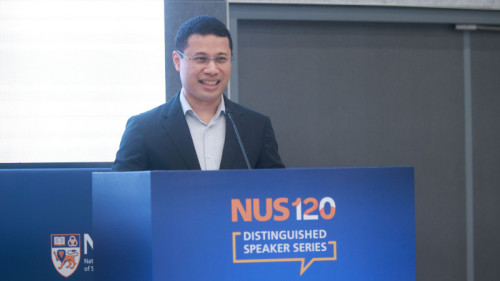
“As AI continues to reshape how individuals learn and work, Singapore is looking to ensure that every tertiary student receives a consistent and strong foundation in AI competencies. From 2027, all students from institutes of higher learning (IHLs) will learn AI skills that are catered to their fields of study, said Education Minister Mr Desmond Lee at the NUS120 Distinguished Speaker Series on 21 May 2026. The lecture series is among a line-up of events held to mark the University’s 120 th anniversary. “If we want to remain a nation that creates opportunities, attracts investments and solves hard problems, our graduates must be confident, capable and responsible in how they engage with AI and technology,” he told 350 students, faculty, alumni and university leaders. Mr Lee, who is an NUS alumnus, recalled his fond memories of studying law at the campus when undergraduates were still taking notes by hand – a far cry from the digitally savvy students today who are living in an AI-transformed world. While encouraging IHLs to equip graduates for this new world, he also highlighted the importance of strengthening human qualities such as curiosity, critical thinking and adaptability, which matter more than ever precisely because of AI. “It's interesting, right? That something artificial provokes our quest to be ever more human,” he remarked. New AI learning frameworks At the event held at the Sea Building at NUS , Mr Lee announced that IHLs have developed two baseline AI competency frameworks – one for autonomous universities, and one for polytechnics and the Institute of Technical Education. Built around the Ministry of Education’s “Four Learns” – Learn About AI, Learn to Use AI, Learn With AI, and Learn Beyond AI – the frameworks establish a baseline for every student to receive a foundation in AI competencies. This covers a range of skills, from understanding what AI can and cannot do, to using it to analyse problems and generate insights. “This seeks to ensure a coherent as well as cumulative learning journey from school, through the IHLs, and into the workforce,” said Mr Lee. These competencies will be infused into compulsory modules for all incoming IHL students from 2027. Students already enrolled will also have opportunities to build these abilities through enhancements to existing curriculum. This builds on Mr Lee’s earlier announcement in April of the formation of the Committee for Artificial Intelligence in Higher Education, which provides strategic direction on AI usage. The committee supports the work of the National AI Council chaired by Prime Minister Mr Lawrence Wong. Beyond building a common baseline, Mr Lee notes, developing mastery in domain-specific AI competencies is also important. “The future will belong to professionals who not only have the confidence to use such tools across common tasks, but also the mastery to combine and apply both AI and their deep knowledge meaningfully within their own discipline,” he said. From 2027, all IHL students, including adult continuing learners, will be given the chance to develop AI competencies within their own domains or disciplines, as part of their full-qualification programmes. Students in the Product Design and Innovation module at the NUS College of Design and Engineering , for instance, are already applying AI tools by using large language models to sharpen problem statements, and platforms like Figma Make to turn descriptions into prototypes. But he also cautioned against letting technology drive pedagogy. “AI must never replace deep, human learning in our schools and IHLs,” he stressed, noting that students must experience the struggle of learning without the shortcuts offered by AI. “Our graduates should not just be competent and confident users of AI… but people who can lead it, steer it and question it.” He cited the example of Dylan Pon, a first-year Business Economics and Political Science student at NUS, who treats AI as a tool for deeper inquiry rather than a shortcut. In a video message, Dylan shared how he uses AI to challenge preconceived notions, test arguments and ask better questions when working on his papers. Crediting this approach as fundamentally transforming the way he learns, Dylan said: “AI helps me think more critically and evaluate whether its responses make sense.” As AI tools continue to advance, learning frameworks will remain dynamic with each IHL developing new approaches suited to its own students and courses, and to pilot new methods of teaching and learning. NUS embraces the AI revolution At NUS, that transformation is already underway. “Our faculty and students are leveraging AI to reimagine learning experiences, innovate teaching methods and unlock new ways of understanding complex subjects,” said Professor Tan Eng Chye, NUS President, in his opening address. He cited ScholAIstic, an AI-powered platform developed by the NUS AI Centre for Educational Technologies. Currently used by over 1,700 students across nine faculties and 20 courses, it enables educators to create immersive learning tools. For example, AI patients help nursing students practise difficult conversations, while courtroom chatbots stimulate different stages of a trial, sharpening law students’ arguments. Prof Tan also echoed Mr Lee’s call for education to remain human-centric. “Critical thinking, metacognitive awareness and sense-making should be augmented by AI, not substituted by it,” he said. Mr Lee built on this call for human-centred learning in his closing remarks. To students and learners, his message was simple: Don’t fear AI, but don’t follow it blindly. “Learn how it works. Test it. Challenge it. Use it to stretch our imagination, deepen our learning, problem solve, and to do good. Always apply our judgement, wisdom and critical thinking. And be discerning,” he said. MORE ON THIS TOPIC Schooling with ScholAIstic: Enhancing learning with GenAI AI that makes us more “human” GenAI + Science: Teaching, learning and shaping the future of discovery
Original story
Continue reading at NUS Newsroom
news.nus.edu.sg
Summary generated from the RSS feed of NUS Newsroom. All article rights belong to the original publisher. Click through to read the full piece on news.nus.edu.sg.

