
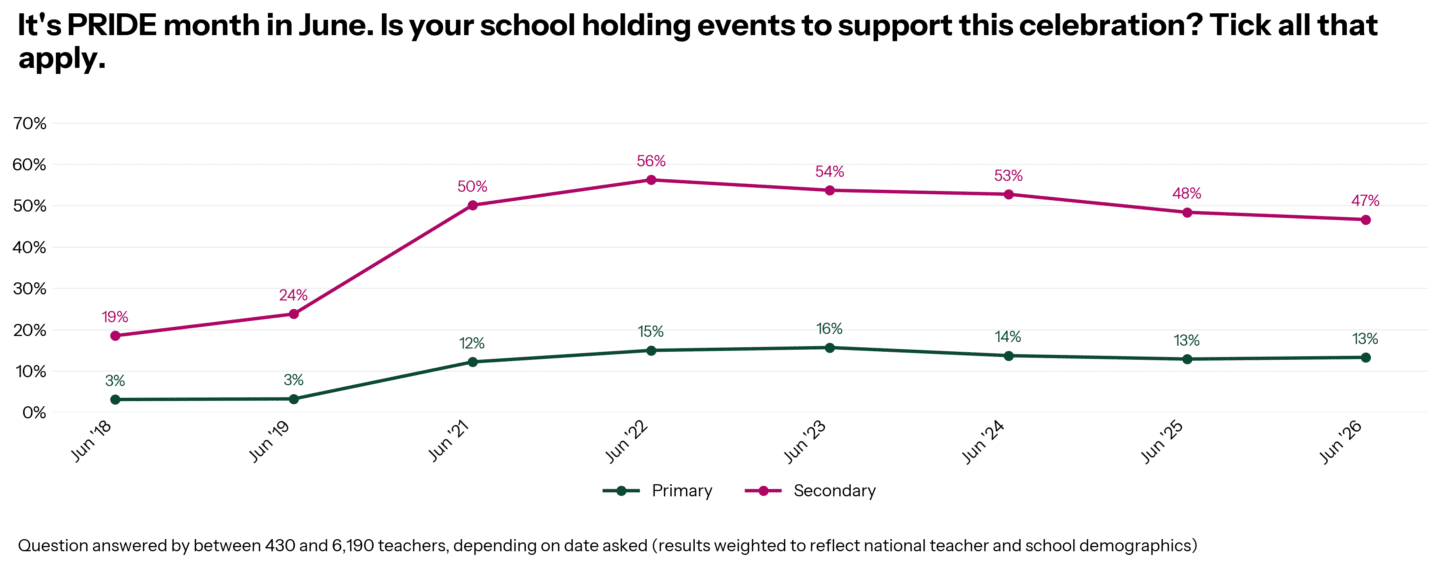
“Hey there Tappers! The last half term of the year is now fully underway. Here at Tapp we have some exciting news about a special giveaway AND lots of juicy edu-data. Let’s get started! New prize draw Here at Teacher Tapp we are incredibly grateful for all of the Tapps you give us. A great example of the difference you have made is the recent Curriculum and Assessment Review by the Department for Education, in which your opinions were included in its use of Teacher Tapp data. Therefore, we feel it is only right that we regularly say THANK YOU, and this month one lucky Tapper will win an iPad! It’s easy to enter – you just have to Tapp in June! Check out the full Ts and Cs here . Now – onto our most interesting findings from the last week… Pride 🌈 in schools June is Pride Month! 🌈 47% of secondary teachers and 13% of primary teachers told us their schools are holding events. This is part of a downward trend in secondary, falling from a 56% high in 2022, and a small drop in primary from a 16% high in 2023. We have some more information about this, plus our results on supportive and derogatory comments from students, plus confidence in supporting LGBT students in our special blog here . Visualiser use “I couldn’t teach without it!” This is the message one Tapper sent in this week after they spotted the question about visualisers – and they wanted to know just how widespread visualiser love was! So we took a deeper look at the numbers… Since 2022, Teacher Tapp has been asking teachers about their use of visualisers – and year-on-year more teachers say they are using it: 21% of teachers reported using it in their last lesson in 2022, this rose to 26% in 2024, and now 29% in 2026. But are all subjects using it at similar rates? Not really: Visualiser use rose in every subject, but at very different rates. English teachers were the most likely to report that they used a visualiser ( 32% in 2022 → now UP to 43% ). There has been very little change among arts incl D&T teachers ( 15% in 2022→ 15% in 2024→ 17% in 2026). Maths saw the biggest rise of 12 percentage points ( 24% in 2022 → now UP to 36% ). The number of languages teachers reporting they used a visualiser has doubled: 9% in 2022 → now UP to 19% . There was a bigger increase between 2024 and 2026 for teachers of humanities ( 19% in 2022 → 23% in 2024 → 30% in 2026). Other subjects saw their biggest increase between 2022 and 2024: Science, KS2 and EYFS/KS1 saw hardly any change between 2024 and 2026. Primary teachers are less likely to use visualisers compared to secondary teachers ( 26% vs 31% ), and KS2 teachers are more likely to use visualisers compared to EYFS/KS1 ( 29% vs 23% ). Would you suggest to a friend that they teach their own child? A few weeks ago, a Teacher Tapper drew our attention to a post on social media asking for advice about a dilemma facing a teacher: their son was due to join their school in reception class, and as the reception class teacher, they could either teach their own son or swap to year one that year. In the comments, teachers were sharing their thoughts and opinions were split. Some thought it would be fine, others thought it was best avoided. Some people shared personal experience, with stories of sons and daughters who struggled to accept the parent in the role of teacher, and others who had taken it in their stride. We thought this was a perfect question to run a small experiment: Teacher Tappers were split into four groups, one group heard the scenario with a male teacher, male child; another group male teacher, female child; third group female teacher, male child; final group had a female teacher and female child. We wanted to know if these differences elicited different responses. Reassuringly, there were only very small differences between responses! Here is what we found out… We found out that Tappers are more likely to recommend a swap for daughters than sons if the teacher parent is male ( 69% vs 65% ), and then less likely when the teacher parent is female ( 66% vs 68% ). Does the Tapper’s gender make a difference? A little. Men were more likely than women to say they “couldn’t advise” — an 8-percentage-point gap on average. Men were also slightly more likely to advise teaching the child themselves, with an average gap of around 3 points . The widest single gap was on advising the father to teach his daughter himself: 14% of men chose this versus 8% of women. Elspeth Kirkman is the chief programmes officer at Nesta , and as part of her work looks at education and how to close income-driven gaps in the early years. She is the author of two books: Behavioral Insights (2020) and Decisionscape (2024) . She holds fellowships with King’s College London and Exeter University. Plus – she has a TikTok channel where she breaks down research papers. We shared these findings with Elspeth, and she shared our surprise there wasn’t more of a gap, saying, “I am surprised, but pleasantly so, by how little effect the sex of the teacher and their child seems to have on the advice given. I am not sure what direction I would have expected it to go in but I would have thought Dads would get different advice to Mums.” However, she did add that she hadn’t expected the gender of the respondent to move the numbers as much as they did, and that the reason for the shift was “driven by a big increase in people saying they wouldn’t want to advise rather than taking a view.”. Do the results surprise you? Let us know what you think England@teachertapp.co.uk . School day timings Since 2021, Teacher Tapp has been tracking the timings of the school day. And a few things have shifted over the years! Beginning at the beginning: lesson start times. Secondary teachers tend to report earlier start times than primary teachers. The majority of secondary teachers reported a start time between 8:30 and 8:44 ( 50% ), whereas the majority of primary teachers reported a start time between 8:45 and 8:59 am ( 53% ). Since 2021, things have remained pretty stable. Primary teachers have seen less change than secondary, with a constant 2% reporting a start before 8:14 am. More secondary teachers are reporting a slightly later start time ( 11% UP from 7% in 2021). And ending at the end: lesson finish times. 91% of primary teachers report finishing between 3 and 3:30 pm, whereas secondary teachers report a wider spread, with 68% reporting a 3-3:30 pm finish time, and 20% report finishing after 3:30 pm, but just 5% of primary teachers say the same. When these two questions were crossed together, secondary teachers were more likely to report a slightly longer school day, with the average secondary day lasting 6 hours and 30 minutes, and the average primary day lasting fifteen minutes less. Although the Department for Education guidance doesn’t require longer school days for secondary learners, this could be explained by the need for movement time to be factored into a secondary teaching day. Daily Reads The Daily Read that got you clicking this week was our Teacher Tapp game ! Have you tried it yet? Give it a go! There are so many great blogs out there and we love featuring them on Teacher Tapp. If you have a blog you think we should feature, then please email us at england@teachertapp.co.uk and we will check it out! The post AI sceptics, visualisers, plus teachers teaching sons or daughters… appeared first on Teacher Tapp .
Original story
Continue reading at Teacher Tapp Blog
teachertapp.co.uk
Summary generated from the RSS feed of Teacher Tapp Blog. All article rights belong to the original publisher. Click through to read the full piece on teachertapp.co.uk.
