
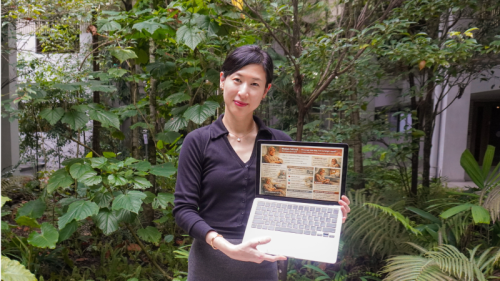
“For NUS students Terra Lee and Dhaaniya Sree Ramesh, Artificial Intelligence (AI) seems to be just a tool of convenience. However, their perspectives profoundly shifted after completing courses like AI for Design , Ideas to Proof-of-Concept , and specialised workshops. These workshops are designed and delivered by Dr Kate Sangwon Lee, Lecturer at the Engineering Design and Innovation Centre under the College of Design and Engineering (CDE) at NUS. Second-year CDE undergraduate Terra discovered that AI "was not just about speeding up work, but also about expanding creative thinking and challenging assumptions during the design process". Her peer at CDE, Dhaaniya echoed this, noting AI "changed the dynamics of the design process from simply creating outputs to spending more time on critical thinking and decision-making". This collective experience, inspired by AI's ability to rapidly generate a wide range of ideas, fundamentally deepened their empathy and enriched their understanding of design approaches and user needs. Unlocking human perspectives with design thinking This transformative experience is at the heart of NUS’ groundbreaking approach to education: integrating AI with design thinking. Here is a human-focused problem-solving methodology that enhances, rather than replaces, human capabilities like critical thinking, creativity and empathy. It capitalises on AI to accelerate and deepen human understanding and innovation. When used thoughtfully, AI unlocks fresh opportunities to enrich teaching and learning. For example, AI enables the use of advanced role-playing prompts to generate nuanced user personas that help student designers address real human emotions and struggles. During a hackathon in May 2026 organised by Dr Lee to design sensor-integrated products for the elderly, an AI-generated persona of "Madam Salmah" – an elderly individual fiercely resisting help due to a fear of losing independence – was created. This has proven to be tremendously useful in designing care from the true perspective of elderly living in Harmony Village, a community care apartment block in Bukit Batok. Dr Lee, who is also Principal Investigator of the Human-Centred AI Design (HCAID) research team, finds her own understanding of human-centred design deepening as such personas challenged even her long-held beliefs. “Before these AI-generated Provotypes (Provocative prototypes) and extreme edge-case personas, students would unconsciously speak of marginalised users as a detached "they", people who needed our help or protection. The most profound lesson was witnessing how quickly students shifted from objectifying users to genuinely empathising with them,” shared Dr Lee. “Even as an educator who has studied these dynamics for years, I found myself surprised by what the personas surfaced. It reinforced my conviction that the real work of education is not transferring knowledge, but it is creating the conditions for assumption-shattering. Witnessing that happen with AI as the vehicle was both humbling and exhilarating,” she added. Henry Lim, a first-year Architecture student who participated in the hackathon, said, “Leveraging my architectural skills with AI, I created an interactive digital twin of a building and linked real life raw data from physical sensors to programmed readable data. My 'ah-ha' moment was realising AI expanded my capabilities beyond what I could achieve alone, inspiring peers and surpassing my own expectations of what was possible.” Keeping the human in charge of the loop Human creativity and critical thinking are amplified as AI rapidly generates brainstorming possibilities and prototypes. Students, however, remain active curators critically evaluating and refining AI output to infuse human judgment and ethical considerations. While AI could structure workflows and generate concept renders, Dhaaniya reflected that “good decision-making still depends on human judgement, empathy and understanding context”. Dr Lee emphasises the 'AI-Human Validation Loop' which trains students to identify systemic gaps and automation bias, fostering a highly inclusive, ethical and critical mindset. She explained, “While AI is an incredible engine for generating vast creative possibilities, the critical filtering and evaluation must belong entirely to human intelligence. Our primary responsibility as educators in this era is to scaffold with this framework and cultivate that discerning eye.” AI creates better versions of ourselves “My ultimate vision is to design technology that fundamentally helps us become better versions of ourselves, ” Dr Lee concluded. “ By centering empathy before intelligence, we ensure that the next generation of engineers, designers and thinkers view AI not as a shortcut to bypass human thought, but as a tool to elevate our collective social impact and tackle society’s most complex, deeply human challenges.” Her long-term goal is to institutionalise 'Responsible AI in Pedagogy' as a distinct discipline, creating guidelines, tools and assessment frameworks to help educators foster more human-centric learning . Presented to fellow educators at the “AI in Education” poster showcase on 12 May 2026, Dr Lee’s experience of applying AI in design thinking highlighted the rapid pedagogical innovations at NUS driven by generative artificial intelligence (GenAI). Professor Melvin Yap, NUS Associate Provost for Education and Technology, shared, “Education for the AI era has to both defend human value and unlock human potential to prepare graduates for complex, AI-resilient roles. The true human edge lies in our unique ability to collaborate with each other and AI agents to perform work of higher value, ahead of the competition. ” By purposefully weaving AI into teaching and learning to boost effectiveness and agility, NUS seeks to demonstrate that advanced technology, when guided by a human-centred philosophy, can powerfully enhance our humanistic skills. The ability to understand, create and critically evaluate these tools will be a defining skill of the future.
Original story
Continue reading at NUS Newsroom
news.nus.edu.sg
Summary generated from the RSS feed of NUS Newsroom. All article rights belong to the original publisher. Click through to read the full piece on news.nus.edu.sg.

