
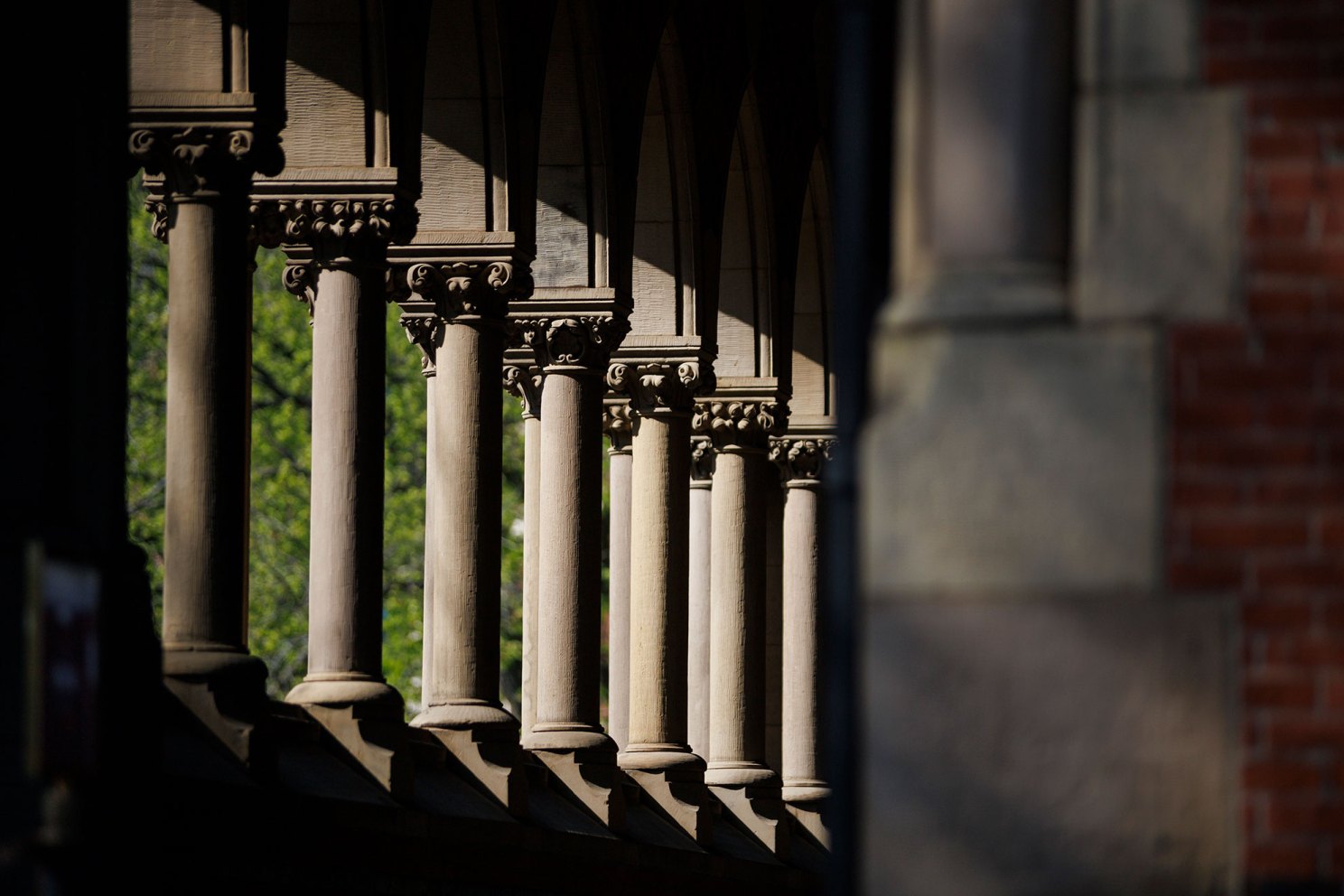
“Sunlight beams through the columns of Memorial Hall. Photo by Grace DuVal Campus & Community Akira Iriye, 91 Memorial Minute — Faculty of Arts and Sciences May 7, 2026 6 min read At a meeting of the Faculty of Arts and Sciences on May 5, 2026, the following tribute to the life and service of the late Akira Iriye was spread upon the permanent records of the Faculty. Born: Oct. 20, 1934 Died: Jan. 27, 2026 The life of Akira Iriye, Charles Warren Professor of American History, Emeritus , who died in Jan. 2026 at the age of 91, was profoundly shaped by the forces of 20th-century international history. He, in turn, transformed the writing of that history. Born in Japan in 1934, Iriye was in the first grade when the Pacific War began and in the fifth grade when it ended in 1945. More than seven decades later, he recalled his shock when the U.S.-led occupation authorities in Japan ordered that school history textbooks be completely rewritten: I still remember the day when our classroom teacher told us to bring a brush and ink so as to erase sections that were considered unacceptable to the occupation authorities. . . . It seemed to us that what our teachers (as well as our parents and other elders) taught us yesterday was no longer true today. . . . In retrospect, that experience may have had a great deal to do with my decision to become a historian. [1] After high school, Iriye won a scholarship to come to the United States to study at Haverford College, a small liberal arts school near Philadelphia. There he encountered Wallace MacCaffrey, a historian of Tudor England (and later chair of the Harvard Department of History), who set him on a path to graduate study in history. Iriye arrived at Harvard in 1957 intending to continue his study of British history, but he found his way instead to a newly established program in what was then called American-Far Eastern Relations. There he studied under the U.S. foreign relations historian Ernest R. May, later his longtime colleague at the Harvard Department of History. After earning his Ph.D. in 1961, Iriye taught at the University of California at Santa Cruz, the University of Rochester, and the University of Chicago before returning to Harvard as Professor of History in 1989 and becoming the Charles Warren Professor of American History in 1991. Although he retired from teaching in 2005 (he explained that he had promised his wife he would retire at 70), his appetite for scholarship remained undiminished, and he continued writing and publishing for many years afterwards. Iriye’s Harvard dissertation became his first monograph, “After Imperialism: The Search for a New Order in the Far East,” 1921–1931, published in 1965. It was the first major study of the international history of East Asia to use sources in Japanese, Chinese, German, and Russian (the latter of which he learned after graduation since he felt the book would otherwise not be complete). In the ensuing decades, Iriye produced a steady stream of books and articles, many of which were centered on the international history of East Asia and were distinguished by his multilingual, multi-archival approach. Throughout Iriye’s career, he showed a special interest in the role of culture in international relations, including the impact of mutual perceptions and cultural exchanges between nations on the conduct of international relations. This approach found expression, inter alia, in his seminal 1979 article Culture and Power: International Relations as Intercultural Relations and in his influential 1997 book “Cultural Internationalism and World Order.” There he traced the history of the transnational movement to foster understanding among nations through programs of cultural exchange, including student exchange programs of the sort that he himself had been part of more than four decades earlier. A stable world order, he argued, could not rely only on governments and power politics; it also depended on mutual understanding among peoples. Iriye always believed in historical knowledge as a force for international understanding and in that understanding as the foundation of peace and the integration of humanity. To some, those commitments appeared utopian, perhaps even a little naive, but they were deeply held and rooted in his wartime experiences and his belief that hard-won peace in Asia could be extended to the whole world. Iriye’s urge to understand the underpinnings of international cooperation led him to produce pioneering work on the history of international organizations, notably with his landmark 2002 study, “Global Community: The Role of International Organizations in the Making of the Contemporary World,” which has served as a foundation for a flourishing field of scholarship. Iriye is survived by his wife, Mitsuko; his daughters, Masumi and Keiko; and his granddaughters Lucy and Maeva. He liked to claim to have married up as his wife came from an aristocratic background (and was born in Paris) while he was allegedly descended from pirates. He was well known in Japan as an expert on the United States; for many years, if you came into Robinson Hall on a Sunday, you might have run into a Japanese television crew taping his weekly interview. Once, when a Harvard History colleague visiting Japan casually told his hosts that he was off to meet Iriye Sensei, they were astonished he knew such a towering figure. Indeed, in 2005, the Emperor of Japan awarded Iriye the Order of the Sacred Treasure, Gold and Silver Star, in recognition of his distinguished service to the public. Iriye garnered many other major awards and honors in his career. He was elected president of the Society for Historians of American Foreign Relations in 1978, inducted into the American Academy of Arts and Sciences in 1982, and became the first and, to this day, the only Asian or Asian American president of the American Historical Association (AHA) in 1988. In his AHA presidential address, The Internationalization of History, he called on the discipline to become “less nation-centered” and “more globally oriented.” Later, looking back on his storied career, Iriye said that he felt fortunate to have studied history at a time “when both history and historiography” were “moving in the direction of global interconnectedness and interchange.” [2] In fact, it was not simply a matter of good fortune; he was instrumental in making it so. Respectfully submitted, David Armitage [1] Akira Iriye, “A Historian’s Formative Years,” H-Diplo Essay 272 (2020), https://hdiplo.org/to/E272 [accessed March 30, 2026] [2] Iriye, “A Historian’s Formative Years.”
Original story
Continue reading at Harvard Gazette
news.harvard.edu
Summary generated from the RSS feed of Harvard Gazette. All article rights belong to the original publisher. Click through to read the full piece on news.harvard.edu.
