
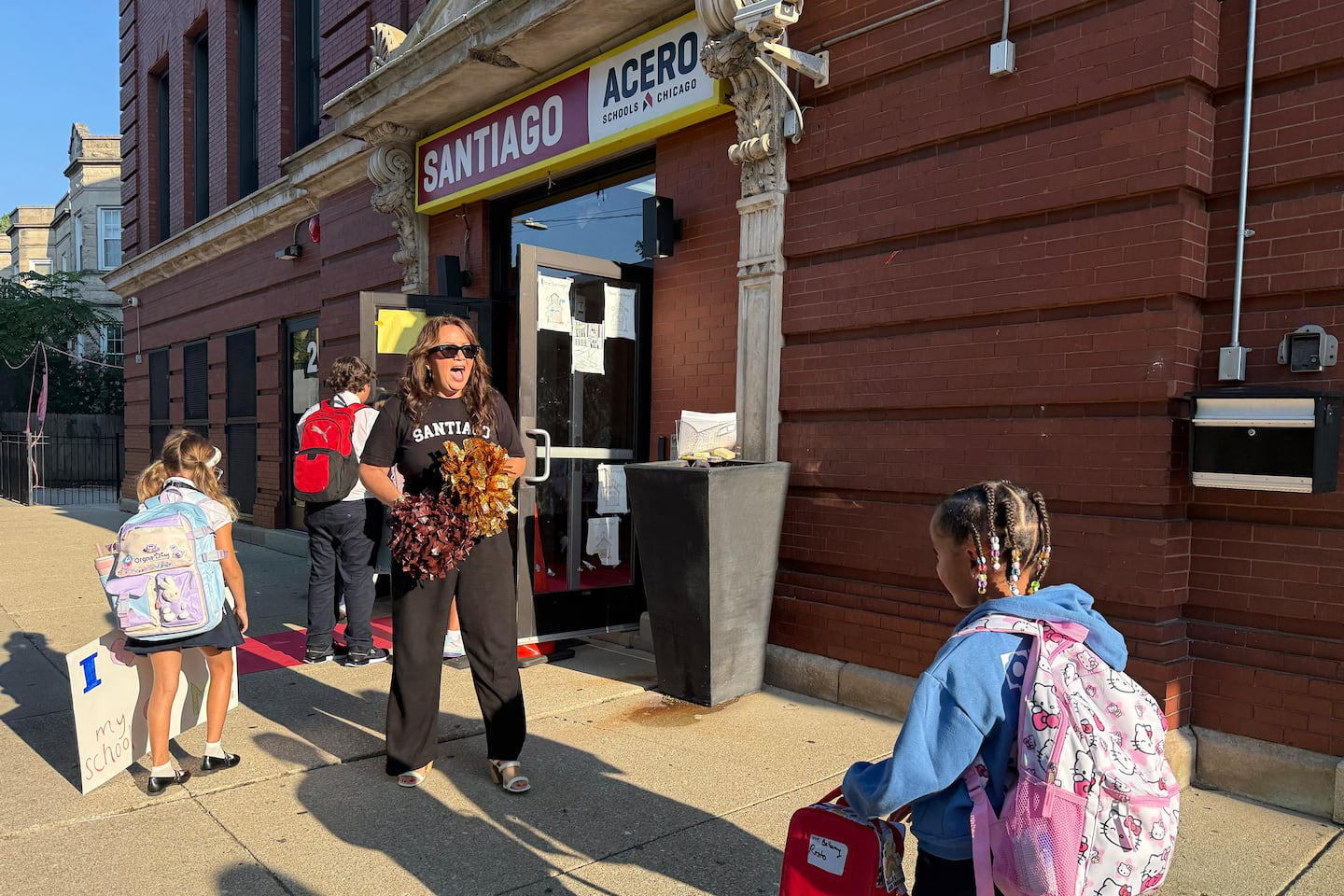
“Sign up for Chalkbeat Chicago’s free daily newsletter to keep up with the latest news on Chicago Public Schools. After a lengthy and tense debate about oversight of charters, the Chicago school board postponed Thursday a decision on renewing seven charter schools or networks serving 8,300 students until after the end of the school year. After two years of intense charter scrutiny and relatively brief renewal terms , district officials this year touted a new process for monitoring charters and also recommended longer renewals. They wanted most schools to get four-year contracts, with one, Academy for Global Citizenship, earning a seven-year renewal recommendation. The Acero network was cleared for a five-year renewal on the heels of its announcement last school year that it would close seven campuses and the school board’s unprecedented decision to absorb five of them . District officials said the longer renewals will cut down on red tape, while a new process of sizing up all charters midcycle and flagging nascent financial issues before they escalate will make for stronger oversight.But school board members aligned with the Chicago Teachers Union — the charter sector’s fiercest critic — pointed to a stretch of intense fiscal turbulence and closure announcements in Chicago’s charter sector to argue they had more outstanding questions and wanted the new process to have more teeth. Some held up Acero as an example, arguing that what they described as an abrupt announcement in fall of 2024 that campuses would close at the end of that school year should count against the network. “An accurate sense of finances has been eluding us, resulting in harm to students and costs to the district,” said board member Karen Zaccor, who moved to table the renewal votes. But other board members praised the new process and argued the board should trust the expertise of the district’s evaluation team. “We can’t keep moving the goalpost because the data and the process do not produce the political conclusion someone wanted from the beginning,” said board member Angel Gutierrez, who was elected with strong backing from charter advocates. Superintendent Macquline King and board President Sean Harden, who both usually abstain from weighing in on board debates, took the unusual step of pleading with board members to approve the contracts and continue to work closely with district officials on fine-tuning the oversight process. King noted thousands of largely Black and Latino students would wrap up the school year without certainty about their schools’ future. “We’ll cause instability and concern,” an unusually emotional King said. “For us, it may seem like, ‘It’s just two weeks.’ For a child, this can be a lifetime.” But in tabling the decisions until a June 10 meeting in a 11-to-8 vote, board members signaled they had no intention of denying the renewals but rather just wanted leverage to push for more CPS oversight. The board did amend the contract for Urban Prep Academy for Young Men to wind down its Bronzeville campus and consolidate its operations on its Englewood campus. That charter was among several that appealed to CPS for a mid-school year cash advance to make payroll, and the district said the merger will help stabilize the school’s finances. Another charter, Rowe Elementary, is also merging its two campuses into one building. For Chicago charters and contract schools, recent years have brought a string of fiscal implosions. Following the unprecedented move to save the Acero campuses, the district also came to the rescue of the Chicago High School for the Arts, a contract school, when its board announced last fall its financial model was no longer sustainable. CPS steered additional dollars to EPIC Academy, a South Side charter high school, so it could finish up the school year before closing permanently . And the district scrambled to accommodate displaced students when it closed two high schools in the ASPIRA charter network after months of financial turmoil. Charter advocates have argued that underfunding by the district, along with citywide enrollment declines, precipitated these crises. But critics of the sector said financial missteps contributed and argued that CPS officials should have done more to see the closures coming. Members appointed by Mayor Brandon Johnson or elected with backing by his allies at the CTU hold a majority on the board and have embraced shorter renewals. Last year, a majority of the 16 schools up for renewal received two-year terms. At the Thursday meeting, Jennifer Conant, the CTU’s charter division chair, argued for keeping renewals shorter, saying some of the schools on this year’s renewal list are budgeting in a way that fails to reflect their declining enrollments — “magical thinking” that she said contributed to EPIC’s and ASPIRA’s closures. But at the same time, she said Acero’s move to close campuses last school year — a decision the network said was necessary to adjust to enrollment drops — should disqualify it from a five-year renewal. “If that has no effect on their renewal length, you are sending an invitation to more charter operators to do the same,” Conant said. Meanwhile, several students at Chicago Collegiate Academy argued the school should get five more years. They said the school has worked to stabilize its finances and is moving to a new building that will allow for student growth in the fall. “A four-year renewal does not reflect where our school is headed,” said honors student Laila Cruthurd. “It’s a limit.” The advocacy group Illinois Network of Charter Schools criticized the trend of shorter terms, arguing it forces charters to expend too much energy and resources on frequent, time-consuming renewals. Andrew Broy, the network’s executive director, said this spring’s longer renewals are a step in the right direction. He also praised some aspects of a new framework for evaluating charters that the district used this spring, in which charters’ academic performance carried more weight. But he decried the late date of the renewals that he said makes it harder for schools to plan for the coming year and said a behind-the-scenes push to shorten the contract terms reveals an anti-charter bias on the board. Conrad Timbers-Ausar, the district’s acting chief portfolio officer, touted what he described as an extensive, data-driven process for evaluating charters and the district’s new financial early warning system, flagging issues such as spending that exceeds budgeted amounts. He compared it to checking in on students’ academic performance throughout the year rather than waiting to fail them on a final exam. “This is not a rubber stamp process, and it’s not just a compliance exercise,” he said. Chicago Collegiate Charter School, Chicago Mathematics and Science Academy, Christopher House Charter School, Intrinsic Charter School, and the University of Chicago Charter School would have received four-year renewals. In other business, the board backed a resolution calling on state lawmakers to pursue progressive sources of additional revenue to raise more money to schools. That vote came after a lengthy and heated debate of an ultimately unsuccessful amendment member Che “Rhymefest” Smith proposed that would have also called on the city to steer more revenue from a special tax program to spur development to CPS. In remarks to the board at the start of the meeting, superintendent Macquline King said cuts to school budgets her team proposed earlier this month reflect state and federal revenue haven’t kept up with the district’s rising expenses. “”It breaks my heart to deliver the budgets I had to deliver,” she said. Mila Koumpilova is Chalkbeat Chicago’s senior reporter covering Chicago Public Schools. Contact Mila at mkoumpilova@chalkbeat.org .
Original story
Continue reading at Chalkbeat
www.chalkbeat.org
Summary generated from the RSS feed of Chalkbeat. All article rights belong to the original publisher. Click through to read the full piece on www.chalkbeat.org.

