
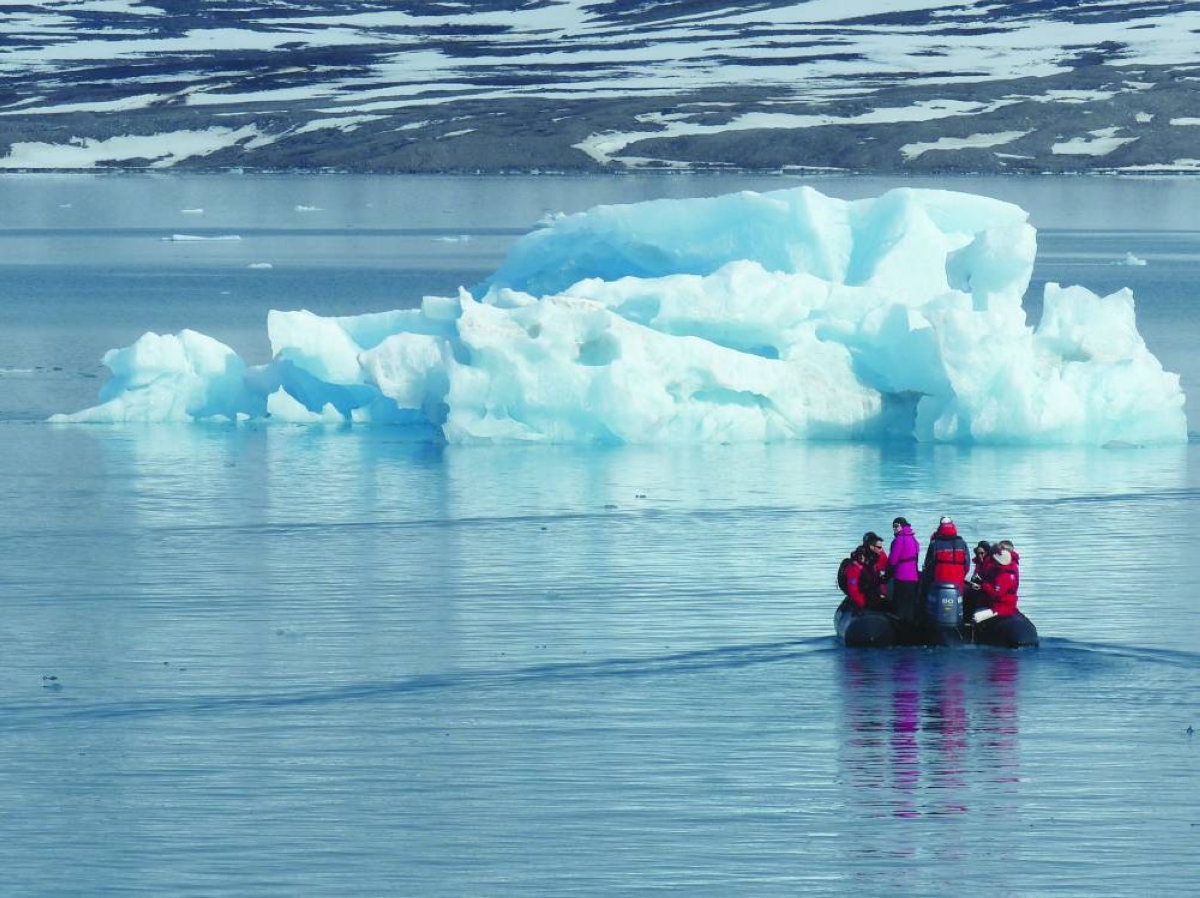
“Power transition theory is one of the most compelling concepts in geopolitics. The international system, it argues, is organised around a dominant state whose power and preferences shape the rules of the system. Other states have no choice but to accept this reality until they can gain enough economic and military capacity to shrink the power differential between them and the leading state. If rising powers can achieve this and they are dissatisfied with the status quo, they will look to challenge the dominant actor on key issues. This theory is currently being played out in the Arctic Circle, the northmost region of the earth. Taking advantange of the relative decline of US power, Russia, China and a host of smaller actors, including some EU states, are resisting Washington’s preferences over the future of the Frozen North. On one level, this is a matter of resources. The Arctic contains an estimated 25-30% of the world’s undiscovered natural gas reserves and 10-15% of its undiscovered oil. It is also home to massive deposits of critical minerals and rare earth elements. Until recently, these valuable resources were often inaccessible under frozen Arctic waters and thick tundra ice. As global warming has taken its toll, melting ice has made it easier and cheaper to build the airstrips, roads, railroads and power systems required to access, mine, transport and process these resources. For the first time in history it is now also possible to navigate Arctic waterways all-year round. This makes investment in expensive port infrastructure more economically viable. Uninterrupted access to Arctic sea routes also significantly reduces the cost and time it takes to ship goods between Europe and Asia. There are eight recognised Arctic states: Canada, Greenland/Denmark, Russia, the US, Iceland, Norway, Sweden and Finland. Of these, Russia has the most comprehensive Arctic strategy. It has operated Arctic oil and gas fields for decades. In recent years, it has launched dozens of mining, transport and port projects. As far back as 2006, Russia excluded competitors from local opportunities by blocking foreign ownership in one of the world’s largest sources of gas, the Shtokman gas field. More recently, Moscow unilaterally declared the Northern Sea Route along the Siberian coast as internal Russian waters. To firm up this claim it has moved to introduce permits and fees for foreign vessels using these waters. Russia has also submitted a claim to the UN to extend its sovereignty over Arctic seabed resources far beyond the standard 200 nautical mile exclusive economic zone. Unlike the US, which is an Arctic state because of Alaska, China has no geographic claim to the Arctic. Unfazed, Beijing has designated itself as a “Near-Arctic State”. This title has no standing in international law but highlights the country’s Arctic ambitions. Like Arctic states, China has pursued a strategy of building “facts on the ground” to establish itself as a key player. This has cost an estimated at $90bn over the last decade and a half. This has been spent on an ice-breaker fleet, oil and gas wells, mineral mines, ports and scientific research centres. Beijing has also extended the Belt and Road Initiative (BRI) to the Arctic. This “Polar Silk Road” connects Arctic shipping routes to key resource hubs. The Arctic is not only an unprecedented commercial opportunity for countries willing to take advantage of climate change and Washington’s weakening grip on geopolitics. It is also an increasingly important military priority. Russia has established an Arctic Command and reopened and modernised Cold War military bases. It has also developed an Arctic warfare doctrine and invested heavily in weapons systems suitable for warfighting in this harsh environment. China is also developing a range of military capabilities specifically intended to challenge the US and its Nato partners in the Arctic. These include space, cyber, and maritime programmes. When President Trump told the world, “We have to have it” regarding Greenland, he was not only referring to the rich mineral deposits on the world’s largest island. He was also talking about continued US dominance of the Western Hemisphere in the face of the Arctic ambitions of rising powers. Mike Waltz, Trump’s ex-national security advisor and current UN ambassador, summed up White House thinking on Greenland, “This is about the Arctic. Russia is trying to be king...”. Located between North America and Europe, Greenland commands the key approaches to newly accessible Arctic maritime corridors. Greenland is already home to the Pituffik (formerly Thule) US military base. Now the Trump administration wants to expand its military presence to curtail and push back the Arctic advances of its competitors. Despite Washington’s constant criticism of its Nato partners for not pulling their weight, many play an important military role in the Arctic. Norway has the longest Arctic coastline of any Nato member. It has invested heavily in Arctic military capabilities and lobbied for years for Nato’s northern expansion. The UK has established Camp Viking on Norway’s Arctic border. Canada is investing billions on Arctic weapons and reconnaissance systems. Denmark runs the Joint Arctic Command. Finnish and Swedish entry into Nato in 2023 and 2024 respectively has also strenghened Nato’s warfighting capabilities in the Arctic. This growing East-West militarisation undermines the Arctic’s long-time status — even at the height of the Cold War — as a role model for multilateral cooperation in non-sovereign territory. More recently, bodies like the Arctic Council and the Barents Euro-Arctic Council brought together Arctic states and key non-Arctic nations to address environmental and development issues. Some even pointed to these frameworks as potential models for cooperative governance in another increasingly explored non-sovereign territory — outer space. But those days are over. Instead, the shrinking power gap between the US and its competitors and the growing distrust of the US amongst its long-time allies have greatly impacted the Arctic. Above all, it has made it likely that this once remote and peaceful part of the world will become a hotspot in any future global conflict. The writer is Professor of International Politics and Director of the Small States and Energy Studies Programs at Georgetown University in Qatar. @RoryDavidMiller
Original story
Continue reading at Gulf Times Education
www.gulf-times.com/community/education
Summary generated from the RSS feed of Gulf Times Education. All article rights belong to the original publisher. Click through to read the full piece on www.gulf-times.com/community/education.
