
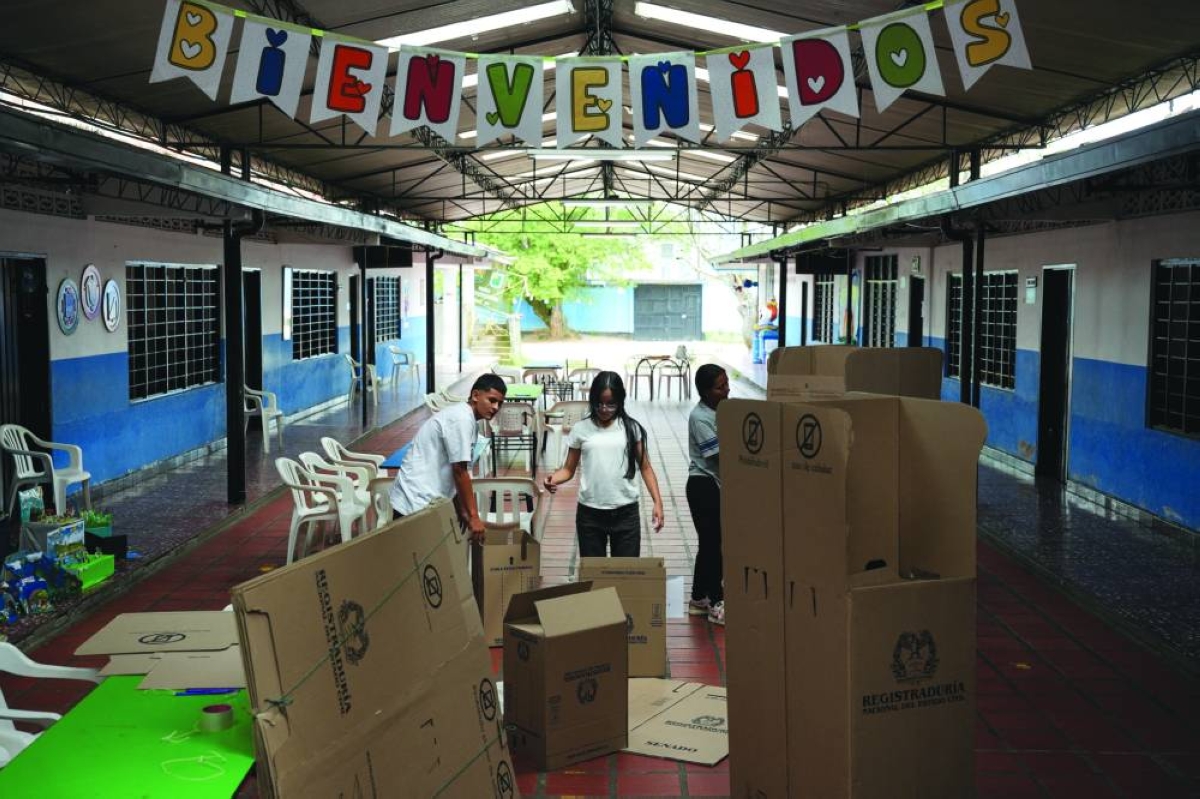
“Jose Moran arrived at his town's community center this week to find its zinc roof destroyed by an explosives-laden drone, the result of guerrilla violence that has blighted this region of Southwestern Colombia. As the Latin American country prepares to vote today for a new president, Moran is pleading for peace, saying that the conflict is taking its toll on residents of the municipality of Suarez, particularly its children. 'We live here in a state of great anxiety, with constant nervousness,' the 73-year-old community leader told AFP. 'And the saddest part is that the children — well, they see a helicopter... or they hear any little sound, and immediately they cry out, 'The war is coming! The war is coming!'' 'So the children are deeply traumatized.' Surrounded by cloud-shrouded Andean mountains and lush tropical vegetation, their community sits near a military base that is under constant assault by dissident factions — groups that broke away from a 2016 peace accord with the now-defunct FARC guerrilla organization. Inhabited predominantly by Afro-Colombian and Indigenous peasant communities, the town of Suarez is a key operational zone for the forces of Ivan Mordisco, the country's most-wanted guerrilla commander, who has waged relentless attacks against both security forces and civilians. The rebels also clash with rival organizations over the spoils of illegal mining and drug trafficking within Colombia, the world's largest producer of cocaine. 'They may have their own reasons for their conflicts, but the problem is that we are the ones caught in the middle,' laments Moran. Outgoing leftist President Gustavo Petro attempted unsuccessfully to negotiate peace with the various armed groups, and Sunday's presidential election will pit opposing visions on how to end Colombia's half-century of conflict. The frontrunner in the polls, leftist Senator Ivan Cepeda, advocates continuing Petro's 'Total Peace' policy — a strategy criticized by the opposition as being too lenient toward armed groups. His closest rival, right-wing lawyer Abelardo de la Espriella, pledges instead to confront guerrilla groups with an iron fist. He plans to dismantle the tribunal established under the peace accord with the FARC, which adjudicates the conflict's worst crimes by offering alternatives to imprisonment for those who tell the truth about their offenses. Regardless of who wins the election, 'may they search their conscience... and be able to bring a little peace and tranquility,' said Flor Valencia, who runs a local school and has witnessed the conflict's impact on children. Petro held peace negotiations with Mordisco for a year, but the rebel leader abandoned the talks in 2024 and redoubled his offensive against the state. 'When those sounds start — the explosions — you just want to weep out of sheer desperation,' said Valencia, who recounted how the children become 'terrified' and she must shield them from stray bullets. Mayor Cesar Ceron said that last year Suarez saw 77 attacks involving explosives and drones — primarily targeting the military base and the police station — though civilians are regularly caught in the crossfire. The violence is 'out of control,' he said. At a hotel across from the police station, staff members are at their wits' end over car bombs and drone attacks. 'Out of fear of the violence, tourists have stopped wanting to stay at our hotel,' said its 25-year-old manager, Tania Cervantes. 'Please, let peace finally come.' Suarez is the birthplace of Petro's Vice President Francia Marquez, who was the 2018 recipient of the prestigious Goldman Environmental Prize for grassroots activists. In 2019, Marquez survived a gun and grenade attack for defending black communities' water resources against mining operations in the region. Ceron said that the next president 'absolutely must provide us with complete security,' but added that cannot be achieved 'solely through military force.' He called for social policies that 'provide economic guarantees to families.'
Original story
Continue reading at Gulf Times Qatar
www.gulf-times.com/qatar
Summary generated from the RSS feed of Gulf Times Qatar. All article rights belong to the original publisher. Click through to read the full piece on www.gulf-times.com/qatar.