
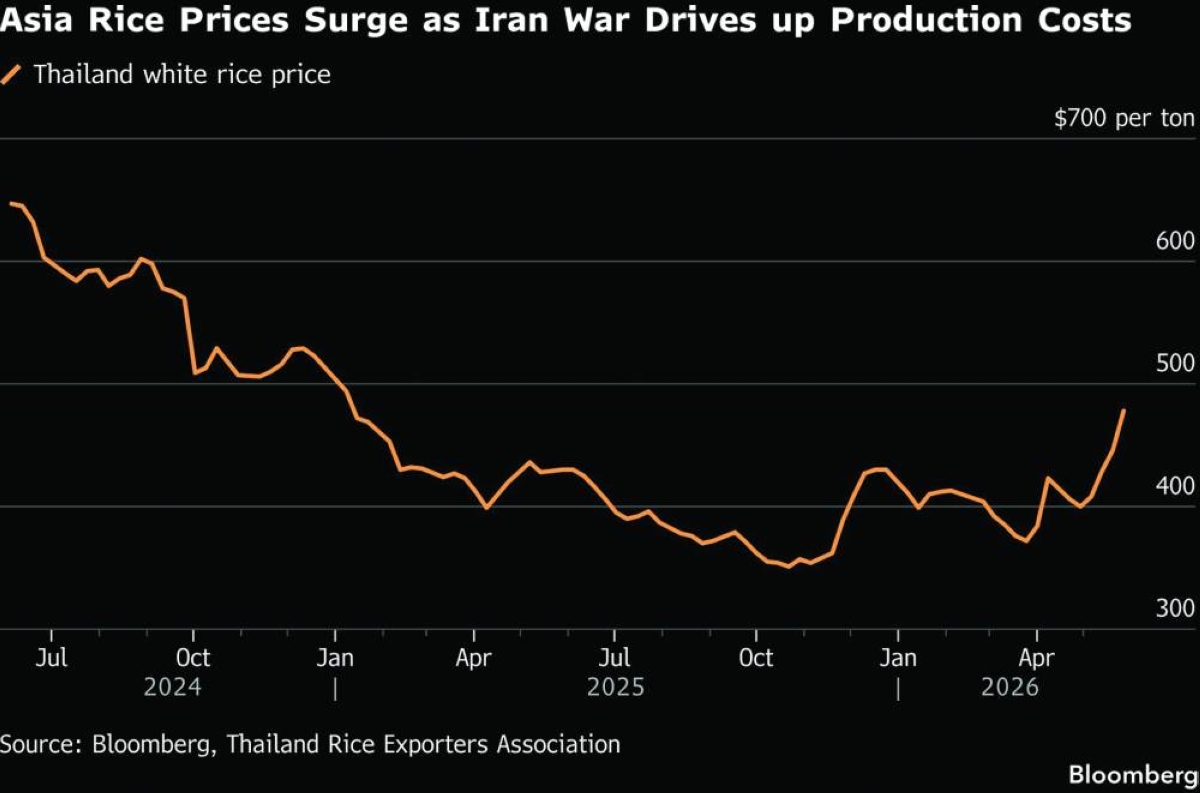
“Asian rice prices posted their biggest monthly jump in nearly two decades in May, and could rally further as weather risks and war-driven surges in energy and fertilizer costs threaten production. Thailand white rice, an Asian benchmark, rallied 20% in May, the most in a month in data going back to 2008. Rice futures on the Chicago Board of Trade also jumped 15% this month. Prices will continue to trend higher, said Bin Hui Ong, a commodities analyst at BMI, a unit of Fitch Solutions, which lifted its forecast for Chicago futures earlier this month. An expected El Nino event — which can bring hotter, drier weather to parts of Asia — presents further upside, she added. With fuel and fertilizer supplies still disrupted due to the near-closure of the Strait of Hormuz, farmers across import-reliant Asia are bracing for the high input costs to start weighing on rice production — a key cornerstone of the region’s economies. The crop is critical to the region’s food security and countries including Thailand, Vietnam and India are also major suppliers abroad. As planting for the main crop season gets underway in many parts, some farmers have been forced to skip or delay sowing the staple crop. Tran Van Be Bay, a 60-year-old farmer in the southern Vietnamese province of Vinh Long used to plant three crops a year. But as fertilizer prices surge, he plans to skip one round this time. “With costs rising and weather this hot, it’s not a good time to sow a new crop,” he said. “Applying more fertilizer not only costs more but also harms the plants.” Rice is known for being a fertilizer-intensive grain and the irrigation pumps used to flood fields often run on diesel. Prices of nitrogen fertilizers in Thailand, Cambodia, and the Philippines have surged about 40%-50% since the start of the war in February, according to the International Rice Research Institute. Though countries had enough reserves in the March-May period, shortages could emerge soon unless the fertilizer trade normalizes, said Alisher Mirzabaev, senior scientist for policy analysis and climate change at the institute. Any reductions in Asia’s output is likely to impact global supply. The Philippines has already warned that a strong El Nino could slash paddy rice production by as much as 700,000 tons or 3.5% of the annual production target. Still, price gains could be capped on the international markets thanks to ample rice stocks, particularly in major producer India, and relatively weak global demand, said Peter Clubb, market analyst at International Grains Council.
Original story
Continue reading at Gulf Times Education
www.gulf-times.com/community/education
Summary generated from the RSS feed of Gulf Times Education. All article rights belong to the original publisher. Click through to read the full piece on www.gulf-times.com/community/education.
