
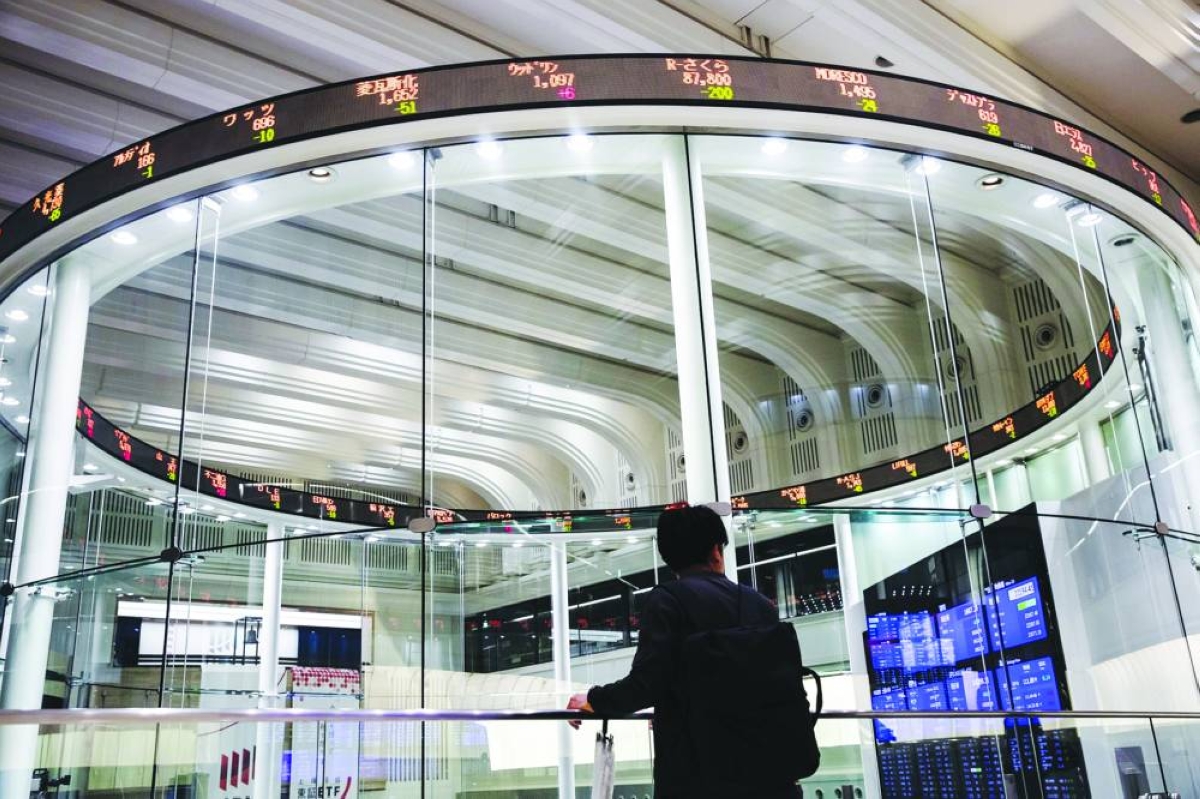
“Asian stocks were mixed on Wednesday as markets digested the lack of progress towards Middle East peace and setbacks that rattled the boom in AI technology. In Tokyo, the Nikkei 225 closed up 0.8% to 63,272.11 points; Hong Kong - Hang Seng Index ended up 0.2% to 26,388.44 points; and Shanghai - Composite closed up 0.7% to 4,242.57 points Wednesday. Iran's chief negotiator said on Tuesday that Washington must accept Tehran's latest peace plan or face failure, after US President Donald Trump warned the truce in the Middle East war was on the brink of collapse. Both sides have refused to make concessions and repeatedly threatened to resume fighting, but neither appears willing to return to all-out war. Traders are now looking to China, where Trump is due to land on Wednesday, the first visit by a US president in nearly a decade, saying he expected a 'long talk' with counterpart Xi Jinping about Iran. Trump's expected arrival in Beijing comes a day after figures back home in the United States showed consumer inflation hit a three-year high in April, as the economic fallout of the Iran war rippled through the world's largest economy. Soaring inflation will pile pressure on Trump to end the war, which is deeply unpopular with the American public, but he insisted on Tuesday that Americans' financial situation did not motivate him 'even a little bit' to make a peace deal with Iran. The US president said he would ask Xi to 'open up' China to American firms, adding that AI chip titan Nvidia's chief Jensen Huang was among a host of top CEOs joining the trip. In Asian markets, Sydney, Taipei, Wellington, Manila, Jakarta and Kuala Lumpur were down, while Hong Kong, Shanghai, Mumbai, Bangkok and Singapore advanced. London, Paris and Frankfurt were higher at the open. Tokyo closed up 0.8% after the yield on 20-year Japanese government bonds hit its highest level since 1997. Pressure on Japanese debt is intensifying as the Middle East war sends oil prices spiralling, fuelling speculation that the Bank of Japan will increase interest rates. Traffic through the Strait of Hormuz -- through which one fifth of the world's oil supplies usually pass -- has virtually ground to a halt. But oil prices cooled, with the international benchmark Brent crude falling 0.7% to nearly $107 a barrel, while US benchmark West Texas Intermediate also slipped 0.9% to $101 a barrel. Seoul showed signs of recovery, climbing 2.6 % after the presidential Blue House distanced itself from calls for a social tax on artificial intelligence profits. The tech-rich Kospi had plunged 5% on Tuesday after a top official proposed a 'national dividend' to redistribute excess corporate profits from artificial intelligence. South Korea has said it will triple spending on AI this year, aiming to join the United States and China as one of the world's top three AI powers. The collapse of Samsung Electronics' talks with its largest labour union dished another blow to Seoul's AI drive, with company shares falling as much as 6.1 percent, Bloomberg reported. Samsung is a major producer of chips used in everything from artificial intelligence to consumer electronics, raising the prospect that a planned walkout could cause severe disruption and losses. Delegations from China and the United States met for trade talks in South Korea, likely putting the finishing touches on any announcements for the Trump-Xi summit in Beijing.
Original story
Continue reading at Gulf Times Education
www.gulf-times.com/community/education
Summary generated from the RSS feed of Gulf Times Education. All article rights belong to the original publisher. Click through to read the full piece on www.gulf-times.com/community/education.

