
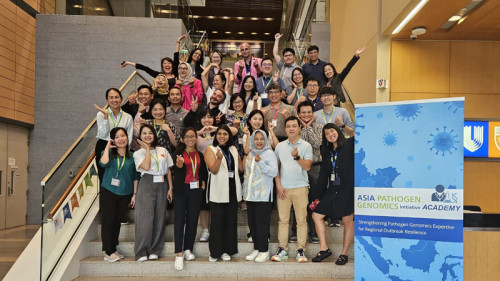
“The Duke-NUS Medical School (Duke-NUS) has been honoured with the prestigious “Outstanding Contribution to Regional Development” award at the Times Higher Education Awards Asia 2026 ceremony that was held on 22 April 2026. The School was also recognised as a finalist in the “Leadership and Management Team of the Year” category, while NUS received a finalist nomination for “Outstanding Contribution to Environmental Leadership”. Widely regarded as the “Oscars of higher education”, the awards programme, launched in 2019, celebrates exceptional achievements across Asian universities, recognising innovative leadership, groundbreaking research, and meaningful community impact. The award recognises Duke-NUS' Asia Pathogen Genomics Initiative (Asia PGI) Academy, which was established in 2022 under the Duke-NUS Centre for Outbreak Preparedness . The Academy was created to address a critical gap exposed during the pandemic: while pathogen genomics and next-generation sequencing proved essential for outbreak response, the expertise and capacity to deploy these tools remained concentrated in well-financed research institutions. Low- and middle-income countries and public health settings, where such capabilities were most urgently needed, did not have such access. The aim was therefore to strengthen pathogen genomics capabilities across the region in preparation for future health emergencies. Since July 2024, the Academy has trained over 100 health professionals from 19 countries – 17 of them classified as low- or middle-income by the World Bank. Through intensive week-long laboratory and data analysis courses co-organised with global leaders such as the World Health Organization (WHO) and national ministries to ensure scientific rigour and policy relevance, participants learn to use genetic sequencing to detect viruses, monitor outbreaks and inform public health decisions. Pre- and post-training surveys demonstrate the programme’s impact, with participants rating their knowledge and practical skills two points higher on average on a five-point scale after the courses. Assistant Professor Ruklanthi (Rukie) de Alwis, former lead and founder of the Asia PGI Academy, noted that the programme builds on decades of scientific partnership, capacity building, and skills transfer developed through the Duke-NUS Programme in Emerging Infectious Diseases . Dr Miruna Rosu, Lead of the Asia PGI Academy, emphasised the Academy's strategic approach as it delivers back-to-back laboratory and bioinformatics training for pathogen genomics focused on specific use cases involving high-risk pathogens in the Asian region, including arboviruses, avian influenza and antimicrobial resistance. She added, “By carefully selecting participants from organisations directly tasked with pathogen surveillance, and from as many partner countries as possible in each training iteration, the Academy has tried to be as efficient and effective as possible. It cannot be stressed enough how important our local and international expert collaborations have been in making this happen. It really goes to show that it takes a village to create something meaningful." The programme's real-world impact is already evident across the region. Trained professionals have applied their new skills to shape national vaccination strategies and conduct breakthrough genomic sequencing during disease outbreaks. Others have established new sequencing facilities at academic institutions, integrating genomic surveillance into university curricula. Some alumni have become trainers themselves, delivering their own capacity-building programmes, while others have innovated by reproducing affordable laboratory equipment locally, significantly reducing dependence on expensive imported supplies. THE Awards Asia judges commended the Asia PGI Academy as an exemplary model of cross-border collaboration for regional progress. With a founding core team from four Asian nations and partnerships extending to the US and beyond, judges noted how the initiative epitomises the strength of regional cooperation in addressing shared health challenges that transcend national borders. Looking ahead, the Academy is building on its strong foundation of partnerships while evolving its approach for greater sustainability and impact. "We're deepening our engagement with regional bodies such as ASEAN, the International Pathogen Surveillance Network, and WHO regional offices to better align capacity-building efforts across the region," said Dr Rosu. "Our continued collaboration with the Duke-NUS Programme in Emerging Infectious Diseases, and Singapore partners, including A*STAR, the National Environment Agency, and PREPARE (Programme for Research in Epidemic Preparedness and Response), alongside national partners across South and Southeast Asia, and global collaborators, gives us a solid platform to expand from." Assistant Professor de Alwis highlighted the Academy's shift toward long-term resilience. She said, “Through Train-the-Trainer models and virtual reality tools, the Academy is shifting toward embedding genomics training within national public health systems, fostering country ownership and ensuring sustained preparedness between crises, well before the next emergency emerges.”
Original story
Continue reading at NUS Newsroom
news.nus.edu.sg
Summary generated from the RSS feed of NUS Newsroom. All article rights belong to the original publisher. Click through to read the full piece on news.nus.edu.sg.

