
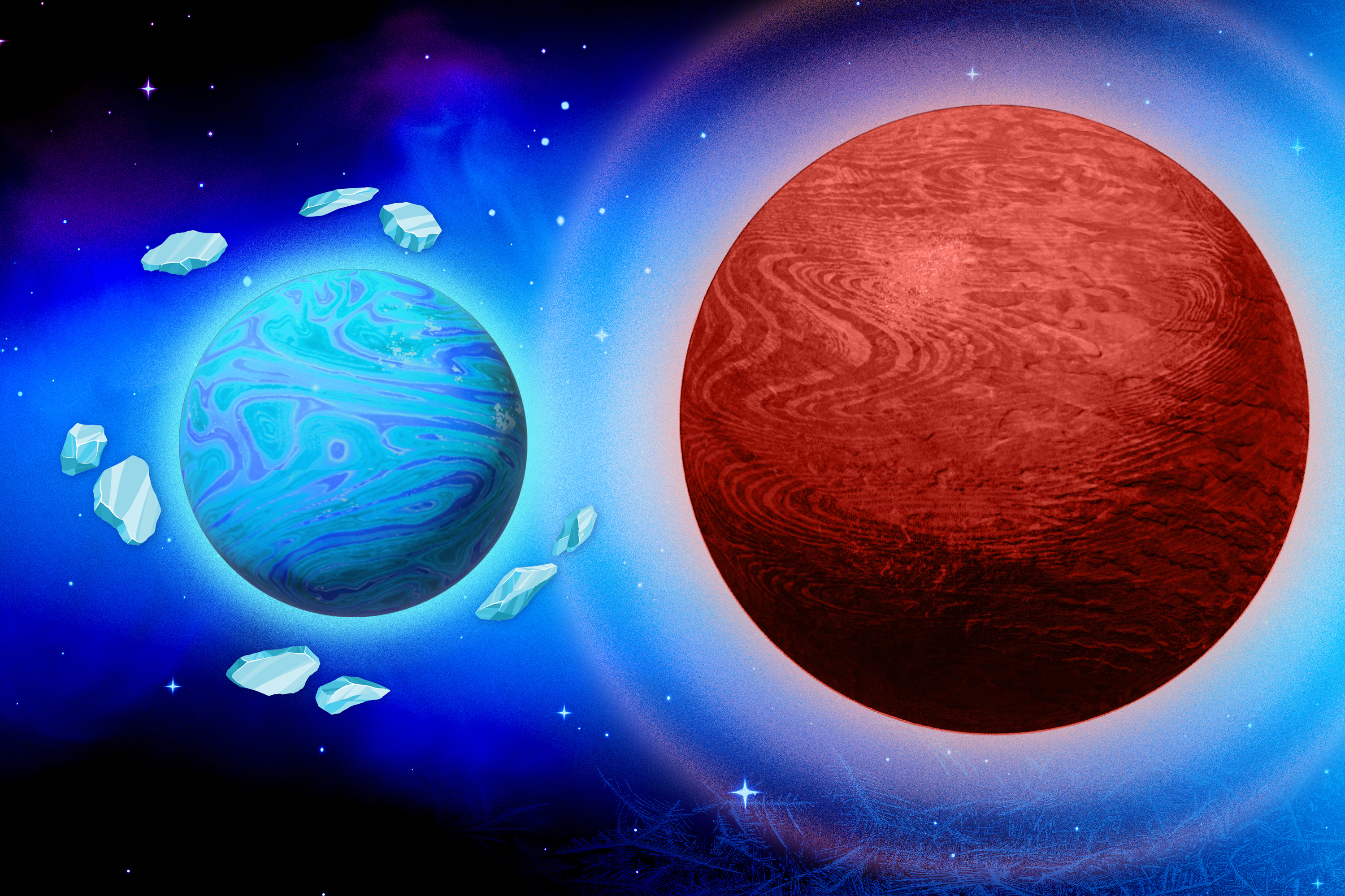
“Across the Milky Way galaxy, a planetary odd couple is circling a star some 190 light years from Earth. A normally “lonely” hot Jupiter is sharing space with a mini-Neptune, in a rare and unlikely pairing that’s had astronomers puzzled since the system’s discovery in 2020. Now MIT scientists have caught a glimpse into the atmosphere of the mini-Neptune, which is circling inside the orbit of its Jupiter-sized companion, and discovered clues to explain the origins of this unusual planetary system. In a study appearing today in Astrophysical Journal Letters , the scientists report on new measurements of the mini-Neptune’s atmosphere, made using NASA’s James Webb Space Telescope (JWST). It is the first time astronomers have measured the composition of a mini-Neptune that resides inside the orbit of a hot Jupiter. Their measurements reveal that the smaller planet has a “heavy” atmosphere that is rich with water vapor, carbon dioxide, sulfur dioxide, and hints of methane. Such a heavy atmosphere would not have been acquired by the planet if it had formed in its current location, very close to its star. Instead, the scientists say their findings point to an alternate origin story: Both the mini-Neptune and the hot Jupiter may have formed much farther away, in the colder region of the system’s early disk of protoplanetary material. There, the planets could slowly build up atmospheres of ice and other volatiles. Over time, the planets were likely drawn in toward the star in a gradual process that kept them close, with their atmospheres intact. The team’s results are the first to show that mini-Neptunes can form beyond a star’s “frost line.” This boundary refers to the minimum distance from a star where the temperature is low enough that water instantly condenses into ice. “This is the first time we’ve observed the atmosphere of a planet that is inside the orbit of a hot Jupiter,” says Saugata Barat, a postdoc in MIT’s Kavli Institute for Astrophysics and Space Research and the lead author of the study. “This measurement tells us this mini-Neptune indeed formed beyond the frost line, giving confirmation that this formation channel does exist.” The team consists of astronomers around the world, including Andrew Vanderburg, a visiting assistant professor at MIT, and co-authors from multiple other institutions including the Harvard and Smithsonian Center for Astrophysics, the University of South Queensland, the University of Texas at Austin, and Lund University. A “one-of-a-kind” system As their name implies, mini-Neptunes are planets that are less massive than Neptune. They are considered to be gas dwarfs, which are made mostly of gas, with an inner, rocky core. Mini-Neptunes are the most commonly found planet in the Milky Way, though, interestingly, no such world exists in our own solar system. Astronomers have observed many planets circling a wide variety of stars in a range of planetary systems. Mini-Neptunes, then, are generally considered to be garden-variety planets. But in 2020, Chelsea X. Huang, then a Torres Postdoctoral fellow at MIT (now on the faculty at University of South Queensland), discovered a mini-Neptune in a rare and puzzling circumstance: The planet appeared to be circling its star with an unlikely companion — a hot Jupiter. The astronomers made their discovery using NASA’s Transiting Exoplanet Survey Satellite (TESS). They analyzed TESS’ measurements of TOI-1130, a star located 190 light years from Earth, and detected signs of a mini-Neptune and a hot Jupiter, orbiting the star every four and eight days respectively. “This was a one-of-a-kind system,” says Huang. “Hot Jupiters are ‘lonely,’ meaning they don’t have companion planets inside their orbits. They are so massive, and their gravity is so strong, that whatever is inside their orbit just gets scattered away. But somehow, with this hot Jupiter, an inner companion has survived. And that raises questions about how such a system could form.” A spot-on snapshot The 2020 discovery of TOI-1130 and its odd planetary pair inspired Huang, Vanderburg, and their colleagues to take a closer look at the planets, and specifically, their atmospheres, with JWST. In its new study, the team reports its analysis of TOI-1130b — the inner-orbiting mini-Neptune. Catching the planet at just the right time was their first challenge. Most planets circle their star with a regular, predictable period, like the tick of a clock. But the mini-Neptune and the hot Jupiter were found to be in “mean motion resonance,” meaning that each can affect the other’s motion, pulling and tugging, and slightly varying the time each takes to orbit their star. This made it tricky to predict when JWST could get a clear view. The team, led by Judith Korth of Lund University, assembled as many past observations of the system as they could, and developed a model to predict when each planet would pass by the star at an angle that JWST could observe. “It was a challenging prediction, and we had to be spot-on,” Barat says. In the end, the team was able to catch a direct and detailed snapshot of both planets. “The beauty of JWST is that it does not observe just in one color, but at different colors, or wavelengths,” Barat explains. “And the specific wavelengths that a planet absorbs can tell you a lot about the composition of its atmosphere.” From JWST’s measurements, the team found that the planet absorbed wavelengths specifically for water, carbon dioxide, sulfur dioxide, and to a lesser degree, methane. These molecules are heavier than hydrogen and helium, which constitute lighter atmospheres. Astronomers had assumed that, if mini-Neptunes formed very close to their star, they should have light atmospheres. But the team’s new results counter that assumption and offer a new way that mini-Neptunes could form. Since heavier molecules were found in the atmosphere of TOI-1130b, which resides very close to its star, the scientists say the only possible explanation for its composition is that the planet formed much farther out than its current location. The planet likely accumulated its heavy atmosphere of water and other volatiles such as carbon dioxide and sulfur dioxide in the icy region beyond the star’s frost line. In this much colder environment, water condenses onto bits of dust to form icy pebbles, which an infant planet can draw into its atmosphere. The water evaporates as it slowly migrates in closer to its star. Barat says the team’s detection of heavy molecules in the atmosphere of TOI-1130b confirms that the planet — and likely its hot Jupiter companion — formed in the outskirts of the system. Through gradual migration, the two planets would be able to stay close together and keep their atmospheres intact. “This system represents one of the rarest architectures that astronomers have ever found,” Barat says. “The observations of TOI-1130b provide the first hint that such mini-Neptunes that form beyond the water/ice line are indeed present in nature.” This work was supported, in part, by NASA.
Original story
Continue reading at MIT News
news.mit.edu
Summary generated from the RSS feed of MIT News. All article rights belong to the original publisher. Click through to read the full piece on news.mit.edu.
