
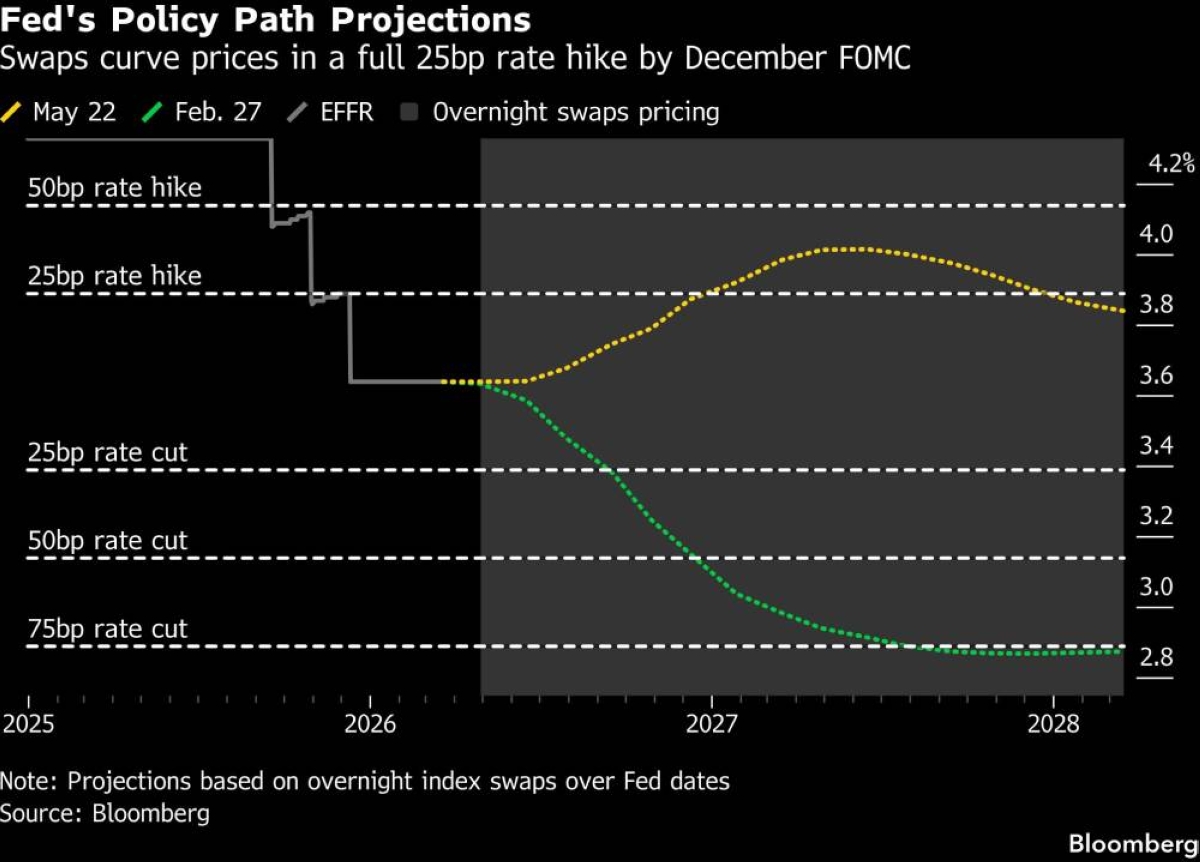
“Bond traders are fully pricing in an interest-rate hike by the Federal Reserve this year, a sign of conviction in the market that Chair Kevin Warsh will need to move quickly to combat inflation. Traders boosted their bets for higher rates on Friday after Fed Governor Christopher Waller — among the most dovish policymakers over the past year — said that based on the inflation trend, the central bank’s next policy statement should “make it clear that a rate cut is no more likely in the future than a rate increase.” Interest-rate swaps repriced to levels anticipating that the Fed’s target range for its benchmark rate — 3.50%-3.75% since December — will be at least 25 basis points higher by the end of 2026, the first time such an outcome has been fully priced. Waller’s comments halted a Treasury market rally, lifting the two-year note’s yield as much as six basis points to 4.14%, the highest level since February 2025. The US dollar rose. “Waller’s latest remarks confirm the hawkish shift at the Fed,” Evercore ISI head of economics and central bank strategy Krishna Guha said in a note. “His discussion of inflation was across the board hawkish.” The shift gathered pace at the most recent policy meeting in April, when three voters on the Federal Open Market Committee voted against the statement announcing the decision to hold rates steady because it also signaled that that the next move still could be a rate cut. The dissenters favored a statement that didn’t mention the possibility of a cut. That was the course that Waller — who dissented from two Fed decisions to hold rates steady in the past year in favor of cutting them — backed in his speech. Short-term interest rate markets fully pricing in a Fed rate increase is a complete turnaround from earlier this year, when President Donald Trump’s selection of Warsh — who was sworn in as the 17th Fed chair in a White House ceremony Friday — inspired Wall Street to bet on at least two quarter-point rate cuts in 2026. Traders began re-calibrating those wagers after the US and Israel attacked Iran in late February. The resulting effective closure of the Strait of Hormuz disrupted Middle East oil exports, causing gasoline prices to surge. That has led to higher actual and expected inflation rates which, feeding through to other parts of the economy, could force a response from central banks. Sharp increases in energy and food prices in April drove a 3.8% year-on-year increase in the US consumer price index, the biggest since 2023. In the months leading up to his nomination, Warsh had criticised the Fed for not lowering rates enough and pointed to longer-term dynamics in the economy — namely an expected boom in productivity growth connected to artificial intelligence — that might justify cuts. But he hasn’t aired his policy views in many weeks. During his confirmation hearing on April 21, lawmakers failed to press him for his near-term views on interest rates. While Trump at the swearing-in ceremony said Warsh should act independently, repeating a comment made earlier this week, as recently as last month he said he’d be disappointed if Warsh didn’t lower rates immediately upon taking the job. The Fed’s next scheduled monetary policy announcement is on June 17, when policymakers are expected to hold rates steady. Minutes of the Fed’s April meeting released this week showed a majority of officials said the central bank would likely need to consider raising rates if inflation continued to run persistently above their 2% target. Concurrently with Waller’s comments, a consumer sentiment survey by the University of Michigan showed that inflation expectations mounted in May. While they remain short of their 2025 highs, respondents’ expectations for inflation over the coming year and over the next five to 10 years increased more than anticipated, to 4.8% and 3.9% respectively. Treasury yields were near session lows just before Waller spoke, with the five- to 30-year tenors the lowest in a week. Signs that Iran and the US are close to a peace agreement provided a catalyst for investors to lock in yields near multiyear highs. The US 30-year rate rose to 5.20% this week for the first time since 2007. It retreated to 5.06% Friday. UK, German and Japanese 30-year yields also reached multiyear highs. While previous indications that a lasting agreement was imminent haven’t panned out, the potential for developments over the US three-day holiday weekend was a factor. US bond trading had an early close at 2 pm New York time, and Treasury futures contracts settled at 1 pm, two hours earlier than normal. “While the two sides appear to be a meaningful distance apart in their respective demands, the fact that there is an ongoing dialogue offers some solace,” said Ian Lyngen, head of US interest-rate strategy at BMO Capital Markets in New York. “There is significant event risk in the Middle East as we head into the long weekend.”
Original story
Continue reading at Gulf Times Qatar
www.gulf-times.com/qatar
Summary generated from the RSS feed of Gulf Times Qatar. All article rights belong to the original publisher. Click through to read the full piece on www.gulf-times.com/qatar.
