
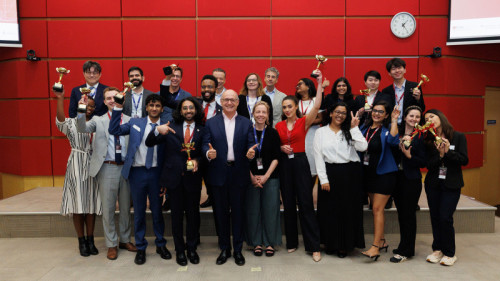
“Policy challenges today rarely stop at national borders, and are becoming harder to solve as polarisation, geopolitical tensions and declining institutional trust loom. Against this backdrop, the Lee Kuan Yew School of Public Policy (LKYSPP) hosted the Global Public Policy Network (GPPN) Conference 2026 on 27 and 28 March, bringing together representatives from eight leading public policy schools to propose innovative solutions to contemporary global challenges while strengthening institutional and personal connections. The annual conference serves as both a rigorous academic competition and a vital networking platform for the GPPN schools, which comprise LKYSPP, Columbia University’s School of International and Public Affairs (SIPA), Fundacao Getulio Vargas’s Sao Paulo School of Business Administration (FGV EAESP), the Hertie School, the London School of Economics and Political Science (LSE), Sciences Po’s School of Public Affairs, University of Tokyo’s Graduate School of Public Policy (GraSPP) and the University of Toronto’s Munk School. A total of 92 student delegates, along with deans and faculty, gathered at the 2026 edition, themed “Reimagining Policy in a Fragmented World”. Participants were challenged to design effective policies that bridge political, cultural, economic and technological divides across the globe, from Europe to Asia, and from Africa to America. The proposals spanned a diverse array of pressing issues, such as education, healthcare, ageing populations, artificial intelligence, transportation and environmental sustainability. Keeping people at the heart of policy Book-ended by the two rounds of competition was an insightful dialogue session on the policy solutions required in an increasingly fragmented world, featuring some of the respected policy academics who served as competition judges. The GPPN Roundtable took place at the end of Day 1 and was moderated by Associate Professor Francesco Mancini, Vice Dean of Executive Education at LKYSPP. He was joined by Professor Andrés Velasco, Dean of the School of Public Policy at LSE; Professor Daiji Kawaguchi, Dean of the Graduate School of Public Policy at UTokyo; Professor Randall Hansen, Director of International Partnerships at the Munk School; and Professor Thurid Hustedt, Dean of Graduate Programmes at the Hertie School. The panellists discussed the root causes of global fragmentation and emphasised that modern policy must address the emotional and identity-based drivers of public sentiment alongside economic factors. Instead of "one-size-fits-all" economic models centred on deregulation, they suggested that state capacity and human dignity should be the new metrics of success to support "left-behind" regions. This reimagining is particularly urgent given that contemporary divides are now cognitive as much as they are geopolitical; the panel noted that digital echo chambers have fractured our shared reality, making evidence-based policy harder to implement without first accounting for how personal values and group belonging shape political polarisation. Ultimately, the session underscored that in a world of declining trust, the survival of global cooperation depends on building lasting international connections and developing the conversational skills necessary to bridge competing worldviews. Innovative solutions to complex challenges After the first round of presentations, the field of 30 competing teams was narrowed down to just eight that proceeded to the Grand Finale on Day 2 of the conference. They presented their detailed solutions to a distinguished panel of judges from each of the eight member schools, witnessed by the entire assembly of student delegates, deans, and faculty. Bongani Masilela and Muawiya Mahomed from LSE claimed top honours with a comprehensive policy proposal aimed at reforming public transportation in Johannesburg, South Africa. Central to their plan is the Taxi Integration Act 2026, which seeks to formalise the sector through a state agency that operates electric minibus fleets while integrating taxi, bus and rail services via unified ticketing and route optimisation. To safeguard these reforms, the proposal also included establishing a Commission of Inquiry to dismantle organised crime and protect witnesses within the transport industry. Two teams tied for second place, with Team LKYSPP recognised for its proposal to implement safe abortion access within public health systems in Kerala, India, alongside the team from UTokyo GraSPP, which proposed a digital-business skill exchange between local youth and elderly business owners in Morioka City, Japan. The Munk School secured third place with a forward-looking initiative that could empower citizens with a tool to distinguish authentic reality from AI-generated imagery. Projects were evaluated based on the depth of their problem analysis, the feasibility and strength of their proposed solutions, and a detailed implementation strategy. Beyond the immediate impact, judges also weighed the long-term sustainability of the ideas alongside the overall quality of the presentation. While the conference’s competition format was demanding, participants experienced a sense of mutual support and camaraderie that made it enjoyable, said Lariba Ashfaq, who is pursuing a master’s in public policy at LKYSPP. “The support we shared, despite the fact that we were in a competition, was just so overwhelming and also very heartwarming,” she said. Ultimately, the event demonstrated that even within a competition, the core mission of public policy continues to be a collaborative effort toward uplifting society. As Professor Velasco said succinctly during the conference, “When public policy is bad, people's lives are bad. When public policy is good, we have a chance at prosperity and a chance at happiness.” By the Lee Kuan Yew School of Public Policy
Original story
Continue reading at NUS Newsroom
news.nus.edu.sg
Summary generated from the RSS feed of NUS Newsroom. All article rights belong to the original publisher. Click through to read the full piece on news.nus.edu.sg.


