
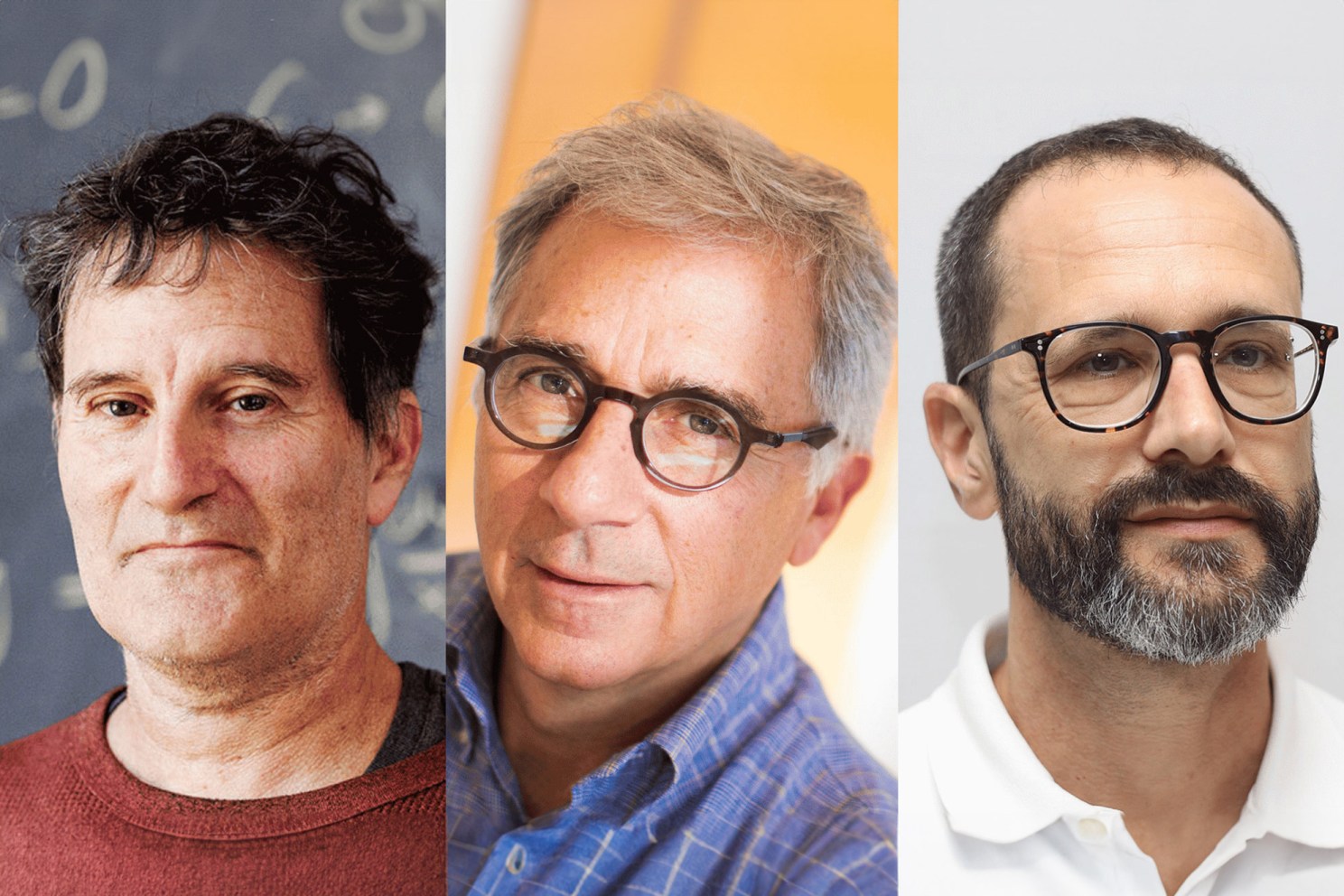
“Campus & Community Catalyst Professorship fosters collaboration with the private sector Michael Brenner, Doug Melton, and Boaz Barak. Harvard file photos (left and center) Jessica McCann Harvard Correspondent May 6, 2026 8 min read New part-time role allows leading faculty to pursue industry employment alongside academic work Seeking to enhance relationships between academia and industry, the Office of the Provost in 2024 introduced the Catalyst Professorship: a distinguished senior faculty role aimed at fostering collaboration with the private sector. Three prominent Harvard faculty have now been appointed Catalyst Professors: Doug Melton, a stem cell scientist; Boaz Barak, a theoretical computer physicist; and Michael Brenner, a scholar of applied mathematics. “The Catalyst Professorships offer an important new approach to supporting academic excellence,” said President Alan M. Garber. “They acknowledge the ambitions of outstanding faculty who seek to drive progress across many fronts as they contribute to the fulfillment of our mission. Doug, Boaz, and Michael are distinguished teachers and researchers who have long inspired Harvard students and scientists. I am eager to see what they achieve in their new roles.” “The Catalyst Professorship provides a terrific, innovative model for making our research ecosystem more porous and collaborative,” said provost John F. Manning. “The three distinguished inaugural professors provide an extraordinary proof of concept.” “As the first opportunity of its kind at Harvard, the Catalyst Professorship offers a unique arrangement for exceptionally distinguished faculty to engage in external opportunities while maintaining their teaching commitments and contributions to Harvard’s academic mission,” said Judy Singer, senior vice provost for faculty. The professorship is open to individuals of the highest academic distinction who have demonstrated excellence, experience, and integrity as researchers, teachers, mentors, and University contributors. It is open to all disciplines, including emerging areas such as artificial intelligence, biotechnology, renewable energy, and quantum technologies, where alliances between academia and industry are especially critical for advancing research and addressing global challenges. Catalyst Professors will not only further scientific exploration but also prepare students for success in a rapidly evolving professional landscape. “This professorship is truly a groundbreaking opportunity that has the potential to lower the barriers between academic insight and industry innovation, positioning Harvard for even greater real-world impact across disciplines,” said senior vice provost for research John Shaw. “I look forward to welcoming more Catalyst Professors over time who will further advance academic scholarship and teaching toward societal impact.” Learn more about Harvard’s three Catalyst Professors below. Doug Melton Melton, who has been the Xander University Professor and co-director of the Harvard Stem Cell Institute (HSCI), was appointed a Catalyst Professor in 2024. In addition to his teaching and research at Harvard, he is a distinguished research fellow at Vertex Pharmaceuticals. “I am very grateful to Harvard and Vertex for this special opportunity, one which recognizes the shared interests in teaching, advancing science, and developing new medicines,” said Melton. “Connecting these and similar institutions in the Boston biomedical ecosystem has the potential to significantly advance discoveries for patients and benefit student education.” Melton’s career has been marked by groundbreaking contributions to diabetes research, following the diagnosis of own children, Sam and Emma, with Type 1 diabetes. Through his pursuit of a cure for Type 1 diabetes, Melton became a leader in the field of embryonic stem cell research. In 2001, his lab created a series of human stem cell lines and distributed them free of charge to scientists pursuing research around the world; in 2008, he and colleagues made major discoveries in reprogramming embryonic stem cells into different types of cells. In 2014, his team produced for the first time large quantities of functional pancreatic islets that contained beta cells making human insulin. He founded Semma Therapeutics — named for his children, and acquired by Vertex in 2016 — to advance the therapy. Prior to his current appointment as Catalyst Professor, Melton held faculty appointments at Harvard Medical School and within the Faculty of Arts and Sciences. He founded and co-chaired what would become the first cross-School department, between HMS and FAS, the Department of Stem Cell and Regenerative Biology. He and his wife, Gail, also served as Eliot House faculty deans for 10 years. Melton earned his bachelor’s degree in biology from the University of Illinois. As a Marshall Scholar, he earned a B.A. in history and philosophy of science at Cambridge University and a Ph.D. in molecular biology at Trinity College and the MRC Laboratory of Molecular Biology. He was also an Investigator of the Howard Hughes Medical Institute, a founder of Gilead Sciences, and a scientific advisory board member of several biotech companies. Boaz Barak Barak, who has been a professor of computer science at the Harvard John A. Paulson School of Engineering and Applied Sciences (SEAS), was appointed a Catalyst Professor in fall 2025. Barak balances his Harvard work with a role on the technical staff at OpenAI, where he works on safety and alignment in artificial intelligence and machine learning. “These are both exciting and daunting times when it comes to artificial intelligence,” said Barak. “I value the opportunity to combine industry and academic perspective, and in particular, to use this learning to teach AI safety to extremely talented and motivated Harvard students.” Barak’s research broadly explores theoretical computer science, with a particular focus on cryptography, algorithms, computational complexity, quantum computing, and machine learning. Recently, he has focused on the foundations of machine learning, seeking to understand the capabilities and limitations of deep learning systems based on the resources they have access to and the best ways of building safety mechanisms into artificial intelligence systems. In addition to his work as a professor and at OpenAI, Barak is a member of the Harvard SEAS Theory of Computing Group and the Harvard Machine Learning Foundations Group. He is an associate faculty member at the Kempner Institute for the Study of Natural and Artificial Intelligence and a member of the Committee on Admissions and Financial Aid in Harvard College, and he was a member of Harvard’s Presidential Task Force on Combating Antisemitism and Anti-Israeli Bias. He served on the editorial boards of the Theory of Computing Journal and the Electronic Colloquium of Computational Complexity and on the scientific advisory boards for Quanta Magazine and the Simons Institute for the Theory of Computing. He is a board member and co-organizer of AddisCoder and JamCoders, nonprofit organizations dedicated to teaching algorithms and coding to high-school students in Ethiopia and Jamaica. Prior to his time at Harvard, Barak worked as a principal researcher at Microsoft Research New England and an associate professor at Princeton University. He holds a B.Sc. in mathematics and computer science from Tel Aviv University and a Ph.D. in computer science from the Weizmann Institute of Science, and he completed a postdoctoral fellowship in mathematics at the Institute for Advanced Study in Princeton, N.J. Michael Brenner Brenner, who has been the Michael F. Cronin Professor of Applied Mathematics and Applied Physics and professor of physics at SEAS, was appointed a Catalyst Professor in fall 2025. He also works as a principal scientist at Google Research, where he leads Science AI. “Rapid changes in generative artificial intelligence have deep implications for accelerating scientific research but also have deep implications for the way we teach and what students need to learn,” said Brenner. “Having a foot both in industry and academia makes it possible to be at the vanguard of this transformation, bringing these lessons to our students with a unique perspective.” Brenner’s research uses applied mathematics principles to address real-world problems in science and engineering. His lab explores a range of topics where applied mathematics can help explain or predict the behavior of complex systems. Areas of focus include self-assembly, or how simple components with programmable interactions can reliably organize into complex structures — and, building on these principles, the emerging field of molecular computing, which uses machine learning and engineering advances to design molecular systems that can solve complex computational issues. His lab has also focused on turbulence and fluid mechanics, looking at various phenomena such as the movements of atmospheric molecules, the aerodynamics of whale flippers, and the splashing of water droplets to understand and establish theoretical mathematical principles. He co-developed “Science and Cooking: From Haute Cuisine to Soft Matter Science,” which explores the scientific phenomena behind the cooking process and has become a wide-reaching online course. His work at Google Science as an applied mathematician focuses on exploring the interface between machine learning and science. Brenner holds a B.Sc. in physics and mathematics from the University of Pennsylvania and a Ph.D. in physics from the University of Chicago. Prior to joining Harvard in 2002, he held a faculty position in mathematics at MIT.
Original story
Continue reading at Harvard Gazette
news.harvard.edu
Summary generated from the RSS feed of Harvard Gazette. All article rights belong to the original publisher. Click through to read the full piece on news.harvard.edu.

