
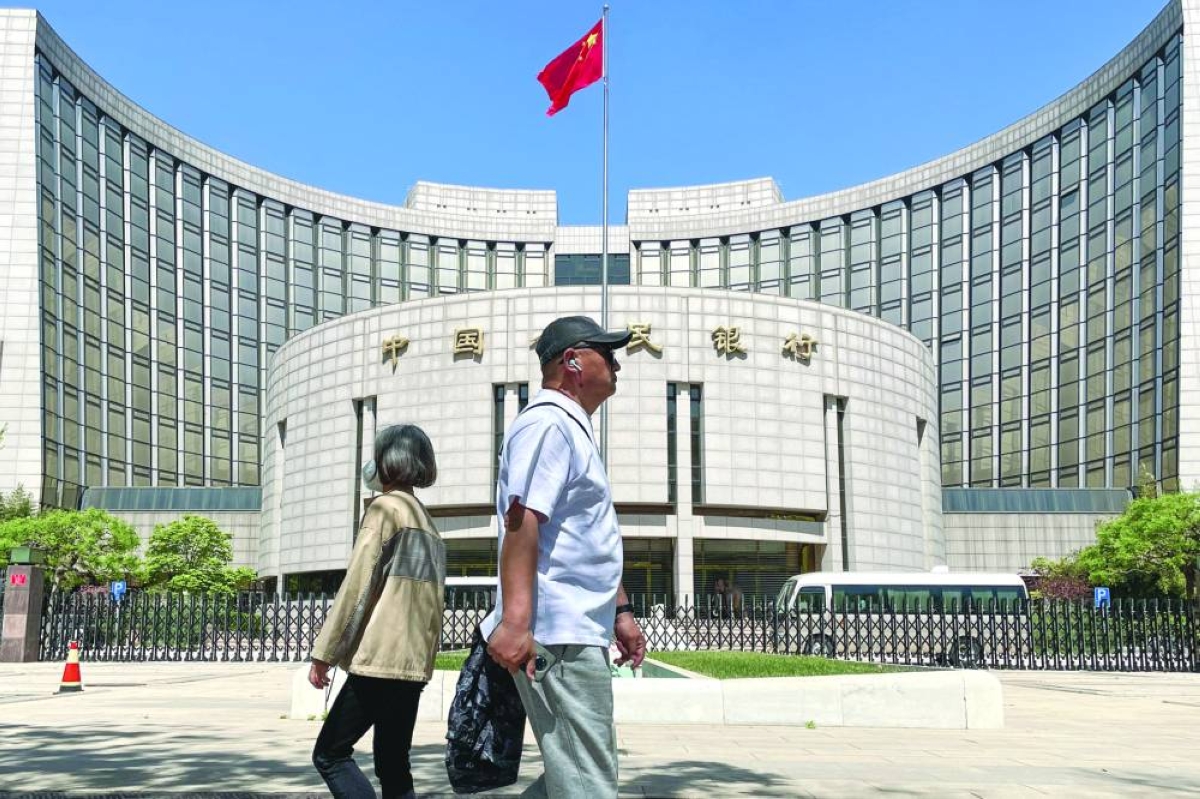
“China’s credit expansion slowed far more than expected from a year earlier in April while banks extended less new loans, underscoring unusually anemic borrowing demand even for a typically slow month for lending. Aggregate financing, a broad measure of credit, increased less than 630bn yuan ($93bn) in April, according to Bloomberg calculations based on data released by the People’s Bank of China on Thursday, compared with an expansion of 1.2tn yuan a year ago. That was about half of the median forecast of almost 1.3tn yuan by economists in a Bloomberg survey. New loans contracted 15.3bn yuan in the month, versus a median forecast of an increase of 300bn yuan. Chinese households net repaid 786.9bn yuan, the most since comparable data going back to 2010. Loan extension usually weakens in April, part of a seasonal pattern after banks rush to meet their credit targets at the end of the first quarter. Still, the rare lending decline points to soft credit demand, sparking concern that a recent pickup in investment in the world’s second-largest economy might be short-lived. “The contraction means the end of fixed-asset investment rebound,” said Zhaopeng Xing, senior China strategist at ANZ Bank China Co. “With no investment expansion, domestic demand will remain subdued,” he said, forecasting the slowdown in credit growth this year to keep the bond market bullish. As the job market deteriorated in early 2026, households remained cautious about borrowing money despite some recent improvement in the property market. Medium and long-term loans taken by Chinese households, a proxy for mortgages, dropped about 341bn yuan in April, and short-term borrowing by the sector also fell 446bn yuan. “The credit data suggests the new housing loan demand was more than offset by repayment,” said Ding Shuang, chief economist for Greater China and North Asia for Standard Chartered Plc. The signs of stabilisation in top tier cities only reflect “a small portion of the national market,” he added. “Also it seems it is not feasible to boost consumer demand by encouraging households to take more loans,” he said. Government financing made up the bulk of credit expansion in April. Net bond financing by the government increased 904bn yuan. Low yields and a stock market rally drove more companies to switch from borrowing from banks to direct financing. Corporate bond and equity financing rose decently last month, while bank loans and shadow banking tools such as undiscounted bankers acceptances contracted. China’s central bank on Monday warned on the risks of imported inflation from higher oil prices stemming from the war in Iran, offering no hint of preparing to ease policy as it looks to ensure its low policy rates trickle through the economy while reasonable profit margins at banks are maintained. That said, the PBoC will likely keep liquidity ample and allow short-term money market rates running slightly below policy rate given the weak domestic demand, Ding said.
Original story
Continue reading at Gulf Times Education
www.gulf-times.com/community/education
Summary generated from the RSS feed of Gulf Times Education. All article rights belong to the original publisher. Click through to read the full piece on www.gulf-times.com/community/education.
