
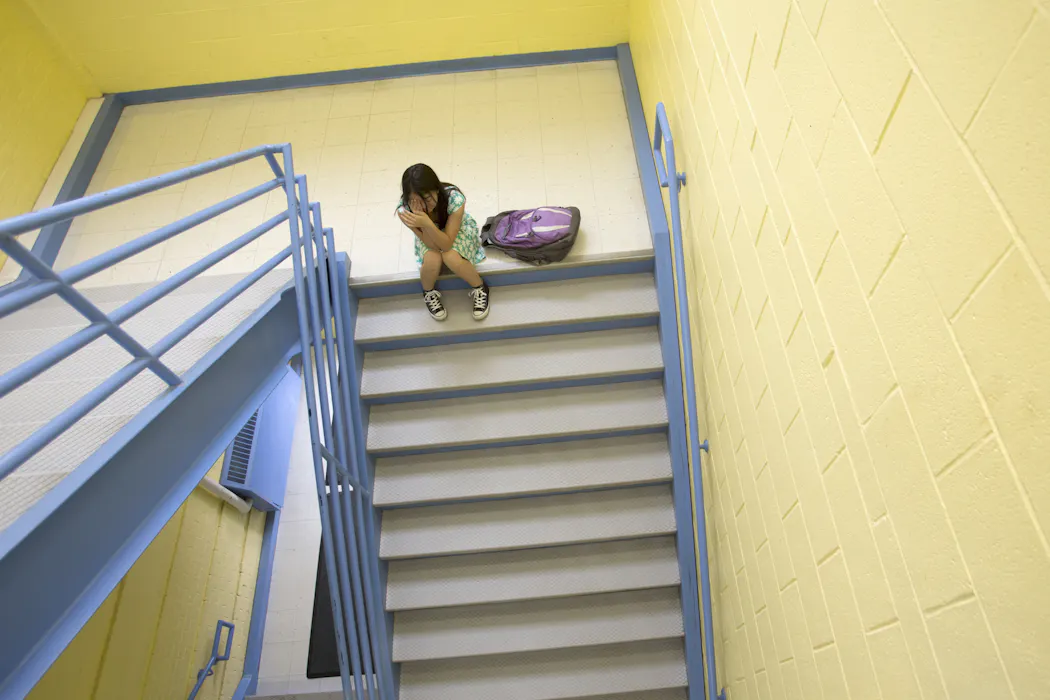
“Many Chinese and Chinese American students do not seek the mental health care they might need, sometimes because of stigma. Jonathan Kirn/The Image Bank/Getty Images She has straight A’s, a full schedule of Advanced Placement classes, a chair in the youth orchestra and a bedroom wallpapered with college acceptance letters. She also hasn’t slept a full night in months. She lies awake at 2 a.m., convinced she is a burden to her family – and she has no idea how to tell anyone. I know students like this. My niece – a teenager who was quiet, hardworking and by every outward measure doing well – was one of them. During the first year of the COVID-19 pandemic, she died by suicide. Her family was not aware she was depressed, no one at her school had raised a concern, and she never sought any mental health support. After her death, I began asking different questions – not only as a family member, but also as an educator and researcher. Between 2023 and 2025, I interviewed 11 Chinese immigrant parents living in the U.S. about how they understood their children’s mental health and why many families avoid mental health services, even when their children are struggling . The parents I interviewed for my doctoral dissertation at Cleveland State University were not indifferent to their children’s suffering or overall well-being. They were navigating mental health through a different framework – one shaped by deeply held, traditional Chinese beliefs about family honor and self-control. Often, they didn’t have the language and understanding to easily discuss mental health openly. Schools could adapt their mental health and counseling services to make sure they are connecting with Chinese immigrant families and other families from different cultures. Raul Ortin/Moment/Getty Images When distress has no name While many immigrant teenagers are vulnerable to mental health challenges , Chinese and Chinese American teenagers whose parents are immigrants experience higher rates of anxiety and depression than many of their peers . Suicide rates among Asian American girls age 10 to 19, meanwhile, have more than doubled over the past two decades . Despite this escalating crisis, a massive treatment gap persists among youth: Only about 10% of Asian American college students and adolescents experiencing emotional distress seek professional help . This leaves the vast majority of these students to struggle silently, because of stigma, academic pressure and fear of their parents’ response if they seek help . Many Chinese immigrant families I spoke with did not use labels people in the West might use, like depression or anxiety, to describe emotional distress. Chinese and Chinese American children and teenagers struggling with mental health challenges might say they are tired, for example. Chinese immigrant parents often only see their children’s physical symptoms, like headaches or loss of appetite. Neither the child nor the parent has the vocabulary to connect what they are seeing to depression or anxiety – and the school sends home an English-language brochure that no one reads. In tight-knit immigrant communities where reputation matters and word travels fast, admitting that a child is struggling can feel like broadcasting the family’s failure to everyone who knows them . One parent in my study told me in 2024: “Chinese parents care a lot about ‘face.’ If something is positive, they want the whole world to know; but if it’s negative, they would prefer to hide or cover it up. Even if they are facing an issue, they are unlikely to seek help publicly.” Another Chinese parent described how the words “mental illness” are heard in her community: “If someone has even a minor mental issue, others think they’re not normal and may discriminate, or even gossip about it. ‘Mental illness’ is often used as an insult.” My research, in the process of publication, also found that many parents missed the warning signs of a child’s mental health deterioration entirely – not because they were not watching, but because they did not know what they were looking for. Many described a “wait and see” approach, assuming that teenage stress was temporary and that the child would grow out of it. One Chinese father, an elementary school teacher who had a 21-year-old son, described what he observes in his community: “Most parents want to protect their child and believe their child is normal. Often parents just hope to get through the day — they think if the child acts up, it’s nothing, it’ll pass. A lot of days just pass by, and these issues get ignored.” One mother in my study shared a story that has stayed with me. A teenage boy in her community jumped from a building on the first day of school because he could not turn in a homework assignment. He survived. Later, his mother realized she had missed warning signs for years, mistaking his exhaustion and withdrawal for laziness. As my participant explained: The boy’s mother “used to think he was just lazy or unmotivated. But in reality, he had no energy — he was deeply lacking motivation. Her philosophy was ‘diligence can make up for lack of talent,” this other parent described. What schools get wrong Schools are one place to intervene in identifying and supporting students with mental health needs. Some parents in my study described supportive teachers who reached out with genuine compassion when they noticed a student pulling away or struggling. Far more encountered counselors who did not understand the family’s cultural context, sent home materials only in English or treated behaviors that were entirely normal within a Chinese household, like a child avoiding eye contact or expressing disagreement through silence rather than words, as a cause for concern . When a school’s entire approach to student mental health is built around the expectation that students will name their feelings directly and families will welcome a clinical referral, it may feel foreign – and therefore unsafe – to many Chinese American families. I think that real progress on supporting Chinese American youth mental health requires a few things: First, states with growing Chinese immigrant and Chinese American populations could fund bilingual, bicultural mental health services. Screening tools used in schools could recognize what might be a cultural way to express distress in Chinese culture, not only through the self-reporting language of Western psychiatry. Second, I think that schools could invest in bilingual family liaison roles within counseling teams – not just translators of paperwork, but genuine bridges between two worlds. Mental health systems could build formal partnerships with the community institutions that families already trust: Chinese-language churches, cultural organizations and community centers. My niece was celebrated for her grades, her discipline and her quiet reliability. What she needed was for someone to look past all of that and see how she was really doing. I cannot change what happened to my niece. But her death continues to shape my work – and my belief that schools, families and communities must learn to see young people more fully – not only for what they achieve, but for what they carry silently. If you or someone you know is considering suicide, the free and confidential 988 Suicide and Crisis Lifeline is available to call, text or chat. Huaying Wang does not work for, consult, own shares in or receive funding from any company or organization that would benefit from this article, and has disclosed no relevant affiliations beyond their academic appointment.
Original story
Continue reading at The Conversation US Education
theconversation.com/us/education
Summary generated from the RSS feed of The Conversation US Education. All article rights belong to the original publisher. Click through to read the full piece on theconversation.com/us/education.
