
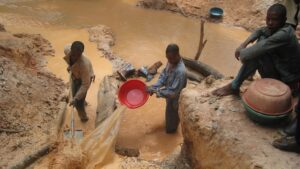
“The UN report has highlighted water as the most immediate and severe casualty of this global transition. Mining operations require vast quantities of water and often contaminate local sources. Credit: UNU-INWEH By Umar Manzoor Shah SRINAGAR, India, Apr 30 2026 (IPS) A newly released United Nations report has raised urgent concerns that the world’s push toward clean energy and digital technologies is driving a hidden crisis in some of the planet’s most vulnerable regions, where mining for critical minerals is depleting water supplies, damaging health, and deepening inequality. The report, Critical Minerals, Water Insecurity and Injustice , released by the United Nations University Institute for Water, Environment and Health ( UNU-INWEH) , warns that the race for minerals essential to electric vehicles, renewable energy, and artificial intelligence could replicate the injustices of the fossil fuel era. Demand for these minerals is expected to surge dramatically in the coming decades. According to the report, global demand could quadruple by 2050, with lithium, cobalt, and graphite seeing increases of up to 500 percent. These materials are indispensable for batteries, solar panels, and digital infrastructure. Prof. Kaveh Madani, UNU-INWEH Director who led the investigation team, says the world lacks an enforceable governance model for critical minerals. Credit: UNU-INWEH Prof. Kaveh Madani, UNU-INWEH Director who led the investigation team, told IPS News in an exclusive interview that the world is lacking an enforceable governance model for critical minerals. He said that without binding international agreements, laws, and policies, environmental and health costs—especially water depletion and pollution—are pushed onto mining regions, leaving affected communities without effective accountability or recourse. “The climate, energy, sustainability, and the so-called “green” policies are narrowly carbon-centric. Demand projections are driven by decarbonisation targets, but water security, health and WASH impacts are not hard constraints in transition planning. As a result, mineral extraction expands even in highly water-stressed regions,” Madani said. He added that the trade and industrial policies reinforce structural asymmetries and that high-income economies retain control over refining, manufacturing, finance, and intellectual property, while mineral-rich countries are locked into raw extraction with weak benefit-sharing. “Together, these failures reproduce inequality rather than delivering a just transition,” Madani told IPS. Communities in mining zones are increasingly described as “sacrifice zones”, areas where environmental degradation and human suffering are accepted as the cost of global progress. Credit: UNU-INWEH The report has further highlighted water as the most immediate and severe casualty of this global transition. Mining operations require vast quantities of water and often contaminate local sources. Producing just one tonne of lithium requires nearly 1.9 million litres of water . In 2024 alone, global lithium production consumed an estimated 456 billion litres, an amount equivalent to the annual domestic water needs of about 62 million people in sub-Saharan Africa. In Chile’s Salar de Atacama, one of the world’s richest lithium reserves, mining accounts for up to 65 percent of regional water use, intensifying shortages for local communities and farmers. Across the so-called Lithium Triangle, spanning Argentina, Bolivia, and Chile, groundwater levels are falling. The report cites evidence of declining water tables and disrupted ecosystems as brine extraction alters underground water systems. “Everyone needs money. But everyone also needs the basics, like water,” a resident in Bolivia’s Uyuni region is quoted as saying in the report. Cases of Birth Defects, Miscarriages, and Chronic Illnesses Toxic chemicals and heavy metals released during extraction often seep into rivers, soil, and groundwater. The report documents widespread pollution in mining regions such as the Democratic Republic of the Congo, where cobalt extraction is concentrated. In some areas, rivers have turned highly acidic, with pH levels below 4.5, rendering water unsafe for drinking and agriculture. Health impacts are severe. In communities near mining sites, 72 percent of respondents reported skin diseases, while more than half of women reported gynaecological problems. Prolonged exposure to contaminated water has also been linked to cases of birth defects, miscarriages, and chronic illnesses. Children are particularly vulnerable. Studies cited in the report show higher rates of congenital abnormalities in areas close to mining activity, along with increased risks of developmental disorders. “These are not isolated cases. They reflect systemic health disparities driven by environmental exposure,” reads the report. Who Benefits and Who Pays? Beyond health, water scarcity and pollution are undermining traditional livelihoods. Farming, fishing, and livestock rearing are becoming increasingly difficult in mining regions. In Bolivia, lithium extraction has reduced water availability for quinoa farming, a staple crop. In parts of Africa, declining fish populations have resulted from river contamination, which has cut off a key source of food and income. In some cases, mining operations displace entire communities. Indigenous populations, whose lands often contain mineral reserves, are among the hardest hit. The report estimates that more than half of critical mineral projects are located on or near Indigenous territories . A main finding of the report is the imbalance between who benefits and who pays the price. While extraction largely occurs in the Global South, the economic and technological gains are concentrated in wealthier nations. Countries rich in minerals often lack the infrastructure and capacity to process them, limiting their role to low-value extraction. In the Democratic Republic of the Congo, which produces over 60 percent of the world’s cobalt, more than 70 percent of the population lives on less than $2.15 a day. Meanwhile, the profits flow to multinational corporations and industrial economies that dominate refining and manufacturing. The report describes this dynamic as a “structural sustainability paradox,” where the environmental benefits enjoyed in developed countries are effectively subsidised by ecological and social harm in poorer regions. Experts warn that the current trajectory could repeat patterns seen in the fossil fuel industry. “The clean energy transition is not automatic. Without deliberate policy intervention, it can reproduce extractive colonialism under a new label,” the report states. Communities in mining zones are increasingly being described as “sacrifice zones”, areas where environmental degradation and human suffering are accepted as the cost of global progress. The report has recommended stronger international regulations, mandatory environmental standards, and greater transparency in supply chains. It also urges investment in recycling and circular economy models to reduce reliance on new mining, as well as the adoption of technologies that use less water. Crucially, it emphasises the need to include local communities in decision-making and ensure they benefit from resource extraction. “Achieving climate goals must not come at the expense of those least equipped to bear the costs,” the report reads. Dr Abraham Nunbogu, UNU-INWEH scientist and the report’s lead author, says legally allocating a share of mineral revenues to water infrastructure, health systems, skills training, and downstream industrial capacity is crucial. Credit: UNU-INWEH Strategic Policy Needed Dr Abraham Nunbogu , a UNU-INWEH scientist and the report’s lead author, told Inter Press Service that a practical step to move up the value chain and keep more economic benefits is a strategic industrial policy: using export conditions, licensing, or joint-venture requirements to promote local refining, processing, and manufacturing. “Second, benefit-sharing and reinvestment mandates: legally allocating a share of mineral revenues to water infrastructure, health systems, skills training, and downstream industrial capacity. Third, regional value-chain cooperation: pooling resources across neighbouring countries to achieve economies of scale in processing and manufacturing that individual countries cannot reach alone,” Nunbogu said. He added that the final step would be to address power imbalances by linking mineral access to ethical sourcing standards and technology transfer obligations in trade agreements. IPS UN Bureau Report Follow @IPSNewsUNBureau
Original story
Continue reading at IPS Africa
www.ipsnews.net/news/regional-categories/africa
Summary generated from the RSS feed of IPS Africa. All article rights belong to the original publisher. Click through to read the full piece on www.ipsnews.net/news/regional-categories/africa.


