
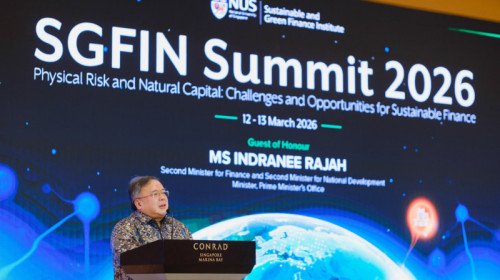
“Just a few years ago, the COVID-19 pandemic turned our lives upside down as Singapore and the world fought to stop the spread of the deadly virus. The following months and years tested the resilience of each country, revealing the importance of tangible and intangible resources like financial reserves, diplomatic goodwill, social capital and trust in government institutions. The pandemic holds lessons for dealing with climate-related crises, with one key difference: as climate change progresses, some of the long-term shifts will be irreversible, like species loss and sea level rise. Resilience will mean not just weathering immediate shocks for an eventual return to normal, but dealing with an altered reality. The need for climate action to include resilience strategies on top of adaptation efforts was emphasised by speakers at the third annual SGFIN Sustainability Summit, organised by the NUS Sustainable and Green Finance Institute (SGFIN) on 12 March 2026. About 220 representatives from the global sustainable finance community attended the event, which had the theme “Physical Risk and Natural Capital: Challenges and Opportunities for Sustainable Finance”. In a speech that outlined Singapore’s ongoing and upcoming plans for climate adaptation, Guest-of-Honour Ms Indranee Rajah, Second Minister for Finance, Second Minister for National Development and Minister in the Prime Minister’s Office, noted that extreme weather events caused over US$70 billion in economic losses across Asia Pacific in 2025. “These mounting losses underscore the urgent reality of climate change and how it affects our economies, our communities and our institutional finance systems,” she said. Promoting research, thought leadership, innovative approaches and partnerships between academics and industry practitioners through platforms like SGFIN is essential in tackling climate threats, she added. “By working together, not just with businesses and financial institutions, but with countries in the region, we can co-develop innovative solutions to climate resilience that benefit all.” Understanding tipping points As an example of a looming threat that will test Singapore’s resilience, keynote speaker Professor Benjamin Horton, Dean of the School of Energy and Environment at the City University of Hong Kong (CUHK), shared a map showing that a sea level rise of 2 metres would cause Changi Airport and parts of the Central Business District to be submerged at high tide. He said: “We have crossed the temperature threshold that scientists said we should never cross – that is, we should not allow our global temperatures to get beyond 1.5 degrees Celsius warming from pre-industrial levels – and there will be consequences… that you cannot adapt to. You can become resilient to the shocks, but you cannot adapt.” Prof Horton, an expert in sea-level change, called for investment in scientific research on the impact of exceeding the 1.5-degree threshold and other interconnected ecological limits, known as planetary boundaries. Understanding the tipping point for each boundary is especially crucial, as their interconnections could trigger a domino effect for other boundaries once one tipping point is reached. The cost of climate change One country already experiencing the physical and financial impacts of climate change is Indonesia, where coastal flooding is encroaching on Java’s northern coastline and rendering parts of Jakarta and Semarang uninhabitable. The flooding is partly due to sea level rise, but it is also driven by a public infrastructure issue – half of Jakarta’s households lack clean water and extract groundwater for their needs, causing land subsidence. Coastal flooding impacts the country’s economy through the damage to physical infrastructure, productivity losses and greater indebtedness as the country borrows funds to rebuild, said the event’s other keynote speaker, Professor Bambang Brodjonegoro, Dean and Chief Executive Officer of the Asian Development Bank Institute. Solving this crisis will require a multipronged approach that includes developing protective infrastructure like sea walls and natural barriers like reefs and mangroves, funding ongoing disaster response and recovery efforts, and providing reliable piped water to eliminate the practice of groundwater extraction. “The practical implication for finance is that most of this physical risk should be treated as credit risk,” said Prof Brodjonegoro, who previously led Indonesia’s ministries of finance, national development planning and research and technology. In the same vein, Indonesia’s economic dependence on fossil fuels and exposure to climate risks should be taken seriously by the Indonesian banking system, which includes regional players like Singapore’s major banks. An SGFIN report titled “Managing Climate Risk Exposure: Transition and Physical Climate Risks in Bank Loan Portfolios Across the Indonesian Banking System” and presented by SGFIN Director Professor Johan Sulaeman at the event highlighted the climate-related risks that banks face through their loan portfolios. For instance, borrowers in sectors that are directly or indirectly dependent on fossil fuels are at higher risk of defaulting on their loans when there is market volatility, which is likely to increase with the global shift away from fossil fuels. Meanwhile, since Indonesia is an archipelagic country, its major cities and industry activities are concentrated along coastlines, resulting in a high concentration of borrowers with assets in flood-prone areas. Prof Sulaeman noted that more granular data is needed to understand risk exposures in different asset classes and locations. This would enable banks to price risk better, shift capital across sectors and develop more resilient loan portfolios.
Original story
Continue reading at NUS Newsroom
news.nus.edu.sg
Summary generated from the RSS feed of NUS Newsroom. All article rights belong to the original publisher. Click through to read the full piece on news.nus.edu.sg.

