
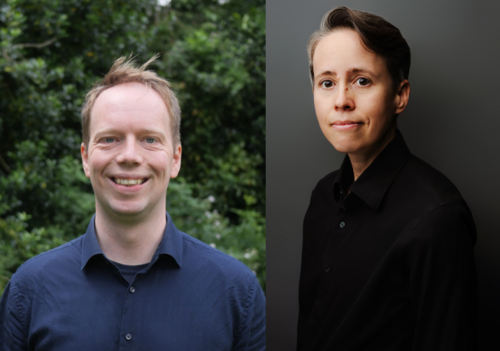
“Share Quantum field researcher Dr. Paul-Hermann Balduf will join Waterloo this October thanks to Feodor Lynen Research Fellowship “Quantum field theory is eighty years old and we still haven’t solved it,” say Dr. Paul- Hermann Balduf , a postdoctoral research at Oxford University’s Math Institute who will join the Faculty of Mathematics this October. “That’s why collaboration – between different countries, institutions, and fields – is so important.” Balduf will be spending at least two years doing research at Waterloo thanks to the Feodor Lynen Research Fellowship, a post-doctoral fellowship awarded by the Humboldt Foundation, which helps Germany researchers do cooperative scientific research abroad. He will be working closely with Dr. Ren Yeats, a professor and Canada Research Chair in the Department of Combinatorics and Optimization who specializes in combinatorial problems in fundamental physics. Together, they are part of a network of more than 30,000 scholars around the world who have been connected by the Foundation. Dr. Paul-Hermann Balduf, left, and Dr. Ren Yeats Quantum field theory is a branch of theoretical physics that combines field theory, special relativity, and quantum mechanics. “It’s useful as a fundamental theory of nature, describing behaviour of elementary particles,” Balduf explains, “but it can also be used in statistics and condensed matter physics, such as for superfluidity and other phase transitions. In cases such as superconductors, which are required to build strong magnets, quantum field theories are even relevant to applications in industry.” Despite quantum field theory’s usefulness in physics, it has yet to establish a rigorous and thoroughly proven mathematical foundation. That’s where research like the work Balduf and Yeats will be doing comes in. “You could just compute forever,” Yeats says, “and if you miss the underlying patterns in what you’re doing, you’ll get stuck and never get where you want to be. That’s where mathematics can really contribute.” Balduf’s background is in physics, but he says that as his research has progressed, he has become increasingly interested in the “rich and exciting” mathematical underpinnings of quantum field theory, particularly as it relates to combinatorics. “Waterloo is particularly unique in the richness and depth of our C&O research,” Yeats explains. “There’s an intensity where you can bring together large enough groups of people interested in this really niche stuff. Also, we have the Perimeter Institute, where I’m an affiliate, that has a lot of people working on the intersection of mathematics and physics. So Waterloo has a lot to offer.” Balduf first met Yeats when they visited his PhD supervisor back in Germany as part of a different Humboldt Foundation program. Soon after, Balduf travelled to Waterloo to work with Yeats on their shared research interests, before taking his current position at Oxford. Now, thanks to the foundation, he’s thrilled to come back to Waterloo for more sustained study. “I am grateful to Ren, and am so excited to be back on Waterloo campus. I really like everything here – the collaborative research, the buildings, the geese, everything!” To learn more about the Humboldt Foundation , visit their website. Math Research Share
Original story
Continue reading at University of Waterloo News
uwaterloo.ca/news
Summary generated from the RSS feed of University of Waterloo News. All article rights belong to the original publisher. Click through to read the full piece on uwaterloo.ca/news.


