
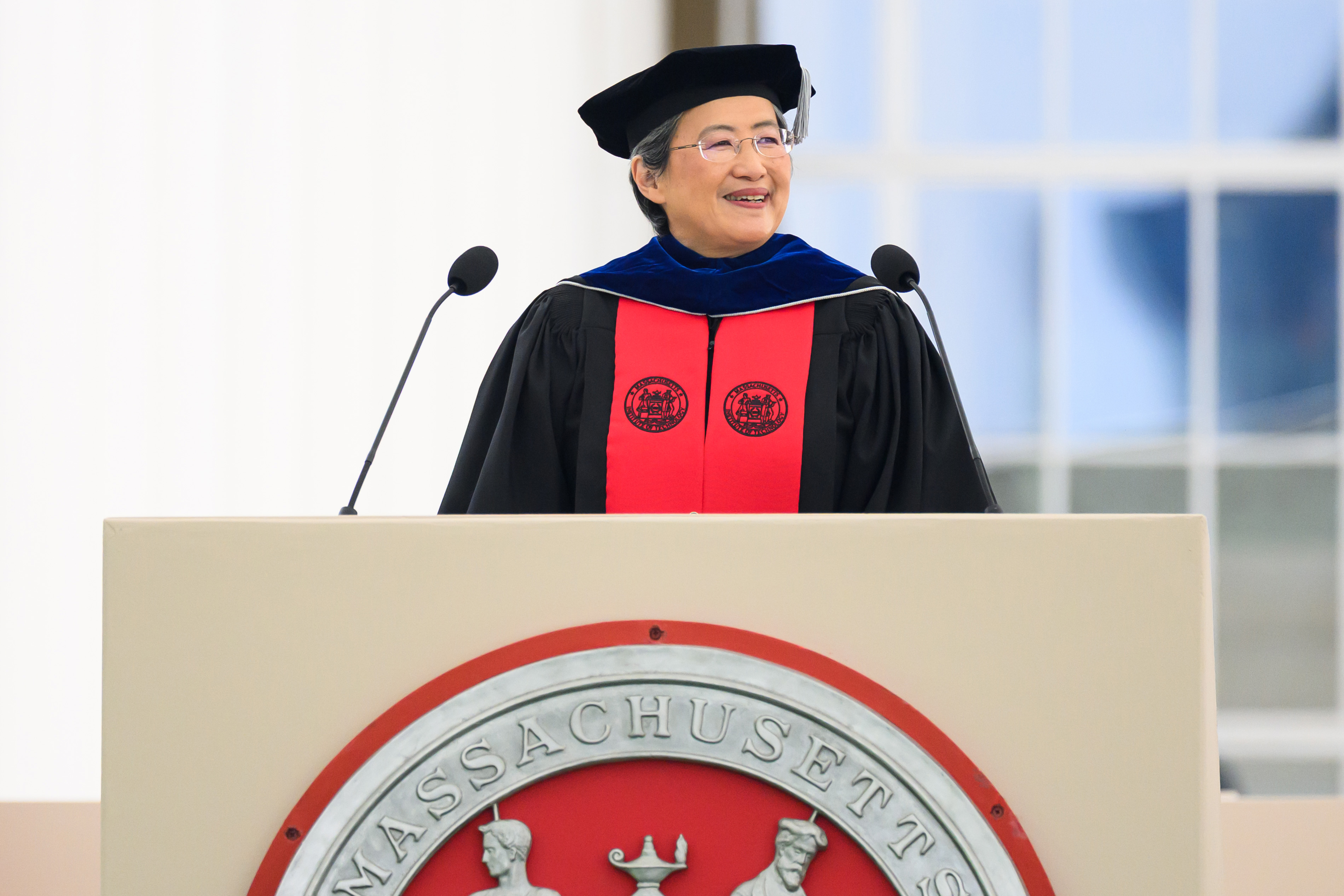
“Below is the text of Lisa Su’s Commencement remarks, as prepared for delivery today. Good afternoon. President Kornbluth, Chairman Gorenberg, trustees, faculty, families, friends … and most importantly, the MIT Class of 2026. Congratulations. You earned this. Standing here feels different than I expected. I've given a lot of talks over the years … but this one is personal. And as Murphy’s Law would have it, I somehow managed to lose my voice this week … so please bear with me if my voice sounds a little rough. I came to MIT in the fall of 1986. My parents dropped me off at Next House. I was 17 years old. Born in Taiwan, raised in Queens … and pretty sure I was good at math. Then I walked into 6.001 and 6.002. Within about two weeks, I realized there were a lot of people at MIT who were very, very good at math. I remember staring at those first problem sets thinking … man, these are super hard. I had never really pulled all-nighters until freshman year … it was a new experience, but it was a lot of fun doing it together with your classmates. MIT has this incredible way of pushing you further than you thought you could go. You wrestled with the problem. You blew up a circuit or two. And then, somehow … the thing worked. And suddenly, you realized you could build something real. And, that’s when I started feeling like an engineer. One of the best parts of MIT is UROP. The opportunity, as an undergraduate, to work on real research. That changed my life. My first UROP was in Professor Hank Smith’s lab in Building 39 … making X-ray lithography mask blanks for a graduate student. To be clear, at the time I had absolutely no idea what that actually meant. But I got to put on my first bunny suit, walk into the clean room, and start building devices on little 2-inch wafers. I learned very quickly to be careful because those wafers were delicate, and I definitely did not want to be responsible for breaking them. I ran a bunch of experiments. Most of them didn’t work the way we expected. So, we adjusted. And tried again. It was the coolest thing ever. For the first time, I wasn’t just learning about technology in a classroom. I was part of a team trying to discover something new. I remember thinking: wow, we can build things this small? Things tiny enough to fit on a die the size of a coin … but powerful enough to change the world. And that is when I fell in love with semiconductors. Later, I had the privilege of working with Professor Dimitri Antoniadis, who became my PhD advisor. That was where I really learned how to solve problems. I remember spending weeks in the clean room fabricating devices, then bringing my wafers up to the test lab, only to discover they didn’t behave the way I expected at all. So, I’d go back to Dimitri’s office, and we’d figure out what experiment we should try next. Looking back, that was probably where I grew the most at MIT. Because little by little, I went from a new grad student learning about the field…to someone doing original research and actually contributing something new to the field. And along the way, I started believing in myself. Not the confidence that I would always know the answer. But the confidence that even when I didn’t know the answer yet…I could figure it out. What I realize now is that MIT was teaching me something much bigger than semiconductor physics. Mens et manus. Mind and hand. When I was a student, I thought it was just a motto. Now I think it captures exactly what makes MIT special. MIT teaches you to think deeply. But it also teaches you to build. To test ideas. To keep going when the first experiment — or even the fifth experiment — doesn’t work. And over time, you start believing you can solve problems that once felt impossible. I carried that feeling with me long after I left campus. When I joined IBM, I found myself starting all over again. IBM had hundreds of thousands of employees. I was 25 years old wondering how I could possibly make a difference in a company that big. But I learned something important very quickly: engineering doesn’t care how old you are. It cares whether your ideas work. And one of my mentors told me something that I’ve never forgotten: Run toward the hardest problems. At the time, I didn’t fully understand what that meant. But over time, I realized this was the best advice I ever received. Hard problems teach you what you're capable of. Fast forward a bit … 12 years ago, I got a chance to put that lesson to the test. I had the opportunity to become CEO of AMD. AMD had enormous potential, but the company had been through some tough years. Some of my mentors thought taking the job was risky. But for me, this was my dream job. This was what I’d been training for all those years. The opportunity to work at the bleeding edge of technology on problems that really mattered. The first thing we had to figure out was what we wanted to be when we grew up. We made a long-term bet that high-performance computing would be the most important technology of the future. We gave our talented team the room to think big. Over the next several years, we built technology to enable the most powerful computers in the world. And, through all of it, I used every skill that MIT ever taught me … And then some. I call it the engineer’s instinct. The ability to face what seemed like an unsolvable problem, break it down, and methodically work through it step by step. But, at AMD, I learned something else. The engineer’s instinct is even more powerful when it becomes shared by a team. And the greatest satisfaction of my career has been bringing people together to do something more than any of us thought was possible. Which brings me to today. Over the last few decades, we’ve experienced several major technology shifts. The internet changed how we communicate. Mobile computing changed how we live. Cloud computing changed how we work. And now we are at the beginning of the AI wave. To me, AI is different from those earlier technology waves. It is not just a tool that can help us do things faster. It is deeper than that. It has the potential to accelerate discovery in every field and help us solve problems we have never been able to solve before. To make it personal, one of the areas that excites me most is medicine and healthcare. We’ve all experienced firsthand what it feels like when someone you love is sick. And even with incredible doctors and the best care, you realize how hard it is for any one person to bring together all of the knowledge that exists in the world to help in that critical time of need. AI can help us change that. It can help doctors and researchers bring the world’s best expertise to each patient … and deliver care with the best chance of a successful outcome. That is the promise of AI at its best. It does not replace people. It makes each of us more capable. Medicine. Science. Energy. Climate. We may discover more in the next ten years than we have in the last thirty. Now let me be clear. Technology itself does not decide what the future looks like. People do. For all the promise of AI … AI cannot decide which problems are worth solving. It cannot make the hard judgment calls with imperfect information. It cannot take responsibility for the outcome. These are our responsibilities. And they matter more now than ever. That is why this is such an extraordinary moment to graduate from MIT. Because the world does not just need people who know how to use powerful tools. It needs people who know what to use them for. People with a sense of purpose. Judgment. Courage. People who look at a hard problem and say: I know this is important, and we can figure this out. And that is exactly who you have become here. So here is what I want to leave you with. I am fortunate in many ways. I am fortunate to have great parents. I received an extraordinary education. I have had the chance to work with great people. But I also believe I’ve been very lucky in my career. When people ask me for career advice, I often tell them: work hard … but also understand that luck matters. And, over time, I’ve come to believe that the best people find ways to make their luck. Luck is not just being in the right place at the right time. It is taking the risk to work on something hard. It is challenging yourself. Choosing problems at the edge of what you know. Surrounding yourself with people who make you better. And believing that, yes … you can change the world. So be ambitious about the problems you choose. Run toward the hardest ones. And trust your engineer’s instinct. That is how you make your luck. I want to take a moment to acknowledge all the families and loved ones here in the audience today. None of these graduates got here alone. Thank you for believing in them, supporting them, and helping them reach this moment. This achievement belongs to you too. And to the Class of 2026… Remember … somewhere in the years ahead, you’re going to walk into another room where you have absolutely no idea what you’re doing. You’ve done this before. Go figure it out. As one MITer to another … I am incredibly honored to be here with you today. Congratulations, Class of 2026.
Original story
Continue reading at MIT News
news.mit.edu
Summary generated from the RSS feed of MIT News. All article rights belong to the original publisher. Click through to read the full piece on news.mit.edu.

