
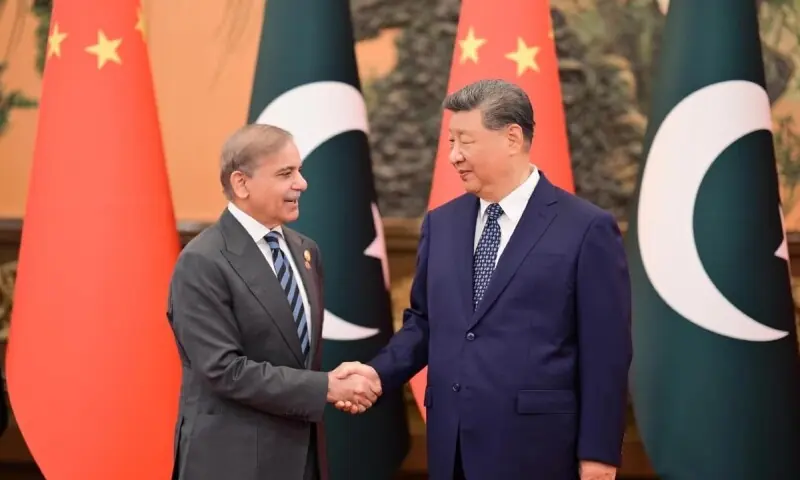
“THIS year marks the 75th anniversary of diplomatic relations between China and Pakistan. Three-quarters of a century is a remarkable milestone; it represents a partnership forged through the crucible of Cold War realignments, regional conflicts, and shifting global order. The upcoming summit in Beijing will be a watershed moment, as it will permanently elevate the tier and institutional efficacy of China-Pakistan strategic communication. Prime Minister Shehbaz Sharif and Chief of Defence Forces Field Marshal Syed Asim Munir’s arrival together — a unique dual-leadership format — will be warmly welcomed in Beijing. It projects strong and seamless civil-military alignment and signals a total consensus within Pakistan regarding its ties with Beijing. For Chinese scholars and policymakers, this unified front eliminates strategic fluctuation and guarantees institutional continuity at the highest levels of statecraft. Beijing recently hosted back-to-back state visits by American and Russian presidents; Pakistan’s arrival serves as the grand finale of this major season of global statecraft Global power structures are undergoing seismic shifts. Recently, Beijing hosted back-to-back state visits by the American and Russian presidents. Pakistan’s arrival serves as the grand finale of this major season of global statecraft. The scheduling is deliberate and deeply appreciative, as it proves that our bond transcends standard diplomacy. Washington comes to Beijing to negotiate the global strategic stability in a constructive way. Moscow and Islamabad come to Beijing to solidify a shared strategic destiny. Beijing recognises that Pakistan is not a pawn on a superpower chessboard, rather, an independent pole of regional stability. The anticipated multi-billion dollar agreements are not merely temporary aid, rather they represent a massive injection of fresh momentum into a new round of sustained, healthy economic growth for Pakistan. The China-Pakistan Economic Corridor (CPEC) has officially transitioned into its second phase. The era of foundational infrastructure building is giving way to profound industrial embeddedness. These billions in new investments aggressively prioritise rapid industrialisation. We are moving beyond mere blueprints to the concrete operationalization of Special Economic Zones. Technology transfers into modern agricultural demonstration zones are accelerating. Chinese labor-intensive industries are actively seeking new production hubs, and Pakistan offers the ideal demographic dividend. By absorbing this manufacturing shift, Pakistan will fundamentally alter its economic trajectory. It transitions from relying on passive financial transfusions to generating robust, autonomous economic vitality. We anticipate monumental project signings and the immediate influx of significant project capital to bring vital foreign exchange. This directly alleviates short-term balance-of-payments pressures. Yet, the true value lies in the structural overhaul. Flagship mega-projects like the $6.6 billion ML-1 railway upgrade and the Karakoram Highway realignment completely reshape Pakistan’s national logistics network and broader business environment. The ML-1 is the logistical spine of this transformation, drastically cutting supply chain costs from Karachi to Peshawar. The Karakoram Highway realignment secures the vital high-altitude artery between Xinjiang and the Arabian Sea against imminent physical geography and climate changes. Business-to-business agricultural modernisation is equally critical. We expect major commercial agreements to deploy heat-tolerant hybrid crops and localised foot-and-mouth disease vaccines. This infrastructural and technological metamorphosis is the fundamental guarantee for Pakistan’s economic health. It systematically rebuilds Pakistan’s long-term sovereign capacity and macroeconomic stability. Economic ambition requires an iron shield. We address security candidly but constructively. China deeply appreciates Pakistan’s immense sacrifices in counter-terrorism. No nation has shed more blood to defeat extremism. Yet, the threat matrix is evolving. Rising asymmetric threats demand a nuanced and decisive response. Hostile UAV networks, cross-border infiltration, and proxy separatist forces seek to derail our economic integration. We will welcome the creation of new joint security frameworks. These arrangements in discussion fully respect Pakistan’s sovereignty. There is no compromise on Islamabad’s territorial jurisdiction. Instead, this collaboration will deeply embed advanced Chinese intelligence and electronic warfare countermeasures into Pakistan’s defensive grid. We are aggressively upgrading the technological shield. We are also developing co-managed security protocols to protect critical infrastructure. We must safeguard the engineers and workers who build our shared prosperity. This proposed joint oversight ensures institutional resilience. It will guard our shared future against external sabotage and intelligence penetration by hostile actors. Pakistan occupies a vital role as a bridge to West Asia and the Middle East. The ongoing Iran crisis highlights this geopolitical reality. Regional fault lines recently threatened to ignite a broader conflagration. Islamabad navigated this extreme regional volatility through master-class peacemaking diplomacy. Pakistan maintained its diplomatic dexterity. By acting as a stabilising mediator amidst tensions involving Washington, Tehran, and neighboring capitals, Pakistan secured its own borders. It also protected the broader international energy architecture from catastrophic disruption. China observes this with profound respect. Beijing strongly supports and encourages Pakistan to play a larger, more autonomous role in regional peace and stability. A strong, confident Pakistan anchors the entire region. It deters geopolitical adventurism. After 75 years, our ironclad bond is entering its most stable, productive era yet. The geopolitical trials of the past have only hardened our mutual trust. Through deep structural alignment and highly effective civil-military dualism, we secure a prosperous future. The upcoming summit will define the next decade of our all-weather strategic cooperative partnership. We move forward not just as neighbors, but as true iron brothers navigating a turbulent century together. Beijing awaits our Pakistani brothers with open arms. The writer is associate dean, Sichuan University School of International Studies, and deputy director, Institute of South Asian Studies Published in Dawn, May 22nd, 2026
Original story
Continue reading at Dawn Pakistan
www.dawn.com
Summary generated from the RSS feed of Dawn Pakistan. All article rights belong to the original publisher. Click through to read the full piece on www.dawn.com.

