
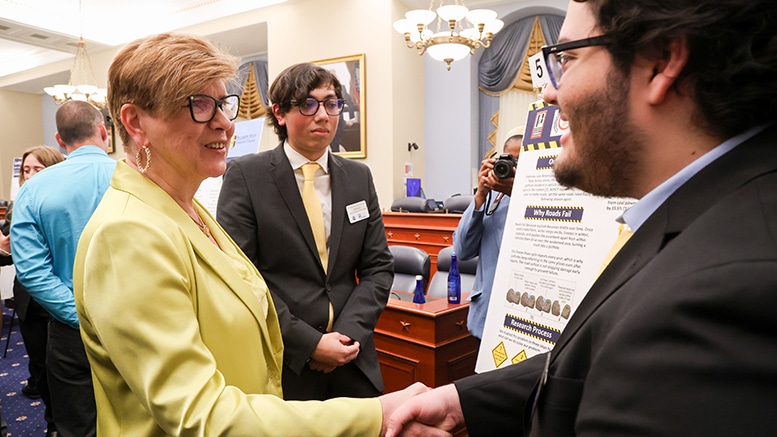
“Twelve teams of community college students from across the United States spent months using creative thinking and classroom learning to design innovations to solve real-world problems. On June 9, they had the opportunity to showcase their projects at a poster session on Capitol Hill in Washington, D.C. The teams of students – along with their faculty mentors – are finalists in the annual Community College Innovation Challenge (CCIC). The program is led by the American Association of Community Colleges (AACC) in partnership with the National Science Foundation (NSF). While in Washington, D.C., the teams also participated in a “boot camp” where experts gave advice on making and selling their STEM-based ideas. Besides pitching their projects during Tuesday’s poster presentation, they made a final push to a panel of judges on Thursday before it would determine the winning teams. Passion projects There were projects designed to test and filter water, to filter microplastics out of washing machines, to keep roads smooth and to prevent power outages. One project aimed to prevent people from being scammed, and another was designed to aid rescue teams in locating drowning victims. What they all had in common was creativity, the application of STEM learning and a lot of passion from the students. “You have distinguished yourself as creative thinkers and problem solvers,” AACC President and CEO DeRionne Pollard told the students during the event. James Moore, III, assistant director for the directorate for STEM education at NSF, told the students to stay the course. “We get to the top with creativity and innovation,” he said. Finding their ‘why’ The CCIC project ideas weren’t random; for students, they were personal. Students from Henry Ford College live about an hour from Flint, Michigan, where clean drinking water can still be an issue more than 10 years after the city’s water crisis began. It’s what inspired them to create SuClara, a smart water testing and filtration system. The project is designed to improve public health and reduce the use of bottled water. The rise of AI data centers in Secaucus, New Jersey, inspired a team of students from Hudson County Community College to design a hybrid immersion-cooling system for use in data centers to save water and energy. Rep. Nellie Pou (D-New Jersey) visits with the student team from Passaic County Community College, who highlighted their idea to reimagine road materials using fly ash. (Photo: Epnac.com) Shawnee Community College (Illinois) student Robert Edwards worked for 25 years in retail management and has seen grocery stores come and go. “I understand the indicators when a store is about to close,” Edwards said. And he understands what happens to communities when residents don’t have access to fresh food. Edwards wants to prevent food deserts, so he went back to school and now is working with his teammates to use aggregated data to help community and state leaders understand where food deserts may pop up. “Food access is infrastructure,” teammate Ty Schuetz said. The San Jacinto College (Texas) team created TrustLine, a phone app designed to keep people from getting scammed through phone calls, texts and emails. A team member’s mother-in-law had gotten scammed and it raised the question, why aren’t there any solutions that are proactive in preventing scams, rather than reactive? And in California, Josiah Chun’s father is living with Parkinson’s, which inspired him to learn more about neuroscience. “I went on a quest for knowledge to learn about the brain,” Chun said. He and his teammates from Pasadena City College created Cortexa to bring neuroscience education to schools. The interactive learning tool processes signals from brainwaves and triggers LED lights embedded in clothes or displays, helping students get excited about neuroscience and showcasing neurotechnology. Spreading education Cortexa isn’t the only project looking to increase access to educational tools. The team from SUNY Broome wants to ensure everyone has an opportunity for hands-on quantum optics education. They’re creating inexpensive classroom kits with open-source classroom guides so students can learn about lasers and more. “Quantum technology is challenging, but the curriculum doesn’t have to be,” said student Alexandra Bouillon. And the Pellissippi State Community College team understands that STEM learning isn’t always accessible for people with disabilities – particularly those who are visually impaired. They’re using what they learned in a 3D-printing class to lower barriers. They created 3D-printed models – which include Braille labels – to allow for hands-on learning in math and engineering classes. And the winners are… The first-, second- and third-place winning teams and their innovations are. First place: SUNY Broome Community College (New York) Project: Hands-On Quantum Education Second place: Springfield Technical Community College (Massachusetts) Project: HydroShield Third place: De Anza College (California) Project: The Micro-Buoy In addition, Passaic County Community College (New Jersey) took home the Innovation Growth Award, which recognizes a team for its exceptional growth, responsiveness to feedback and continuous improvement throughout the competition. The post Creativity, innovation come together for CCIC teams first appeared on Community College Daily .
Original story
Continue reading at Community College Daily
www.ccdaily.com
Summary generated from the RSS feed of Community College Daily. All article rights belong to the original publisher. Click through to read the full piece on www.ccdaily.com.