
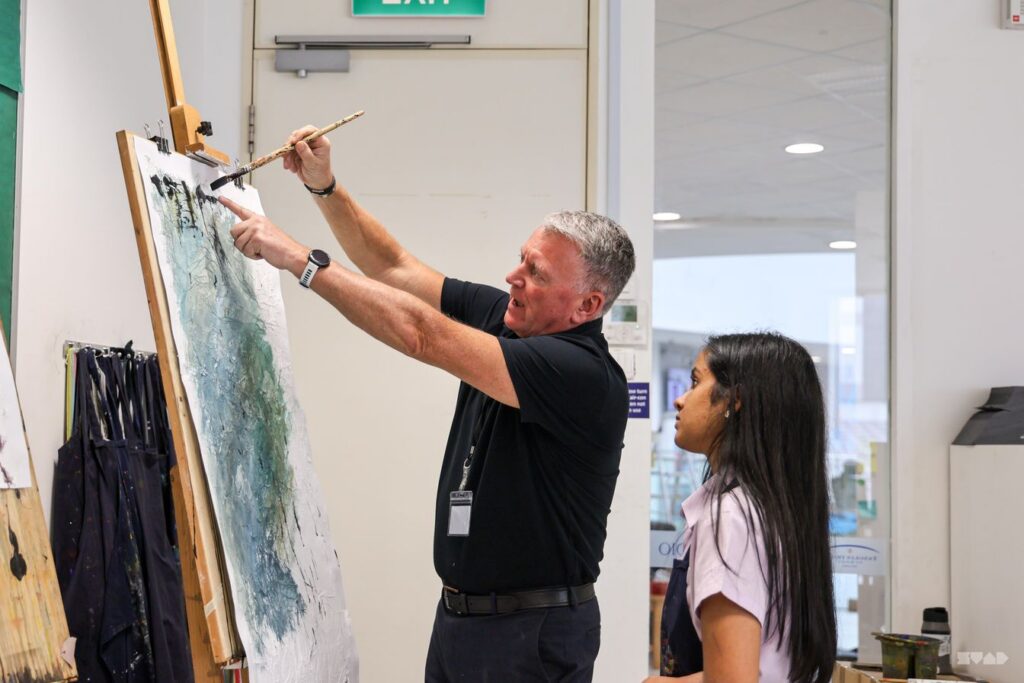
“What does it take to thrive in an AI-driven workplace? Leadership, analytical thinking, and technical literacy? Yes, but they are only part of the picture. As AI becomes more embedded in how we work, the qualities that set graduates apart are increasingly human ones. It’s our creativity and emotional intelligence that keep ideas fresh and prevent the kind of homogenisation that AI can unintentionally reinforce. And according to research from advertising giant Dentsu , 87% of chief marketing officers believe modern strategy calls for more creativity, empathy, and humanity, and 78% don’t see AI replacing human imagination anytime soon. For schools like Tanglin Trust School in Singapore, this reinforces the importance of an arts education. “Numerous studies have shown a strong correlation between participation in the arts and improved academic performance across a range of subjects,” shares Richie Baxter, Head of Senior School Arts. “This is some proof that being involved in the arts translates to greater achievement in standardised tests, as well as verbal, maths, and overall academic achievements.” British artist Ian Murphy demonstrating art techniques in a Senior Art workshop. Source: Tanglin Trust School The impact of an arts education in preparing for the future cannot be understated, according to Elizabeth Anstiss, Head of Senior Art and Design and Graphic Communication. “There is growing recognition that arts education is fundamental and cannot be replaced by AI. In art, 75% of the marks are based on the process and only 25% on the final outcome,” she says. “When students study art, employers can see that they can solve problems, think creatively, take risks, and learn from failure.” At Tanglin, the creative arts therefore form a central part of a holistic education, nurturing imagination, confidence, and self-expression while supporting well-being and character development. As CEO Craig Considine puts it, “Creativity is truly the beating heart of what we do in education at Tanglin.” Alongside instrumental lessons, over 50 co-curricular ensembles meet every week, ranging from beginner groups to more advanced ones such as Symphonic Winds and the Chamber Orchestra. Source: Tanglin Trust School Growing through art, inside and out The Senior School Arts programme at Tanglin is all about giving students the space to be creative, refine their thinking and perspective, take risks, and discover what makes them unique. This philosophy underpins both classroom learning and co-curricular activities across Music, Art, Drama, Film, and Dance. “We strongly believe students will graduate with transferable skills that make them more desirable to universities and future employers,” Baxter explains. “Being part of productions and performances also teaches them how to collaborate, communicate effectively, and lead with confidence.” Importantly, the creative journey at Tanglin is an opportunity to develop not just in the classroom. Tanglin students step into the spotlight through productions, concerts, competitions and performances of all kinds. For example, 80 students performed in the Senior School production of “Sister Act.” More than anything, these experiences give them the chance to grow and share what they love with the wider community. “Being part of productions teaches you things about the performing arts that you simply cannot learn in the classroom, and I ended the show not only having learned more about the production process, but also about myself as a performer,” says Year 12 student Alannah K. Another big part of the experience is learning directly from industry professionals. “The students benefit so much from the visiting artists who come to Tanglin on a regular basis. Award-winning artists who are at the top of their field give masterclasses, workshops and tips on how to be successful in the industry. The students cannot help but be inspired and learn new skills,” says Baxter. A Tanglin Music Scholar participating in a masterclass with the Brodsky Quartet. Source: Tanglin Trust School Tanglin regularly welcomes experts in their artistic fields, offering students engaging ways to learn beyond the syllabus. The Brodsky Quartet music masterclass, for example, provided Senior School strings players with an unforgettable learning experience that sharpened their performance skills and elevated their musical expression. Over the years, Tanglin has welcomed a wide range of accomplished creatives, including Aardman Animation , filmmaker Ian Pike, artist Simon Purse, composer Bob Chilcott , artists Ian Murphy and Charles Fazzino, drama practitioner Bill Bowyers, as well as performers from Singapore Ballet . Senior students working with 3D pop artist Charles Fazzino. Source: Tanglin Trust School A place to shine These moments are built on creative foundations introduced in Infants, then continued in Juniors, where teachers focus on developing creative confidence. This learning goal has been enhanced through the new Junior Arts Centre, a five-storey creative building with specialist studios for music, dance, drama, and art, as well as a black box theatre and library. The centre reflects Tanglin’s commitment to ensuring the arts are an integral part of academic enrichment as students progress through the school. One example of such enrichment is the Articulation Prize Singapore, a national competition hosted by the National Gallery, which requires students to research artists, analyse artworks, and present in front of an audience. “By placing emphasis on research, presentation, and intellectual rigour, programmes like this reinforce the idea that an arts education develops scholars as well as practitioners,” shares Anstiss. Practical enrichment teaches students to create. Academic enrichment helps them understand why it matters. Together, they spark personal growth. Source: Tanglin Trust School This commitment to support and artistic development can also be seen across other disciplines. Now in its second year, the Tanglin Centenary Music Scholarship programme, open to students from Year 7, attracts nearly 200 applications from both current Tanglin students and external candidates across Singapore and the region. Rob Hall, Tanglin’s Director of Music, explains that the wider purpose of the scholarship programme is “to create a thriving musical environment in which scholars excel and, in turn, inspire younger musicians throughout the school community.” Michael Y, for instance, first learned about the cello as part of the Junior School introduction to the strings programme. “I was invited to continue learning the instrument within the school and haven’t stopped playing since,” shares the Tanglin Music Scholar in Year 12. “The scholarship programme has motivated me to refine my musicianship while providing invaluable performance opportunities.” Finn C, a Tanglin Music Scholar and Musician of the Year 2026 winner. Source: Tanglin Trust School Tanglin’s approach to the arts is both considered and all-encompassing. As CEO Considine explains, “The arts are not enrichment on the margins; they are central to how young people learn to observe closely, express ideas with clarity, collaborate meaningfully, and engage with the world imaginatively and thoughtfully. Whether through visual art, music, drama, or design, the arts help our students make sense of complexity, develop their voice, and build confidence in who they are and what they have to say – qualities that matter deeply in any future they will face.” Follow Tanglin Trust School on Facebook , LinkedIn , Instagram , and YouTube
Original story
Continue reading at Study International
www.studyinternational.com
Summary generated from the RSS feed of Study International. All article rights belong to the original publisher. Click through to read the full piece on www.studyinternational.com.
