
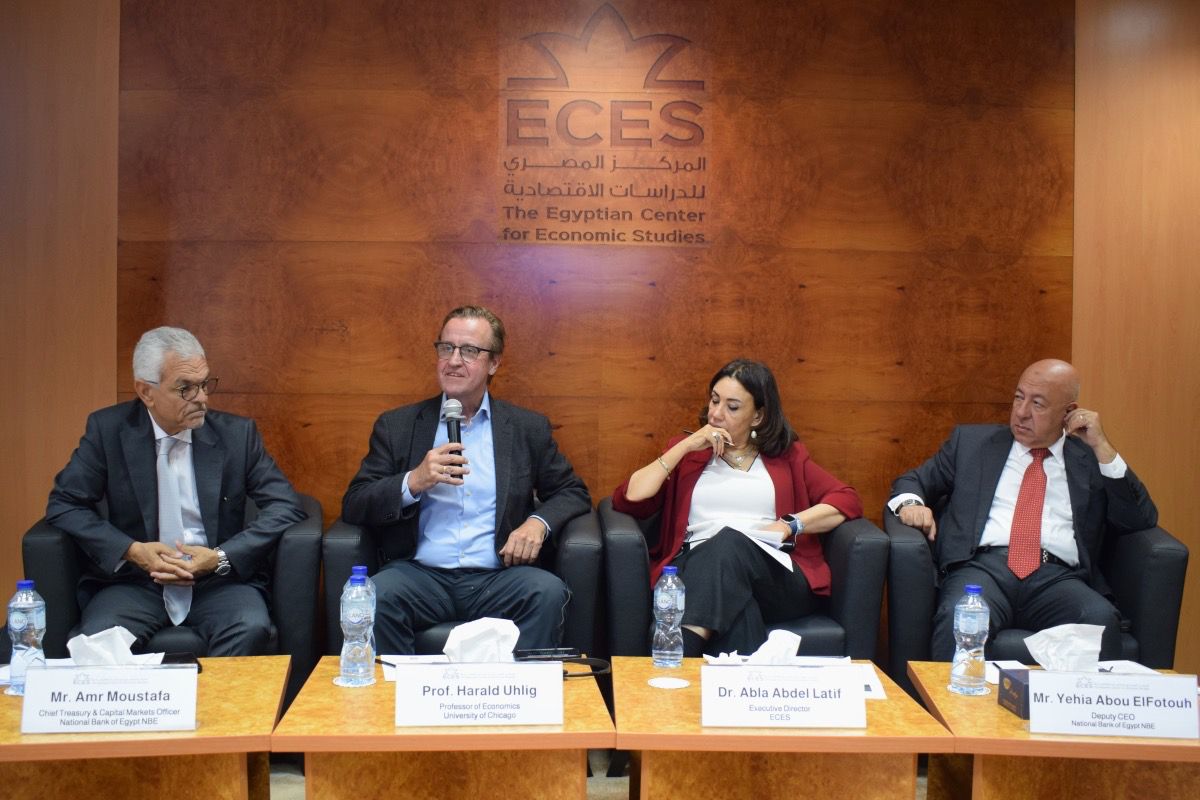
“Digital currencies are reshaping the global financial landscape and imposing unprecedented challenges on monetary policy, according to leading experts who gathered at a seminar hosted by the Egyptian Center for Economic Studies (ECES). The event underscored how cryptocurrencies and central bank digital currencies (CBDCs) are no longer marginal phenomena but central issues that policymakers must confront. The seminar featured Harald Uhlig, professor of economics at the University of Chicago; Yehia Aboul Fotouh, deputy chief executive of the National Bank of Egypt; Amr Mostafa, head of treasury and capital markets at the bank; and economic expert Omar El Shenety. The discussion was moderated by Abla Abdel Latif, the centre’s executive director and director of research. Abdel Latif explained that the seminar was part of the centre’s mission to address emerging economic issues attracting global attention. Digital currencies, she said, have become one of the most significant developments in the financial system, sparking debate across governments, banks, and academia. Uhlig provided a sweeping overview of global developments. He noted that Bitcoin remains the most visible cryptocurrency but is only one among thousands of digital assets, collectively valued at around $2.6trn. This sheer scale, he argued, makes digital currencies impossible to ignore. Yet their defining contradiction, fixed supply paired with extreme volatility, poses analytical challenges. Economic models suggest Bitcoin’s price follows a “risk adjusted martingale,” meaning today’s price is the best predictor of tomorrow’s, adjusted for risk. He pointed out that Bitcoin currently trades near $78,000, with projections suggesting it could reach $521,000 within five years. Such forecasts highlight both the extraordinary opportunities and the profound risks inherent in the market. Uhlig warned that stablecoins pegged to the US dollar could exert pressure on central banks, forcing them to adjust policy frameworks and potentially limiting their independence. Around 70% of central banks worldwide are studying the issuance of their own digital currencies, he said, reflecting recognition of their importance. He contrasted approaches: the United States is cautious, relying on private sector stablecoins, while the European Union is advancing legislation to establish a digital euro. Uhlig cautioned that CBDCs could trigger “disintermediation” if individuals choose to hold funds directly with central banks, bypassing traditional banks. This would challenge the structure of the financial system and require a fundamental rethink. He emphasized that central banks face a complex trade off: maintaining trust in the currency, ensuring system efficiency, and preserving price stability–objectives that are difficult to achieve simultaneously. Aboul Fotouh distinguished between digital currencies and cryptocurrencies, stressing that Egypt’s banking system is undergoing digital transformation but cryptocurrencies remain legally prohibited. He cited barriers including volatility, liquidity risks, and weak investor protection. “Who would users turn to in cases of fraud or loss?” he asked. Despite these risks, Aboul Fotouh highlighted opportunities. Cryptocurrencies and blockchain could enhance financial inclusion, reduce the cost and time of cross border transfers, and improve efficiency in trade finance. He stressed the importance of capacity building and financial literacy to ensure the market can absorb these tools responsibly. Mostafa emphasized that cryptocurrencies are still used primarily for speculation rather than payments, raising doubts about their suitability as currencies. He argued that the future lies with stablecoins and CBDCs, which combine efficiency and ease of use with regulatory clarity and user trust. He warned that insufficient regulation remains a major challenge, particularly for investor protection, and said central banks should only engage through regulated instruments. El Shenety observed that cryptocurrency use is expanding among younger groups despite the absence of regulation. He argued that integrating these activities into the formal system would enhance oversight and protect users. He noted that valuations are driven less by fundamentals than by behavioral factors and investor expectations, explaining their volatility. The seminar also explored macroeconomic implications, including effects on inflation, money velocity, reserve asset potential, and international settlements. Experts debated whether digital currencies could serve as reserve assets or play a role in global trade settlements, while acknowledging the uncertainty surrounding their long term trajectory. Abdel Latif urged the Central Bank of Egypt to adopt a proactive approach. She argued that waiting for international experiences to mature would leave Egypt behind. Engagement, she said, does not mean excessive risk but rather studying and applying CBDC models that offer secure, regulated alternatives. Providing official tools would encourage users to shift from informal practices to more stable channels, enhancing efficiency and resilience. She stressed that rapid technological advances, including artificial intelligence, underscore the pace of global change. Digital currencies, she argued, are no longer marginal or temporary but an economic reality requiring preparedness. The real challenge lies in building institutional capacity, not rejecting innovation. Think tanks, she added, play a vital role in fostering informed debate and equipping policymakers with knowledge. The seminar concluded with consensus that the world is moving toward a hybrid financial model combining traditional systems with modern technologies. Policymakers must balance innovation with stability, developing flexible regulatory frameworks capable of accommodating rapid transformation. The post Cryptocurrencies reshape monetary policy, challenge central banks first appeared on Dailynewsegypt .
Original story
Continue reading at Daily News Egypt
www.dailynewsegypt.com
Summary generated from the RSS feed of Daily News Egypt. All article rights belong to the original publisher. Click through to read the full piece on www.dailynewsegypt.com.
