
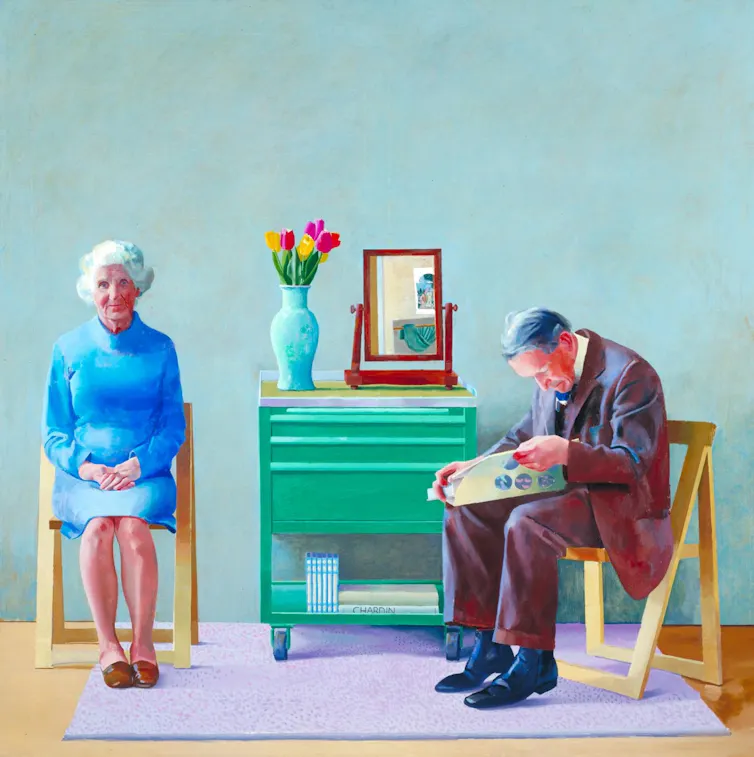
“David Hockney, who died on June 11, was perhaps the most successful and well-known British artist of his lifetime. His exhibitions, from career-spanning shows like David Hockney 25 at Fondation Louis Vuitton in Paris (2025) to his groundbreaking touring immersive exhibition David Hockney: Bigger & Closer (not smaller & further away) (2025), drew thousands of visitors. His paintings broke sales records. Take his Portrait of an Artist (Pool with Two Figures), 1972, which became the most expensive painting by a living artist sold at auction after fetching US$90.3 million (£70.3 million) at Christie’s in New York in 2018. Such success stands in stark contrast to his more humble beginnings. Born in Bradford into a working-class family in 1937, he came of age in a post-war era where access to education and to culture in Britain began to broaden. Through policies and schemes, previously unheard-of opportunities for people of his background began to open up, without which he would not have become the success he is considered today. The situation today for aspiring artists from a similar background is much starker. A hopeful place for working-class artists After leaving school at 16, Hockney studied at Bradford School of Art between 1953 and 1957. He had a brief gap of two years working as a hospital orderly due the national service requirement at the time and being a conscientious objector. He then took up a place at the Royal College of Art (RCA) in London. He benefited from the expansion of universities and art schools in this period, and the availability of means-tested grants for fees and living costs . This article is part of our State of the Arts series. These articles tackle the challenges of the arts and heritage industry – and celebrate the wins, too. In 2026, the affordability of higher education for young people in Britain has been under the spotlight – with warning the situation will get worse, especially for working-class students . More and more students cannot afford to move away to study or take up further education opportunities, as Hockney did. Creative higher education institutions have also seen cuts to funding of around 50%, and it has been proposed that creative degrees will not be covered by the reintroduction of maintenance grants from 2028. In the early part of his studies at the RCA, Hockney produced paintings like 1960s Going to Be a Queen for Tonight . Such paintings demonstrate the captivating, intoxicating possibilities that the RCA and London more widely offered for a young, gay, working-class artist. Hockney’s London was accessible and cheap. He lived in a room in Earl’s Court and had about £100 a term from a scholarship. “You could do exactly what you wanted,” he recounted in an interview with the RCA about his time there. “You could even smoke. I remember having to sandpaper off the nicotine stains on my fingers before going to visit the registrar to borrow some money. They couldn’t be seen to be lending to fellows that smoked … Most of us were living on scholarships.” The escalating cost of living means that for students today maintenance loans often fall short of actual living expenses (like rent and food). Affordability of university is an increasing concern for many and more than two-thirds of full-time students have jobs to help supplement their loans and grants. At the RCA, Hockney was able to experiment with printmaking for the first time, as the graphics department provided materials for students for free. He quickly flourished in this medium, winning a prize of £100 for an early etching titled, Three Kings and a Queen. For a young artist with no money, this prize was significant. He was able to spend the summer of 1961 not working and afford a plane ticket to New York. Such desire to experiment would come to define his prolific career as he relentlessly moved between mediums, exploring the possibility of expression through theatrical design, photocollage and eventually digital creation. In 2026, most art students are expected to purchase their own materials so their ability to experiment and discover can be more limited. Hockney’s trip to New York produced his series of etchings A Rake’s Progress (1961 1963) . It was inspired by a print series produced by William Hogarth, published in 1735, that depicts the rise and fall of a young man who inherits wealth then squanders it in 18th-century London. Hockney adapted Hogarth’s narrative to his own encounter with New York, working in some biographical elements like his decision to dye his hair blonde while he was there. The series is a humorous and earnest reflection on the new possibilities and changes arising for a working-class man from the north of England. A helping hand Alongside free education, additional help from prizes and a cheaper cost of living, Hockney’s early career was also supported by the art dealer John Kasmin . Kasmin bought Hockney’s work while he was still at the RCA, and made Hockney part of his stable of artists at his gallery, which opened in London in 1963. Kasmin helped Hockney sell his paintings to the right kinds of buyers, but also provided him with a steady income and opportunity for further travel to the US. It was in America that he produced the paintings of Los Angeles for which he remains best known. Here, Hockney’s celebrity and market value were managed while allowing him to work as he wished. My Parents. Tate. , CC BY-NC-ND Hockney’s early experiences are in contrast to the more exploitative flipping of works by young artists by buyers in recent years. There is evidence that this practice, involving buying art by young artists then quickly reselling them for a large profit , has a detrimental effect on young artists’ careers. Later in Hockney’s career, he made a quiet nod to his working-class roots with My Parents (1977) . This double portrait of his mother, posing obediently and affectionately for her son, and his father, leafing through an art book, is not only a moving depiction of family, but also a painting about social mobility. Amid the celebrations of and tributes to Hockney from politicians and the media, we might recognise the role of class and how it shaped his art, and the structures, particularly state-supported art school education, that made success possible for someone like him. Gregory Salter does not work for, consult, own shares in or receive funding from any company or organisation that would benefit from this article, and has disclosed no relevant affiliations beyond their academic appointment.
Original story
Continue reading at The Conversation UK Education
theconversation.com/uk/education
Summary generated from the RSS feed of The Conversation UK Education. All article rights belong to the original publisher. Click through to read the full piece on theconversation.com/uk/education.

