
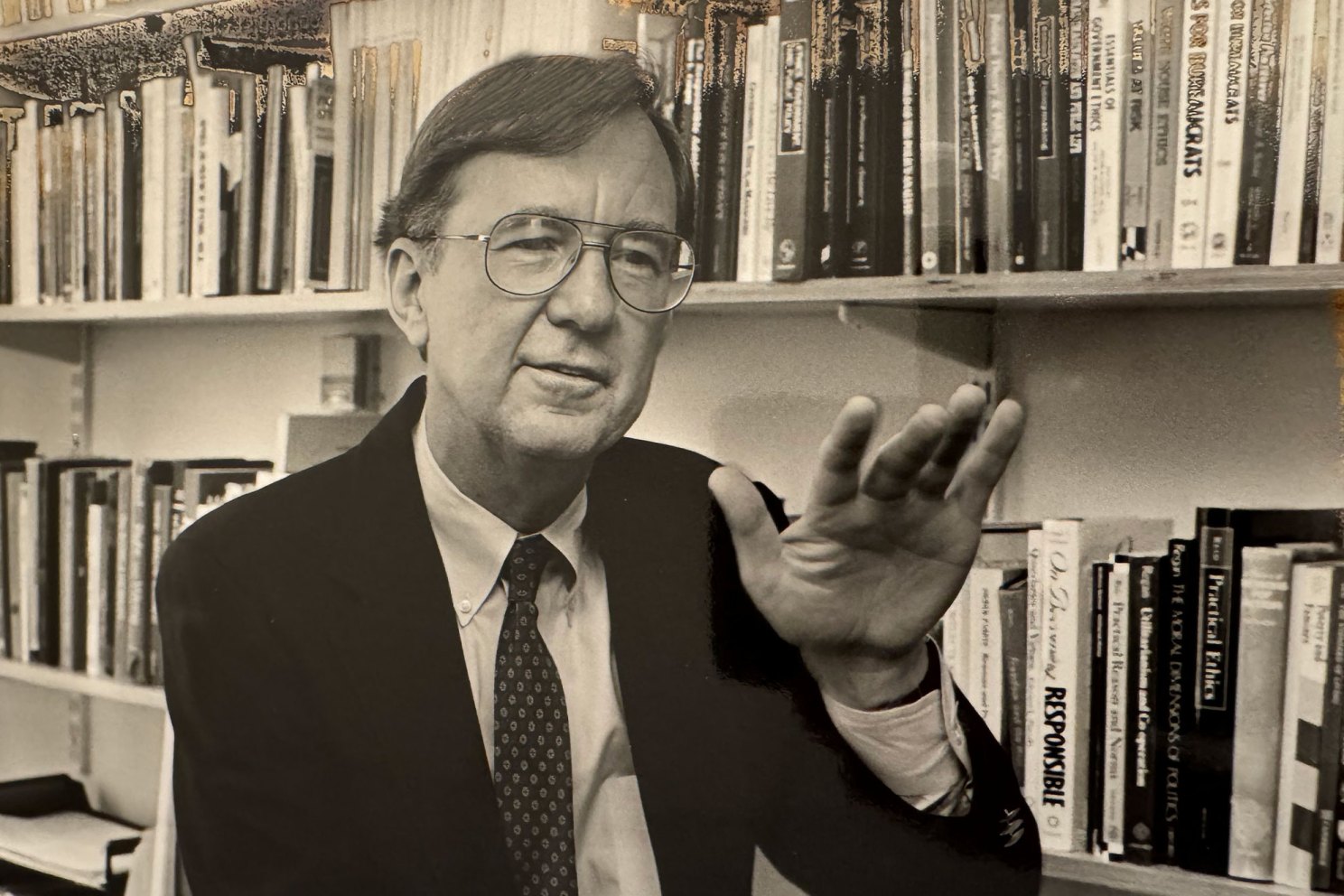
“Dennis Frank Thompson. Harvard file photo Campus & Community Dennis Frank Thompson, 84 Memorial Minute — Faculty of Arts and Sciences May 7, 2026 6 min read At a meeting of the Faculty of Arts and Sciences on May 5, 2026, the following tribute to the life and service of the late Dennis Frank Thompson was spread upon the permanent records of the Faculty. Born: May 12, 1940 Died: March 30, 2025 Dennis Frank Thompson once described the early days of the program he founded at Harvard as the work of “a peripatetic Director” on “a quixotic undertaking.” The skeptics, he noted, fell into two camps: “Some critics complained that we were teaching people to be ethical, which they assumed is impossible, especially at Harvard. Other critics complained that we were not teaching people to be ethical, which they assumed is irresponsible, especially at Harvard.” He could hold both objections in view, find humor in each, and build an institution that outlasted them both. Dennis was born on May 12, 1940, in Hamilton, Ohio, to Frank and Florence Thompson. He was the first in his family to attend college. He graduated summa cum laude from the College of William and Mary in 1962, then crossed the Atlantic as a Fulbright Scholar to Balliol College, Oxford, where he earned a First in Philosophy, Politics, and Economics. He completed his Ph.D. in the Department of Government at Harvard in 1968. Thompson began his teaching career at Princeton University, where, for 18 years, he taught political science and ethics. Thomas Scanlon, who taught philosophy alongside him, credited Thompson with pushing him to consider how philosophy fit into the wider life of institutions and politics and how things actually worked inside them. In seminar, Thompson used a chess timer so that every student received equal time; when the bell rang, one stopped, even mid-sentence. But he was at his best at a seminar’s close, gathering an afternoon’s worth of remarks that had pulled in different directions and weaving them into a Hegelian synthesis — one that made each person’s contribution sound more interesting than when it was first offered. In 1986, at the invitation of President Derek Bok, Thompson returned to Harvard to found the University’s Program in Ethics and the Professions — now the Edmond and Lily Safra Center for Ethics — the first interfaculty initiative at a university where, as Thompson put it, “every tub on its own bottom” was an article of faith. He was simultaneously appointed Alfred North Whitehead Professor of Political Philosophy in the Faculty of Arts and Sciences and Professor of Public Policy in the John F. Kennedy School of Government. Over more than 20 years as director, he built a community that brought scholars and practitioners from law, medicine, government, business, and the humanities into sustained conversation about moral questions in public life. Where others might have seen mission creep, he saw mission enrichment. It helped that John Rawls told colleagues he thought some of the most interesting discussions at the university were taking place in the Program’s seminars, which he attended regularly. The house that Thompson built has inspired similar centers at universities around the world. Thompson also served Harvard as Associate Provost, Senior Advisor to the President, and twice as acting Provost. Beyond the university, he consulted with the Joint Ethics Committee of the South African Parliament, the American Medical Association, and the United States Senate Ethics Committee, where he assisted in the investigation of the Keating Five scandal. He first testified before Congress in 1980 and returned so often that he joked, under oath, that he would keep coming back until they solved institutional corruption. With Amy Gutmann, Thompson co-authored “Democracy and Disagreement” and “Why Deliberative Democracy?,” works that advanced the claim that democracy depends not merely on aggregation but on reasoned exchange and mutual respect. His distinction between personal and institutional corruption opened a new field of inquiry and reform. His books — among them “The Democratic Citizen: Social Science and Democratic Theory in the 20th Century,” “Just Elections: Creating a Fair Electoral Process in the United States,” and, again with Gutmann, “The Spirit of Compromise: Why Governing Demands It and Campaigning Undermines It” — showed how philosophy could engage the friction of actual governance without losing its grip on principle. He wrote of politicians with a generosity rare among political philosophers, urging that we learn to tolerate some inconsistency between promise and performance, lest politics be abandoned to, in his phrase, “cynics and the prigs.” Thompson’s intellectual gifts and his gifts for community were not separate things. At annual dinners, he moved from table to table, naming every person in the room and saying something about their work that made clear he had been paying attention all year. He was a jazz pianist of real skill, and his renditions of “Ain’t Misbehavin’” at closing dinners — with annually revised lyrics reflecting the exploits of that year’s fellows — became the Center’s unofficial anthem. Thompson’s humor was wry and precisely timed. He could tease, but his targets tended to feel flattered. His feedback on student work began with what had been done well before turning to what needed repair — the reverse of standard academic practice — and it made his praise, when it came, something to remember. Former fellows, over the years, have said that their year at the Center under Thompson was the best of their academic lives. A colleague once told him that he made disagreement almost sound like fun. Thompson is survived by his wife, Carol, whom he met in high school; his sons, Eric and David; and three granddaughters. He died peacefully on March 30, 2025, in Peterborough, New Hampshire, and is buried at Mount Auburn Cemetery. On Oct. 11, 2023, the Ethics Center dedicated its seminar room in his name. The Dennis F. Thompson Seminar Room now hosts the kind of exchange he spent a lifetime orchestrating — frank, generous, and shaped by the conviction he once put this way: “The ethics of public life is too important to be left only to ethicists.” Respectfully submitted, Danielle Allen Michael Sandel Eric Beerbohm, Chair
Original story
Continue reading at Harvard Gazette
news.harvard.edu
Summary generated from the RSS feed of Harvard Gazette. All article rights belong to the original publisher. Click through to read the full piece on news.harvard.edu.
