
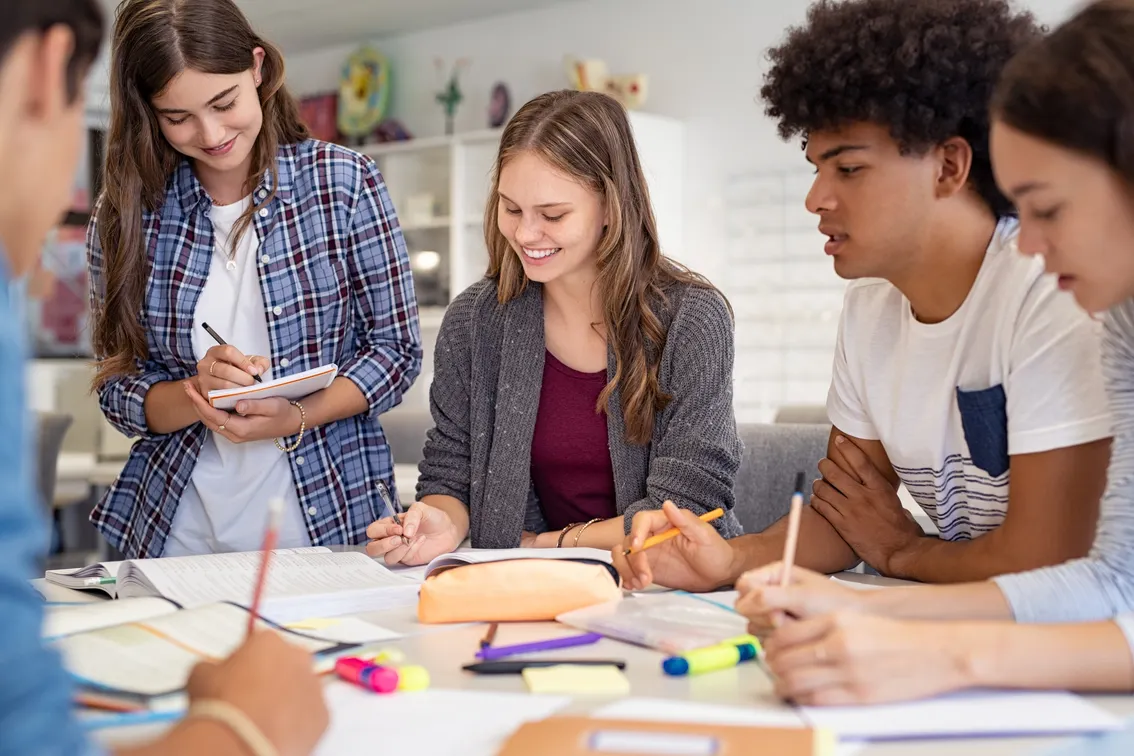
““College and career readiness” (CCR) is often framed around the skills needed for the workforce — such as competency with career-focused technologies or interpersonal communication. Yet for nearly two-thirds of new high school graduates, the next step is college. And about half of recent graduates will enter the workforce and college simultaneously. While national data on new graduates’ college enrollment, persistence, and graduation rates remain steady, college educators argue that today’s new entrants are less prepared for the academic rigors of college than even a few years ago. Faculty surveyed by the College Board said they’ve had to lower the rigor of their courses and that first-year students today are less successful in core academic skills than before the COVID-19 pandemic. Those areas include: Close reading and analysis: 75% Critical thinking and analysis: 72% Problem-solving skills: 70% Emotional intelligence: 71% Academic writing: 67% “We know the pandemic disrupted a critical period of learning for the majority of students matriculating into college today,” says Katie Wilczak, Head of Product Learning & Design for School Assessment at Pearson. “We need to look closer at how we’re approaching college readiness, including how technology can enable the personalized learning we need to close this gap.” Can AI Support Better College Readiness? When done right, artificial intelligence (AI) embedded in learning technologies has the potential to help reinforce learning while improving the timeliness and personalization of the feedback students receive. And recent studies indicate that teachers are interested in learning how AI can help them close the college-readiness gap while preserving their mental health and work-life balance. What’s more, middle and high school students are already using AI, and they’re doing so in fast-growing numbers. According to RAND data , between May and December 2025, the share of students using AI to help with homework in three or more classes rose … +16 points for middle schoolers (to 46% of students) +14 points of high schoolers (to 63%) K-12 students’ use of AI is still largely in uncharted territory, however. ChatGPT, a publicly available generative AI platform, was the most commonly cited AI tool (53%) used by students in the RAND survey. Google Gemini (28%) and Google Translate (20%) followed. Given the frequent and varied AI use among K-12 students, the study’s authors recommend that K-12 leaders take steps to help students understand the difference between: AI use that does the actual work of learning (cognitive offloading) AI use that enables deeper learning (cognitive augmentation) This is critical because the skills cultivated through deeper learning practices are essential for college success. AI use in K-12 must support that goal. “AI for learning should help students explore and deepen their understanding of core concepts, with strategies like asking students process-oriented questions, creating opportunities for them to apply or transfer their learning, or allowing them to test models with different variables,” Wilczak says. “That’s what AI for cognitive augmentation looks like.” College and Career Readiness Aren’t Mutually Exclusive Similar to students heading to college after high school, for students entering the workforce right out of high school, attaining transferable, future-ready skills remains critical. However, many K-12 students believe they aren’t ready for college or a career. In one recent Gallup survey , more than 40% of middle and high school students said they don’t feel prepared for the future. And two-thirds (66%) of teens and young adults say they don’t know what career to pursue, a Morning Consult survey found. What’s more, that study also showed that half of the students who aren’t sure about their future career say they don’t know how to find a quality job. K-12 leaders have an opportunity to increase college and career readiness by embedding opportunities to develop future-ready skills into teaching and learning, often in partnership with postsecondary stakeholders and local employers who demand them. And many are already at work developing better pathways for students to learn future-ready skills in ways that align with their interests and next steps after high school. By documenting and sharing them through frameworks like Portraits of a Graduate , all stakeholders — educators, students, parents, and even local colleges and employers — can see which skills the school or district prioritizes and what that learning entails. Beyond the Test: Can We Close the Readiness Gap? The ingredients to support better college readiness are there: Timely data pinpoints where first-year college students are struggling academically. AI-enabled learning tools can help K-12 educators strengthen learning to develop the postsecondary skills needed, such as writing, critical thinking, and close reading. School and district leaders are adapting one-size-fits-all learning frameworks to student-centered approaches that connect K-12 learning to post-graduation goals. The challenge, of course, is that learning outcomes are still determined through standardized assessments. In a recent study of districts’ efforts to implement their Graduate Portraits, Pearson found that school leaders struggled to balance their desire to showcase and scale the real progress students were making through student-centered learning with the need to capture outcomes in formats that align with accountability and college admissions requirements. “We need new frameworks that capture meaningful learning outcomes so we can expand student-centered learning and close the college and career readiness gap,” Wilczak says. States like Kentucky are already exploring this connection, and others are following . In the meantime, the report advises, K-12 schools can lay their own groundwork for student-centered learning to improve college readiness while also preparing students for the workforce by taking steps such as: Designing assessment systems that value student development and growth over time. Using assessments that provide specific, actionable feedback for students. Implementing classroom practices that foster student ownership and self-evaluation of their learning. For more insight on how K-12 districts are supporting students’ future-ready skill development and college readiness, download the full report .
Original story
Continue reading at K-12 Dive Technology
www.k12dive.com
Summary generated from the RSS feed of K-12 Dive Technology. All article rights belong to the original publisher. Click through to read the full piece on www.k12dive.com.
