
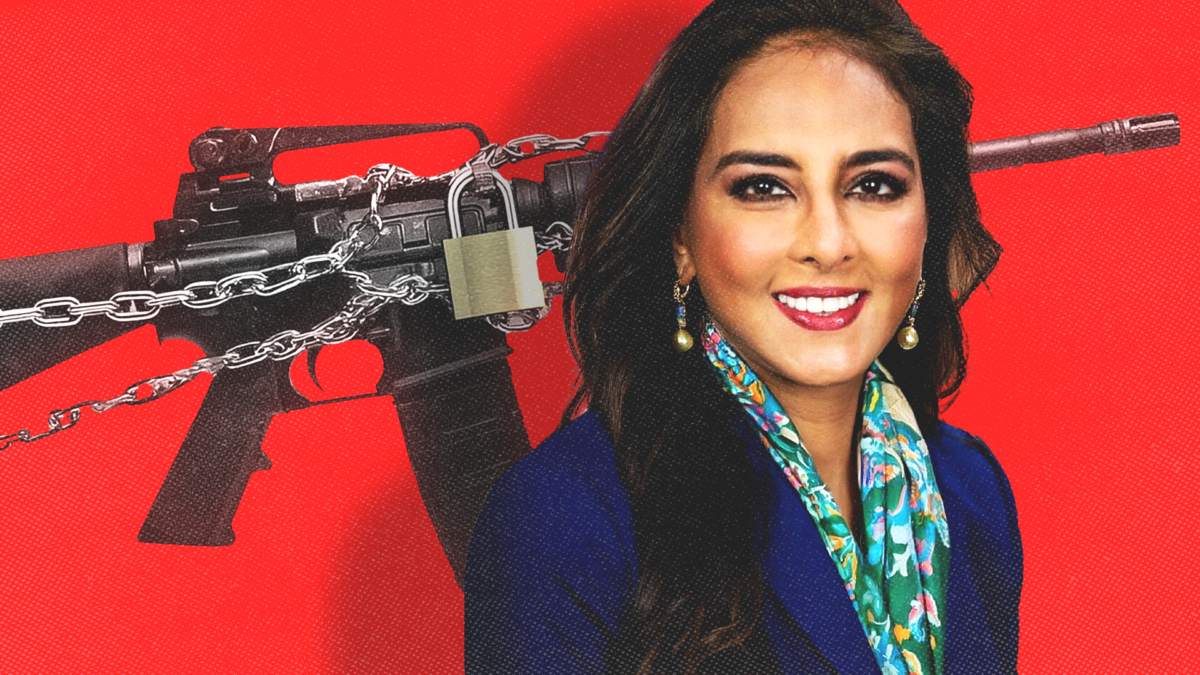
“The Department of Justice this week filed two Second Amendment lawsuits in the U.S. District Court for the District of Colorado, challenging that state's ban on "large capacity" magazines and Denver's ban on "assault weapons." Harmeet Dhillon, the assistant attorney general in charge of the department's Civil Rights Division, argues that both laws are unconstitutional for the same reason: They ban arms in common use for lawful purposes, which the Supreme Court has said are covered by the Second Amendment, and there is no "historical tradition" that would justify such a policy, as required by the Court's 2022 ruling in New York State Rifle & Pistol Association v. Bruen . "The Constitution is not a suggestion and the Second Amendment is not a second-class right," Acting Attorney General Todd Blanche said on Tuesday after the lawsuit against Denver was filed. "Denver's ban on commonly owned semi-automatic rifles directly violates the right to bear arms. This Department of Justice will vigorously defend the liberties of law-abiding citizens nationwide." Denver's ordinance was enacted in 1989, the same year that California became the first state to ban so-called assault weapons, a politically defined category that typically hinges on arbitrarily disfavored rifle features such as pistol grips, folding stocks, and flash suppressors. But Denver's ordinance , which prohibits the sale, transfer, or possession of "assault weapons" within city limits, defines the term to include any semi-automatic pistol or center-fire rifle with a fixed or detachable magazine that holds more than 15 rounds. It therefore covers many of the most popular guns sold in the United States when they are equipped with standard-issue magazines, including AR-15-style rifles. The complaint in United States v. Denver notes that "the term 'assault weapon' is not a technical term used in the firearms industry" but rather "a rhetorically charged political term developed by anti-gun publicists." It adds that the guns banned in Denver "include ordinary semiautomatic rifles possessed by millions of law-abiding Americans." For example, "Americans own literally tens of millions of AR-15 style rifles, the paradigmatic 'assault weapon' covered by the Ordinance." In a case decided last year, Supreme Court Justice Elena Kagan noted that "the AR–15 is the most popular rifle in the country." In January, the National Shooting Sports Foundation (NSSF), the gun industry's trade association, reported that Americans own more than 32 million "modern sporting rifles," the industry's preferred term for the rifles usually covered by "assault weapon" bans. Survey data suggest that somewhere between 16 million and 25 million Americans have owned AR-15-style rifles. They commonly report using them for lawful purposes, such as self-defense, hunting, and target shooting. Such rifles are rarely used by criminals. In 2019, according to FBI data , "only 364 homicides were known to have been committed with rifles of any type , compared to 6,368 with handguns, 1,476 with knives or other cutting instruments, 600 with personal weapons (hands, feet, etc.) and 397 with blunt objects," Dhillon notes. The magazines targeted by Denver's ordinance are also in common use for lawful purposes. "AR-15 platform rifles are usually sold at retail with a detachable box magazine capable of holding up to 30 rounds, and the majority of owners of AR-15 platform rifles use magazines with a capacity of 20 and/or 30 rounds," Dhillon notes. Between 1990 and 2021, according to a 2024 NSSF report , Americans bought more than 400 million rifle magazines with a capacity of 30 or more rounds. All of this is constitutionally relevant under the Supreme Court's 2008 ruling in District of Columbia v. Heller , which said the Second Amendment applies to arms "in common use" for "lawful purposes like self-defense." Under Bruen , Denver has the burden of showing that its ordinance nevertheless is "consistent with this Nation's historical tradition of firearm regulation." Denver cannot possibly meet that test, Dhillon argues, because "there is no historical tradition of banning arms in common use." Since Bruen , Denver City Attorney Miko Brown notes in a May 4 letter to Dhillon, "all six federal appellate courts that have considered assault weapons or large-capacity magazine ('LCM') prohibitions…have upheld them." But there are signs that the Supreme Court may be inclined to reject those applications of Bruen . In addition to Justice Brett Kavanaugh, who as a judge on the U.S. Court of Appeals for the D.C. Circuit dissented from a 2011 decision upholding the District of Columbia's "assault weapon" ban, Justices Clarence Thomas, Samuel Alito, and Neil Gorsuch have indicated their receptiveness to Dhillon's argument. The Justice Department's complaint in United States v. Colorado , which was filed on Wednesday, mirrors the lawsuit against Denver. Since 2013, Colorado has banned the sale, transfer, or possession of magazines that can hold more than 15 rounds. In addition to reiterating the information about rifle magazines, Dhillon notes that "many full-sized 9 mm semi-automatic pistols are sold at retail with magazines with capacities of greater than 15 rounds." Pistols sold with magazines banned in Colorado include the Glock 17 , which is "one of the most popular handguns sold in the United States," and the SIG Sauer P365 , also a top seller . "Law-abiding Americans own and use for lawful purposes literally hundreds of millions of magazines [like] those banned by the State," Dhillon says. "The State's magazine ban is a ban on an arm in common use for lawful [purposes] by law-abiding citizens. Therefore, the Magazine Ban violates the Second Amendment." She describes Colorado's law as "political virtue signaling at the expense of Americans' constitutional right to keep and bear arms." In response to the lawsuit, Colorado Attorney General Phil Weiser promised to "vigorously defend our state large-capacity magazine limit law from this attack by the Trump Justice Department." Such laws, he said, "are responsible policies that satisfy Second Amendment protections, decrease the deadly impacts of mass shootings, and save lives." These lawsuits, which seek permanent injunctions barring enforcement of the bans, are part of a litigation campaign launched last year with the establishment of a Second Amendment Section within the Civil Rights Division. Dhillon also has challenged the D.C. "assault weapon" ban. The legal hook for the lawsuits is 34 USC 12601 , which prohibits any law enforcement "pattern or practice of conduct" that "deprives persons of rights, privileges, or immunities secured or protected by the Constitution or laws of the United States." That statute authorizes the attorney general to address such abuses by filing civil actions seeking "appropriate equitable and declaratory relief." Weiser questions Dhillon's use of the law. "Using federal civil rights law to put Coloradans at greater risk of gun violence is a dangerous overreach by the Justice Department," he said , "and this lawsuit turns the mission of the DOJ's Civil Rights Division on its head." Brown has a similar take, saying Dhillon's use of Section 12601 is "neither compelling nor proper." Congress enacted that law "in the wake of the horrific Rodney King beating to provide the federal government with tools to combat excessive force and other kinds of misconduct in state and local police departments," she told Dhillon. "Your effort to use Section 12601 to mount a facial challenge to the City's democratically-enacted Ordinance flies in the face of text, history, and past practice." Although Dhillon's lawsuits look different from previous uses of Section 12601, that is partly because the Justice Department has not previously taken an interest in litigation aimed at vindicating Second Amendment rights. The statute's broad language, however, encompasses all "rights, privileges, or immunities" guaranteed by the Constitution or by federal statute. You could argue, as Weiser and Brown presumably will, that Dhillon is improperly challenging legislatively approved policies under the guise of correcting unconstitutional police conduct. But Dhillon argues that enforcement of the Denver and Colorado bans constitutes a "pattern or practice of conduct" within the meaning of Section 12601. Although the Trump administration has hardly been consistent in defending Second Amendment rights, it deserves credit for challenging at least some of the gun control laws that seem vulnerable under Bruen . Last month, Virginia became the 12th state to enact an "assault weapon" ban, which Gov. Abigail Spanberger signed into law on April 13. Fourteen states and D.C. have imposed limits on magazine capacity, typically 10 rounds. "I have directed the Civil Rights Division, through our new Second Amendment Section, to defend law-abiding Americans from restrictions such as those we are challenging in these cases," Dhillon said on Tuesday. "Law-abiding Americans, regardless of what city or state they reside in, should not have to live under threat of criminal sanction just for exercising their Second Amendment right to possess arms which are owned by tens of millions of their fellow citizens." The post DOJ Challenges Denver's 'Assault Weapon' Ban and Colorado's Magazine Limit appeared first on Reason.com .
Original story
Continue reading at Reason
reason.com
Summary generated from the RSS feed of Reason. All article rights belong to the original publisher. Click through to read the full piece on reason.com.


