
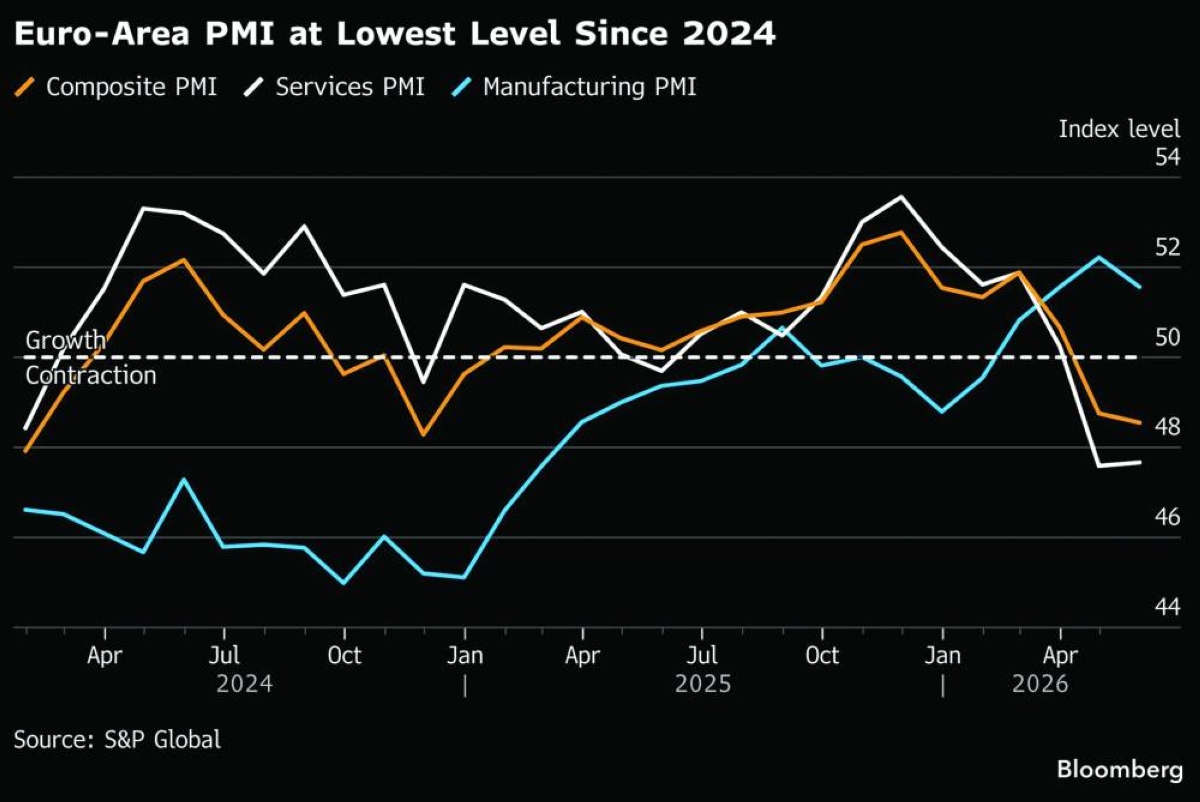
“The European Central Bank’s resolve to uphold its inflation-quashing reputation risks luring it into a damaging error when it meets this week, economists warn. After holding off since the Iran war erupted, officials now look convinced that an interest-rate hike is needed to stop soaring energy prices igniting a broader inflation surge. Yet the case for caution remains strong, with the eurozone economy wobbling and investors in danger of interpreting any move as the first in a series. That dilemma has some analysts arguing that the ECB can bide its time further to assess how persistent the shock will be, particularly as the US and Iran work toward a peace accord. They caution that a premature move could echo widely criticized rate increases 15 years ago that were later reversed as Europe’s debt crisis deepened. “The ECB seems hellbent to prove its credibility,” said TS Lombard’s Davide Oneglia. “The 2011 hikes were a clear policy mistake and repeating it is one of the highest risks we’re facing with the ECB so focused on inflation expectations and the scars left behind by the 2022 experience.” Policymakers from hawkish Executive Board member Isabel Schnabel to dovish Greek central-bank chief Yannis Stournaras suggest they can no longer “look through” the energy shock and must preserve trust in the ECB’s commitment to keep inflation at 2%. The latest reading for the 21-nation bloc already hit 3.2%, with further acceleration likely. Even stripping out energy and food costs, underlying pressures have shifted sharply higher. Firms’ plans for price increases, meanwhile, are elevated. Households’ views on where inflation will go from here are too. “The risk of de-anchoring inflation expectations is rising,” Schnabel cautioned last week. Not everyone’s so concerned. Some analysts say faster core inflation may be due to factors beyond energy pass-through. Others see little sign of undue upward forces on things like wages just yet. “When the ECB hikes before there’s firm evidence of second-round effects, it risks unwarranted tightening and will be taking a risk,” said Michala Marcussen, group chief economist at Societe Generale. Such scenarios recall 2008, when the ECB was forced into a U-turn, reversing a July hike just months later when Lehman Brothers collapsed. But even more economists compare it to 2011, when the ECB under President Jean-Claude Trichet increased borrowing costs twice, only for Mario Draghi to cut toward year-end after taking charge. Back then, policymakers also fretted about spikes in commodity and energy prices. But they underestimated the precarious state of the region‘s financial plumbing, and ultimately the region endured a double-dip recession. The discussion is fueled by the fact that the ECB is positioning itself as the most aggressive inflation-fighter within the Group of Seven central banks, while counterparts like the Federal Reserve adopt a wait-and-see approach to evaluate the Iran fallout. The most recent experience, in 2021-2022, showed the perils of waiting, however. Russia’s attack on Ukraine jolted energy markets and sent inflation to a record 10.6%. Despite an unprecedented campaign of monetary tightening, many said the ECB acted too late. For former ECB Chief Economist Peter Praet, “at some point you have to show that you’re willing to act.” While Finland’s Olli Rehn has described this week’s likely action as an “insurance hike,” Praet said it’s more like “a warning shot to show you mean it.” He stressed, however, the “importance” of not signaling “that this is the first in a series of hikes.” There are those who see a rate increase as justified, even if shifting data prompt a rethink down the line. Economic expansion is waning, particularly in France. Business activity is shrinking at the quickest pace since 2024. The eurozone economy shrank at the start of the year after an unprecedented contraction in Ireland forced a revision to data that originally showed feeble growth. Excluding Irish figures, it grew 0.2%-0.3%, according to Bantleon calculation. Policymakers will “give themselves scope to say if the situation changes materially, if the economy really starts to deteriorate in the way some of these surveys are showing, we will cut,” Katharine Neiss, chief European economist at PGIM, told Bloomberg TV. “They will do it in a way that gives them the space to do that without the reversal affecting their credibility,” she said, predicting a “dovish tone.” Like investors, economists see two quarter-point rate rises this year, possibly what President Christine Lagarde meant by a “measured adjustment” to an inflation overshoot that’s big but should be temporary. They see at least one cut in mid-2027, however. Jens Eisenschmidt, chief European economist at Morgan Stanley who’s worked at the ECB in the past, predicts two hikes in the months ahead, with both to be undone next year. That outcome shouldn’t be viewed as a policy error, though, he said. A June move to address above-target inflation and rising price expectations “would likely be a carefully-weighed decision under uncertainty,” Eisenschmidt said. “Likewise, a decision to cut rates a year after would likely be motivated by an assessment that the insurance provided by a tighter policy stance was no longer needed.” Such justifications don’t fly for some. Holger Schmieding, chief economist at Berenberg, reckons ECB tightening will burden households and firms unnecessarily, with inflation pressures likely to dissipate regardless due to economic weakness. There’s “no need for an ECB hike amid consumer misery,” he said. Given headwinds to demand, “the inevitable temporary surge in prices seems unlikely to turn into a protracted inflation problem to be addressed by rate hikes.”
Original story
Continue reading at Gulf Times Education
www.gulf-times.com/community/education
Summary generated from the RSS feed of Gulf Times Education. All article rights belong to the original publisher. Click through to read the full piece on www.gulf-times.com/community/education.
