
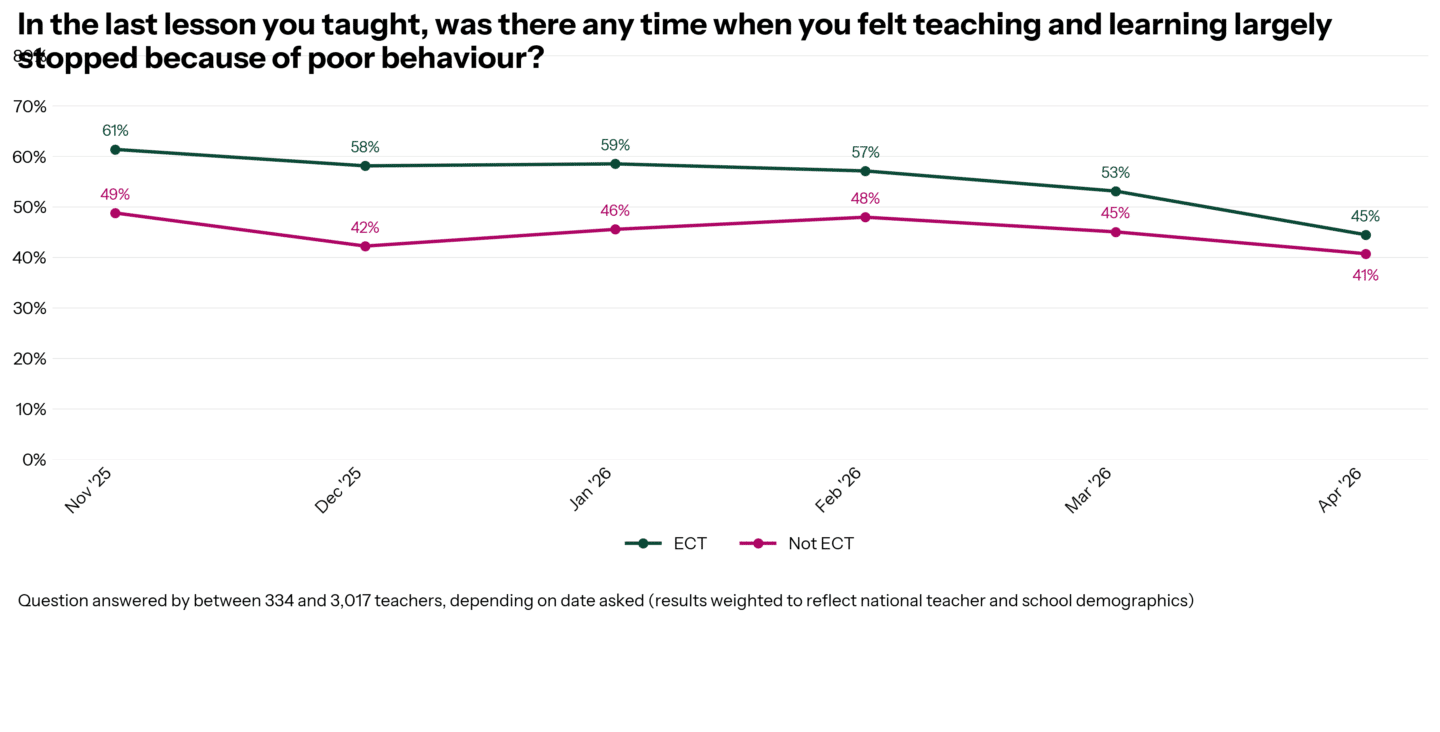
“Well done, ECTs! The Summer term has begun! Our tracking has continued here at Teacher Tapp, and we have more insights to share with you. You can read our first blog here . Now, let’s take a look at how Spring term 2026 went for ECTs… 1. Behaviour gap closes Let’s start off with some good news! The gap between ECTs and non-ECT teachers who report behaviour disrupting their last lesson is closing. This means that, compared to the start of the year, ECTs are now experiencing levels of disruption more in line with those experienced by non-ECTs. Back in December, the gap between ECTs and non-ECTs reporting disrupted learning was 16 percentage points . But since the new year, it’s been closing: 13 , 9, 8 and now 4 . This is really heartening as it suggests rapid improvements in behaviour management – and this was the element of teaching ECTs told us at the start of the year they were most worried about! The number of ECTs finding behaviour stressful has also dropped: 66% reported that student behaviour had been a source of stress in October. In April, that dropped to 59% . These aren’t huge swings, but it’s lots of little shifts all in the right direction. Things are looking up! 2. ECTs are using AI more than other teachers – but only for specific tasks ECTs tend to be younger than the average non-ECT. And it’s all young people using AI, right? Hmm not quite. If you thought AI use was being used more by ECTs than other teachers, you would be right…but only partly. Let’s look at the figures: First off, when looking at general use of AI, ECTs and non-ECTs report very similar levels: 64% of ECTs report using AI in the last week for school work, compared to 60% of non-ECTs. When it comes to having confidence you can spot when students have used AI, again, ECTs and non-ECTs are actually pretty similar: 79% of ECTs and 77% of non-ECTs say they feel confident they would know if a student had used it . However, to fully understand how use of AI might be different we have to look at the details. ECTs are more likely to use AI to plan their last lesson compared to non-ECTs ( 27% vs 20% ). This suggests that although similar rates are using it, what they’re using it for is different. More ECTs using AI for planning lessons might be explained by the fact more experienced teachers already have previously planned lessons to draw upon. However, it might prove to be a problem if the planning itself is the important learning ECTs need to do in order to better understand what works in the classroom. ECTs mentor wrote in to Tapp after this question to ask to flag a concern they had about the use of AI for planning lessons while a teacher was still learning the role. Perhaps one to ask more questions about in the future! 3. ECT lunchtimes It’s been a busy day. The bell rings for lunch, and the students pour out of the classroom. Finally, a chance to use the toilet and get something to eat…but is it? For many teachers, the lunchtimes are far from relaxing – but how do ECTs fare when compared to non-ECT classroom teachers? Let’s start with the small wins: we want ECTs to have a slightly more gentle introduction to the teaching profession, and not be overwhelmed by the tasks of being a teacher, so it’s good news is that ECTs are slightly more likely to say they had a proper break from work ( 27% vs 23% ), and that is probably because they are less likely to deal with work tasks ( 58% vs 64% ). However, as an overall picture of lunchtime experiences, these findings are pretty worrying: just 8% felt refreshed after their lunch break; more than a third ( 37% ) had their lunch interrupted by pupils; and more than half had to work ( 58% ). Yes, a busy lunchtime is part of school life, but can more protections be put in place to allow ECTs time to get in the right headspace for afternoon teaching? After all, ECTs are just at the start of their teaching journey, and to perform at their best, they must take the time to look after themselves too. ➕ Words of advice for the staff room For lots of ECTs the staffroom is their first proper experience of a workplace, and when we asked about what aspects of the ECT year made you feel nervous, a number highlighted worries about staff and professional relationships. And it makes sense! The staffroom can feel like uncharted territory when you’re new, but the good news is that we asked teachers about the WORST staffroom behaviour, to create a guide of what to do! The golden rule is simple: clean up after yourself. Wash your cups, wipe down the microwave, and don’t leave teabags festering in the sink. On that note, think twice before reheating fish or anything equally pungent — it’s the staffroom sin that was mentioned more than anything else (forty times!). And never, ever touch someone else’s lunch 👀. Be the person who makes the room feel welcoming. Say hello to the TA who’s been there twenty years and the supply teacher who doesn’t know where the mugs are kept. New or not, you can set the tone. Equally, steer clear of cliques, gossip, and anything that could come across as bitching about colleagues, SLT, or parents — staffrooms have long memories. Keep it professional in the way you’d want others to. Use headphones for your phone, take difficult conversations to a private space, and remember that venting loudly about a student or a parent decision isn’t just unprofessional – it can become a serious issue if the wrong person overhears. And if you have made any of those mistakes…it really isn’t the end of the world. The good thing is that everyone in the staffroom has once been in your shoes. You can be sure whatever mistake you have made, someone else has also done it before! If you have a suggestion for an ECT question, be sure to get in touch! england@teachertapp.co.uk 📧 The post ECTs – how did Spring term 2026 go? appeared first on Teacher Tapp .
Original story
Continue reading at Teacher Tapp Blog
teachertapp.co.uk
Summary generated from the RSS feed of Teacher Tapp Blog. All article rights belong to the original publisher. Click through to read the full piece on teachertapp.co.uk.