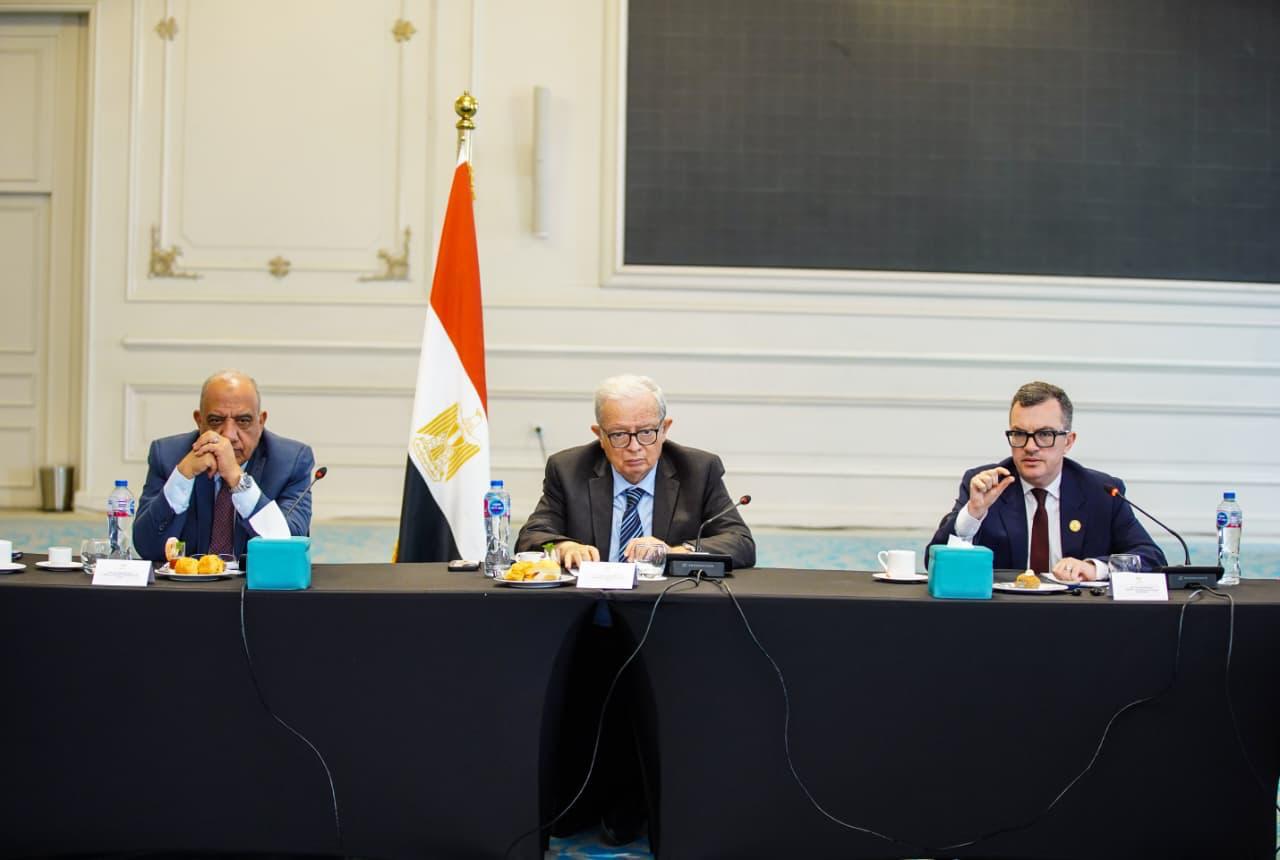
“Ahmed Rostom, Minister of Planning and Economic Development, inaugurated a high-level consultation session with the World Bank Group as part of joint efforts to examine an infrastructure financing and guarantee mechanism for Egypt. The meeting brought together Hussein Eissa, Deputy Prime Minister for Economic Affairs; Mahmoud Essmat, Minister of Electricity and Renewable Energy; Ahmed Omran, Deputy Minister of Housing, Utilities and Urban Communities for Utilities Affairs; Samar El-Ahdal, Deputy Minister of Foreign Affairs for International Cooperation; alongside officials from several ministries and financial institutions. Representatives from the World Bank Group also attended, including Yira J. Mascaro, Practice Manager for Finance, Competitiveness and Innovation for the Middle East and North Africa, Afghanistan and Pakistan, and Saad Sabra, Country Manager of the International Finance Corporation (IFC) in Egypt, in addition to representatives from government bodies and development partners. The session was held within the framework of the strategic partnership between Egypt and the World Bank Group, and forms part of efforts to diversify financing sources for infrastructure projects, strengthen public-private partnerships (PPPs), reduce implementation costs, and provide innovative long-term financing solutions. Deputy Prime Minister for Economic Affairs Hussein Eissa said the government’s direction towards introducing financing and guarantee mechanisms in local currency for infrastructure projects—particularly in the energy and housing sectors—would support Egypt’s broader economic reform agenda. Eissa noted that Egypt requires additional infrastructure investments, especially in the energy sector, to support industrial development and agricultural expansion. He added that the government is seeking to channel further investments into these sectors while creating greater opportunities for private sector participation, particularly in renewable energy projects. Mahmoud Essmat reiterated the state’s commitment to diversifying energy sources and expanding reliance on renewable energy, describing it as a priority in the coming phase in line with the objectives of Egypt Vision 2030. Rostom stated that the meeting forms part of ongoing discussions with the World Bank Group on activating the infrastructure financing and guarantee mechanism, which he described as one of the institution’s innovative tools used in emerging markets to provide diversified, long-term financing solutions and encourage public-private cooperation. He added that discussions are continuing with the World Bank on integrating financing structures in both local and foreign currencies, alongside implementing guarantee systems for infrastructure projects to improve financing efficiency and effectiveness. Rostom expressed appreciation for the longstanding partnership with the World Bank Group and its continued support, noting that implementing such a mechanism in Egypt could pave the way for broader financing tools designed to reduce project risks, particularly as the country expands renewable energy investments. For her part, Yira J. Mascaro stressed the World Bank Group’s commitment to strengthening cooperation with Egypt amid the economy’s ongoing development, underscoring the institution’s support for implementing the infrastructure financing and guarantee mechanism to advance the country’s development priorities. Saad Sabra said the proposed mechanism represents a joint initiative between the World Bank Group and the Egyptian government and could facilitate participation from additional international financial institutions and investors, further supporting infrastructure financing efforts in Egypt. Sabra added that the IFC’s strategic approach focuses on expanding financing and investment opportunities while increasing private sector participation to help ease pressure on public finances. During the session, World Bank Group officials delivered a presentation outlining the objectives of the infrastructure financing guarantee mechanism and its potential role in strengthening public-private partnerships, mobilising capital in both local and foreign currencies, and enabling the implementation of additional infrastructure projects without increasing pressure on the state budget. The post Egypt explores infrastructure financing, guarantee mechanism with World Bank first appeared on Dailynewsegypt .
Original story
Continue reading at Daily News Egypt
www.dailynewsegypt.com
Summary generated from the RSS feed of Daily News Egypt. All article rights belong to the original publisher. Click through to read the full piece on www.dailynewsegypt.com.