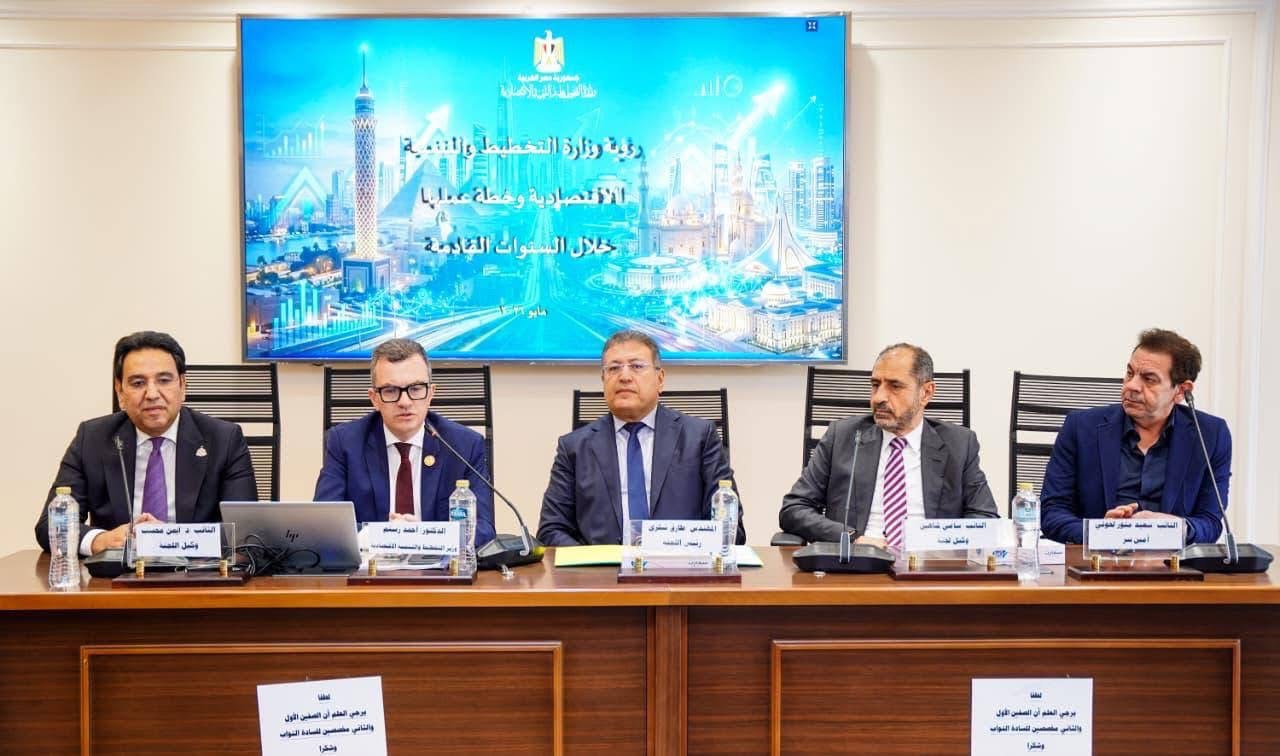
“Egypt is targeting an economic growth rate of 5.4% and total investments of EGP 3.7trn for the upcoming fiscal year (FY) 2026/27, the Minister of Planning and Economic Development announced on Sunday. Presenting the economic and social development plan to the House of Representatives’ Economic Affairs Committee, Ahmed Rostom stated that gross domestic product (GDP) at current prices is expected to reach EGP 24.5 trillion next year, up from an expected EGP 21.2 trillion in the current fiscal year. By the end of the medium-term plan in FY 2029/30, the growth rate is projected to scale up to 6.8%. However, the government has modelled a conservative scenario, capping the FY 2026/27 growth target at 5.2% should regional and global uncertainties persist, Rostom added. Of the targeted EGP 3.7 trillion in total investments for the upcoming fiscal year, private investments will account for 59%, or EGP 2.2 trillion, while public investments will make up 41%, or EGP 1.5 trillion. This allocation brings the investment-to-GDP ratio to approximately 17%. Rostom noted that measures to govern public investments and rationalise spending have successfully increased private sector participation in economic activities. Five sectors are forecast to contribute 64% of the economic growth in the next fiscal year, led by manufacturing at 29%. This is followed by wholesale and retail trade (11.3%), tourism (9.3%), construction (7.2%), and agriculture (7%). Furthermore, four overarching sectors—agriculture, industry, construction, and wholesale and retail trade—are projected to account for 62% of the overall GDP. Outlining the macroeconomic context, Rostom stated that despite successive local and external shocks over the past two decades, Egypt’s economy grew by 4.4% in FY 2024/25, compared to 2.4% in FY 2023/24, with strong performance noted in the first two quarters of the current year. The minister addressed the economic impact of ongoing regional tensions, which he said have disrupted supply chains, slowed global trade, unsettled financial markets, and increased both energy and food prices. He noted that the negative repercussions of the crisis have affected various nations, prompting 78 countries worldwide to approve measures to mitigate the economic impact. In response, the Egyptian government has implemented urgent measures, including rationalising government consumption, alongside medium-term recovery strategies. Despite inflationary pressures driven by higher production and energy costs, international credit rating agencies have maintained Egypt’s rating between stable and positive, reflecting ongoing economic reform efforts, Rostom said. To counter these challenges, the ministry is introducing innovative mechanisms to enhance the efficiency and flexibility of investment spending. Rostom announced three new economic development and employment initiatives starting in FY 2026/27, which include productive agricultural clusters, entrepreneurship support, and startup programmes. Overall, the ministry’s action plan includes 24 new procedures across six work axes, monitored by 109 performance indicators. “Within the framework of this vision, work is underway on many strategic goals, including developing the planning system and improving the management of public investment to maximise the developmental impact of investment spending, diversifying sources of development financing, interacting with developmental initiatives and efforts at the regional and international levels, and directing public investments to priority sectors and areas for the state with precise monitoring of performance and implementation rates, and supporting climate action efforts and the transition to a green economy, through the implementation of about 24 procedures and a number of performance measurement indicators that ensure the effective implementation of the targets,” Rostom said. The presentation to the committee, chaired by MP Tarek Shoukry, aligns with President Abdel Fattah El-Sisi’s directives to improve economic conditions and citizens’ quality of life, as well as instructions from Prime Minister Mostafa Madbouly. Rostom expressed his appreciation to the House of Representatives, headed by Counselor Hisham Badawy, emphasising the ministry’s commitment to continuous parliamentary communication. Rostom concluded by asserting that the state’s plan prioritises improving citizens’ lives by increasing public investments in health, population, pre-university and higher education, scientific research, and social protection. The strategic goals also prioritise completing the first phase of the “Decent Life” initiative, accelerating the comprehensive health insurance system, upgrading the education system, and capitalising on local market stability to attract regional investments, substitute imports, and boost agricultural and food exports. The post Egypt targets 5.4% economic growth and EGP 3.7trn total investments in FY 2026/27 first appeared on Dailynewsegypt .
Original story
Continue reading at Daily News Egypt
www.dailynewsegypt.com
Summary generated from the RSS feed of Daily News Egypt. All article rights belong to the original publisher. Click through to read the full piece on www.dailynewsegypt.com.

