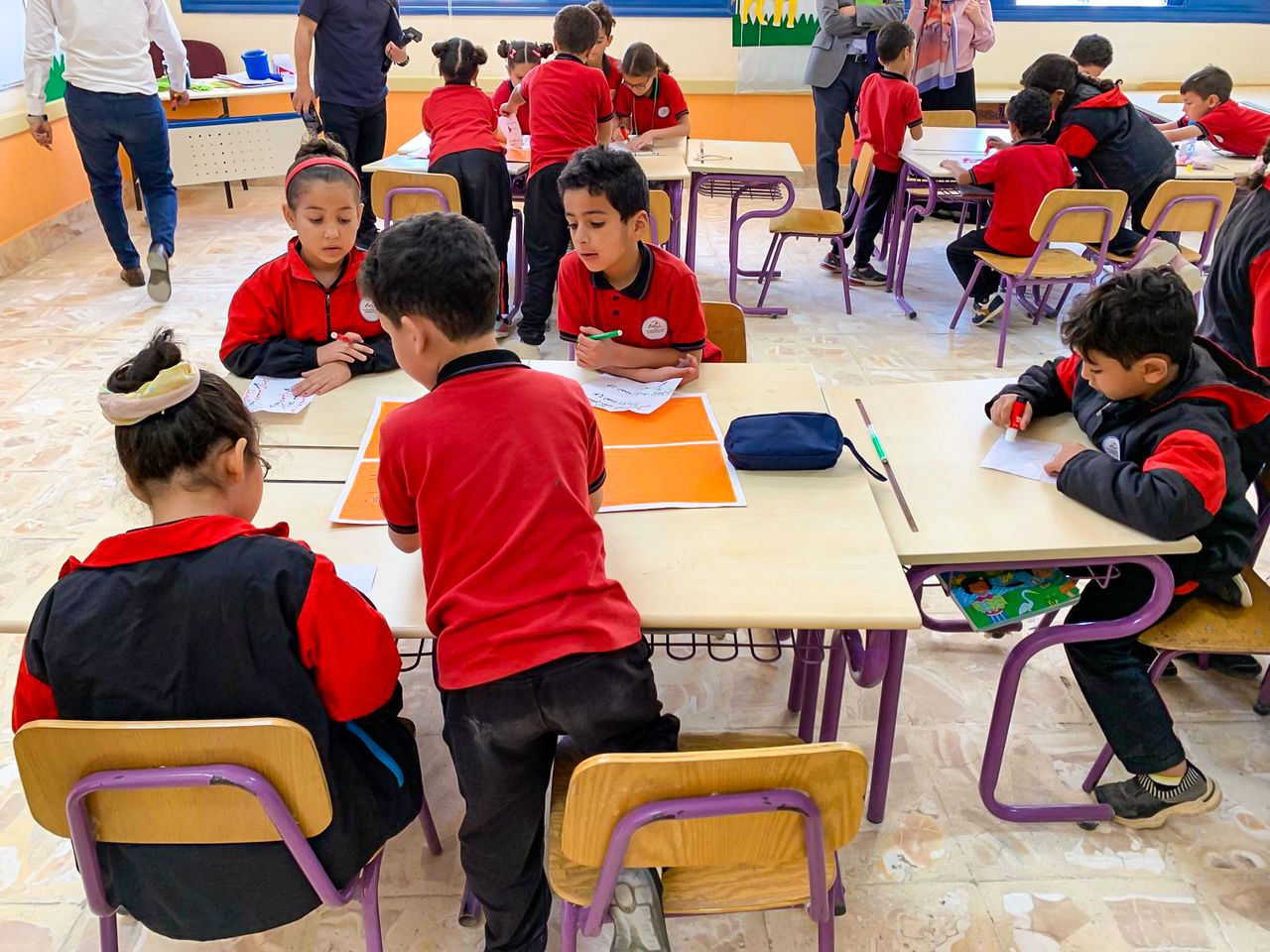
“For the Egyptian state, fixing the nation’s beleaguered public school system is no longer viewed merely as an administrative hurdle, but as a critical pillar of national security and geopolitical strategy. Driven by mandates from the highest political echelons, Cairo has orchestrated a sweeping, fast-paced turnaround of an education sector that was previously crippled by mass absenteeism and infrastructure deficits. A newly unveiled rapid assessment study by UNICEF, titled “Securing Egypt’s Future Through Education Transformation,” details how the government is aggressively rebuilding its human capital to compete in a hyper-competitive, AI-driven global economy. The overarching agenda is a delicate exercise in modern statecraft: catapulting Egyptian youth into international competitiveness while fiercely protecting the republic’s cultural identity. The economic stakes could not be higher. As Chao Wang, an education economist at UNICEF Egypt, pointed out at the study’s launch event in Cairo, Egypt, the country was previously suffering from a severely suppressed human capital dividend. “The economic returns to education were far below the global average,” Wang noted, highlighting a sobering baseline.”With one additional year of schooling, your earnings only increased by 3.4% in Egypt, compared to around 9% globally.” The root causes—low attendance, shortened school days, and massive class sizes—meant children were schooling, but not learning. Reversing this trend, Wang argued, is not merely a social initiative but a macroeconomic imperative. Global evidence suggests that sustained improvements in learning outcomes could ultimately boost Egypt’s GDP by 5 to 36% over the long term. The Mechanics of a Miracle The sheer scale of the turnaround was detailed by Shiraz Chakira, Chief of Education for UNICEF Egypt, who stated unequivocally: “We are confident that the education system is being restored.” The data presented by Chakira was little short of staggering. Student attendance, which languished at a dire 15%, has surged to 87%. Classrooms that once crammed over 100 students together have been eliminated entirely. In primary schools—the system’s most severe pressure point—average class sizes have dropped from 63 to 41 pupils. Furthermore, learning time has increased by 58%, and a targeted 60-hour remedial literacy program for grades 3 to 6 saw Arabic literacy scores jump by over 50% in just three months. “This is not just one single change,” Chakira observed. “It is a coordinated system-wide effort.” He emphasised that the introduction of weekly, grade-linked assessments was the behavioural catalyst that drove students back into the classrooms, reconnecting the act of attending school with the tangible outcomes of learning. Shiraz Chakira, Chief of Education for UNICEF Egypt Amine Marai, the study’s lead researcher and a lecturer at the Harvard Graduate School of Education, underscored the unprecedented speed and fiscal efficiency of the reforms. Over just two years, the Ministry of Education tackled a massive deficit of roughly 467,000 teachers through a blend of redeployment and new hiring incentives. More impressively, the state addressed its infrastructure bottleneck without breaking the bank. By creatively repurposing existing spaces and bringing underutilised facilities back into service, the ministry effectively created 98,000 “new” classrooms—a 20% expansion of system capacity. “If you’re thinking about the equivalent of that in terms of monetary value,” Marai explained, “adjusted for inflation, it would be around $2.5 to $3bn. That’s billion with a ‘B’.” Amine Marai, the study’s lead researcher and a lecturer at the Harvard Graduate School of Education The Macroeconomic View: Financing the Future Despite the operational triumphs, the spectre of fiscal constraint looms large. Mahmoud Mohieldin, United Nations Special Envoy on Financing the 2030 Agenda and Egypt’s former Minister of Investment, delivered a sobering but pragmatic macroeconomic perspective. Referencing Nobel laureate Esther Duflo, Mohieldin reminded attendees that systemic change requires three inseparable enablers: financing, technology, and behavioural incentives. “Without these, nothing will change in any field,” he stated. He issued a stark warning that failure to build the skills required for the future will subject Egypt to severe economic and social pressures. Mahmoud Mohieldin, United Nations Special Envoy on Financing the 2030 Agenda and Egypt’s former Minister of Investment Drawing on his extensive experience at the World Bank and IMF, Mohieldin urged the government to explore innovative financing mechanisms to sustain the reforms without exacerbating sovereign debt. He pointed to successful international models, such as Indonesia’s use of long-term sovereign sukuk for school construction, and Côte d’Ivoire’s debt swaps, which converted €400m in commercial debt into funding for 33 new schools. “I had hoped that what is spent on education, healthcare, and basic infrastructure in my country would exceed what we spend on debt servicing,” Mohieldin remarked, stressing that education must not be crowded out by the state’s fiscal obligations. Looking forward to the AI-driven economy, he cited the IMF’s AI Preparedness Index, noting that technology alone is insufficient; true readiness demands aggressive, sustained investment in human capital. A Global Blueprint The international community is taking note of Egypt’s aggressive timeline. Natalia Winder Rossi, UNICEF Representative in Egypt, commended the “scale, ambition, and speed” of the undertaking. “Often, progress is incremental and systemic change can take a decade or more,” she noted. “What we’re witnessing here in Egypt is remarkable.” However, she cautioned that the country is only at the end of the beginning, noting that true transformation “will require stamina, focus, and continuous investment.” Esohe Ebike, Country Engagement Lead for Egypt at the Global Partnership for Education (GPE), echoed this sentiment, admitting that the pace of the ministry’s work left her wondering, “Do these people sleep?” She confirmed the GPE’srecent approval of a system capacity grant for Egypt and positioned the country as a vital case study for the Global South.”Expect yourselves to be inundated with other countries seeking to learn from you,” she advised Egyptian officials, while outlining the GPE’s campaign to leverage $10bn globally for education transformation. The View from the Top: State Power and National Identity The most forceful political mandates of the day came from the highest echelons of the Egyptian government, signalling that these reforms are viewed not merely as departmental policy, but as the cornerstone of national security and statecraft. In a comprehensive and deeply philosophical address, Minister of Education and Technical Education Mohamed Abdel Latif positioned the reform agenda as the ultimate measure of the republic’s global standing. Directing his remarks to the Prime Minister, Abdel Latif asserted that “education is the true measure of the strength of nations and their ability to compete globally.” For Abdel Latif, the granular operational successes—the repurposed classrooms and the eliminated teacher deficits—are in service of a much grander geopolitical imperative. He emphasised that under the direct directives and comprehensive vision of President Abdel Fattah El-Sisi, the state has fundamentally redefined human development. The goal is no longer just basic literacy, but the construction of a modern, resilient Egyptian citizen capable of navigating and dominating an increasingly complex global economy. The Minister made it clear that the state’s investment in human capital is non-negotiable, viewing it as the highest priority of the political leadership. Prime Minister Mostafa Madbouly reinforced this structural commitment, delivering an overarching mandate that bridged the gap between global integration and domestic sovereignty. Acknowledging the monumental shifts achieved by the Ministry of Education, Madbouly explicitly committed the full weight of the state apparatus to continuing these reform efforts. The Prime Minister articulated a dual mandate for Egypt’s educational future: the absolute necessity of aligning with the highest international benchmarks, without sacrificing the nation’s cultural soul. The state, he declared, is dedicated to”building a modern educational system that aligns with the latest global standards, while preserving our national identity.” This delicate balancing act—integrating Egyptian youth into the hyper-competitive, AI-driven global workforce while fiercely protecting their cultural and historical roots—lies at the very heart of the government’s long-term strategic vision. As the dust settles on this initial, explosive phase of reform, Egypt finds itself at a critical juncture. The classrooms are full, the teachers are at the chalkboards, and the data is pointing upward. The challenge now is maintaining the fiscal discipline, political stamina, and international partnerships required to ensure that this rapid turnaround evolves into a permanent economic renaissance. The post Egypt’s great education turnaround: Overhaul of nation’s public education first appeared on Dailynewsegypt .
Original story
Continue reading at Daily News Egypt
www.dailynewsegypt.com
Summary generated from the RSS feed of Daily News Egypt. All article rights belong to the original publisher. Click through to read the full piece on www.dailynewsegypt.com.

