
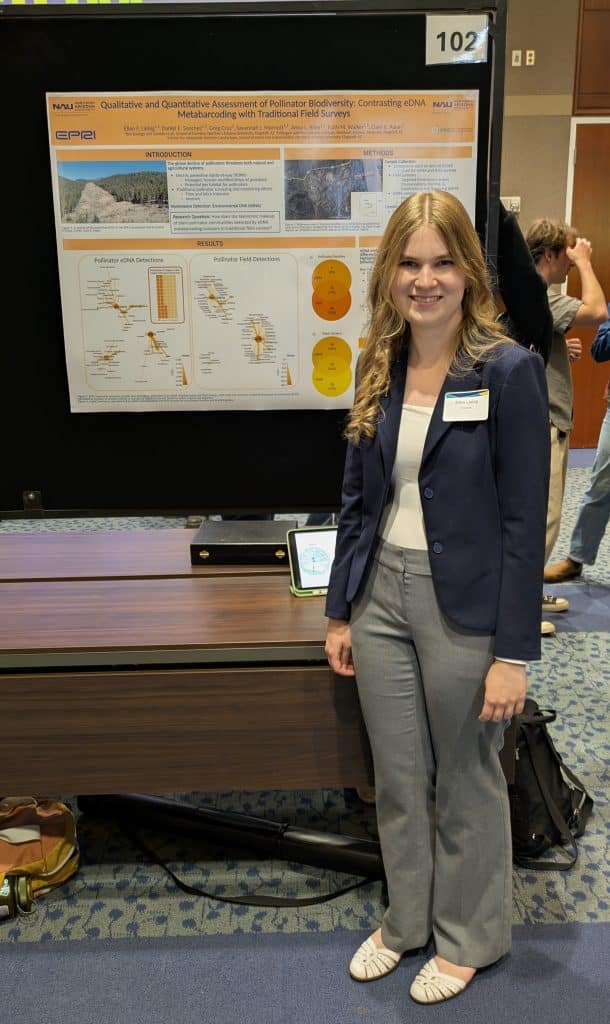
“These days, it’s cool to know a lot about a little. Researchers carve out hyper-specific niches in their respective fields. Social media influencers pick a lane—long-distance bikepacking, trends in needlepoint—and stay there. Medical students’ interest in general internal medicine has halved in the last 10 years, with more of them gravitating toward specialties like anesthesiology or orthopedic surgery. But Ellen Liebig ? She’s all about the big picture. This graduating senior at NAU aspires to help people with complex, misunderstood medical problems, and that requires a holistic understanding of the human body and the world we live in. So rather than choosing one major at NAU, she chose two: environmental sciences and chemistry. Not content with fulfilling all of NAU’s chemistry requirements, she also decided to pursue an American Chemical Society-certified degree in biochemistry , which demands an additional set of advanced courses that give graduates a better understanding of complex topics. And in addition to completing an Honors College capstone project, she completed nine more capstone courses as part of her two majors. Yes, you read that right. Liebig completed 10 capstones. “The big picture is, I want to be a doctor or a researcher working for people who have spent years desperately searching for an explanation for what’s going on with them,” Liebig said. “I want to be the person who has the answer. I want to do research that, years down the line, can help us come up with some treatment or diagnostic option that can help them. Knowing that’s the ultimate goal is a big motivation for me.” In addition to completing an Honors College capstone project, Liebig completed nine more capstone courses as part of her two majors. But why? Liebig didn’t always see a medical career in her future. Born in Germany and raised in Tempe, she loved hiking, reading and doing jigsaw puzzles. As a kid, she was curious (“I annoyed my teachers by asking a billion ‘but why?’ questions”) and dreamed of becoming a turtle farmer…before realizing that wasn’t a real career. “When I was little, I took German lessons at a house with a big backyard and a giant tortoise, and I got to feed it bananas,” Liebig said. “I imagined owning a house with a pond in the back with tons of turtles swimming around.” Liebig soon discovered an aptitude for science and problem-solving. When one of her middle school science teachers asked the class to design a mission to Mars’ moon Phobos, Liebig went above and beyond, creating a spinning base to artificially create gravity powered by solar panels. She loved Science Olympiad tournaments where her team had to build Rube Goldberg machines or develop environmentally sustainable solutions to real societal problems. Once, in high school, she memorized 450 digits of pi just for fun—and for extra credit. When it came time to apply to college, Liebig thought practically: With graduate school in her future, she needed to save money on her undergraduate degree by staying in state. It was between NAU and one other public school—until she found out that attending the other school would require a long commute between two campuses. In the end, she applied only to NAU and the Honors College. “I’m so glad I chose NAU,” she said. “The funding opportunities, the paid undergraduate research I’ve been able to do throughout my four years here, all the supportive people in the chemistry program…I don’t think I’d have been able to have all of that at a bigger school.” From quantum mechanics to bat poop Once in Flagstaff, Liebig hit the ground running. With the goal of attaining an ACS-certified degree, she enrolled in rigorous courses that covered all five subdisciplines of chemistry, from the analytical to the organic, plus classes in quantum mechanics, instrumental analysis and more. She broke up those intensive science requirements with honors humanities courses like Art in Social Justice, trading lab goggles for group discussions. But when it came to electives, Liebig didn’t exactly take the easy way out. This semester, she’s enrolled in Drug Discovery , a graduate-level course that requires students to navigate extremely complicated scientific concepts. As a researcher in NAU’s Pathogen & Microbiome Institute (PMI), Liebig takes samples of plants and animal feces—mostly bat poop—and sequences their DNA. “Understanding how drugs work is important, especially for complex patients,” Liebig said. “If you understand the chemistry behind these drugs and how they work, you might understand what off-label uses they can have. I want to go into treating and researching complex medical conditions, and this is an important piece of the puzzle.” Cindy Browder , the organic chemistry professor who teaches Drug Discovery, said it’s Liebig’s “deep inquisitiveness,” coupled with her willingness to adjust as she learns more, that keeps her at the top of every class. “Those are features of more advanced learners and allow her to function at a level years ahead of the typical student,” Browder said. “Ellen is constantly asking questions and making connections between content in all of her courses and the problems she sees in the real world. It is a great way to succeed academically and to build a career in science.” Outside of class, Liebig took a paid research job in NAU’s Pathogen & Microbiome Institute (PMI). Working with research professor Faith Walker in the Bat Ecology & Genetics Lab, Liebig takes samples of plants and animal feces—mostly bat poop—and sequences their DNA to help other scientists better understand different ecosystems throughout the world. After three years in the lab, Liebig became PMI’s head undergraduate researcher. The job involves overseeing the undergraduate students within the institute, ordering lab supplies, performing safety checks and more. “Over time, she grew more confident and independent, carrying work from data generation through interpretation,” Walker said. “I’ve truly enjoyed working with her, and I expect she will continue to grow into roles that combine research leadership with real ‑ world impact. Watching her develop into a thoughtful, capable and collaborative young scientist has been a real highlight of mentoring.” Meant to mentor Graduating from lab beginner to lab lead was almost inevitable for Liebig, who’s found herself in leadership and mentorship roles for years. In high school, Liebig tutored fellow students in math, got involved with student government and served as one of seven student ambassadors for Arizona 4-H. “People think 4-H is just agriculture, but it’s everything you can imagine—there’s underwater robotics, there’s dancing,” she said. “I was part of a 4-H entrepreneurship club selling handcrafted German paper stars called Fröbelsterne. As an Arizona ambassador, I represented our state at national congresses and helped the 4-H Foundation promote their scholarships, which have been so essential to students who want to go to college.” As president of Ambassadors of CEFNS, Liebig has logged many hours helping fellow students find tutoring, research jobs and scholarship opportunities. At NAU, Liebig became a pro at finding and applying to scholarships, winning more than 10 over the course of four years . Now, she’s passing her hard-earned knowledge on to others as president of the Ambassadors of the College of the Environment, Forestry, and Natural Sciences (CEFNS). She’s also served as a peer mentor in the Research Assistant Mentoring Program, where she helped students land research gigs on and off campus, including at the Mayo Clinic. “A lot of students—freshmen especially—think they can’t apply for scholarships or internships because they don’t qualify or they don’t have enough experience,” Liebig said. “I like explaining all of the different opportunities, showing them how to apply and giving them tips on how you can boost your application.” When she’s not studying and mentoring students, Liebig de-stresses by gardening on campus or snuggling with newborn babies as a volunteer in the neonatal intensive care unit at Flagstaff Medical Center. “A big part of my role is holding babies when they’re crying and the nurses are really busy,” Liebig said. “It’s been great to get immersed in the clinical side of healthcare, talk to nurses and build connections with them.” The big picture Liebig’s experience at the hospital may be her first in a clinical setting, but it certainly won’t be her last. This spring, Liebig was honored with Distinguished Senior and Gold Axe awards. Next month, as she awaits her MCAT results, Liebig will travel east for a biomedical research internship at the University of Rochester. Then, she’ll choose her path: medical school or a dual Ph.D./M.D. program. “I love research, but connecting with patients and solving their medical mysteries is also very important to me,” Liebig said. “I’m hoping to do both.” Whatever direction she chooses, she’s certain of one thing: She wants a career defined by positive impact, specifically for those who have struggled to find solutions to their symptoms. “I want to treat those people who never fit the description of one specific condition or one simple set of symptoms,” she said. “Obviously, it’s valuable to have doctors with specialties, but we can’t lose sight of the bigger picture when patients don’t fit in checklists. I don’t want to be someone who says, ‘That’s not my specialty; I can’t help you.’ I want to be able to say, ‘What you’re going through is real, and we’re going to figure this out together.’” Jill Kimball | NAU Communications (928) 523-2282 | jill.kimball@nau.edu
Original story
Continue reading at NAU News (NAU Review)
news.nau.edu
Summary generated from the RSS feed of NAU News (NAU Review). All article rights belong to the original publisher. Click through to read the full piece on news.nau.edu.

