
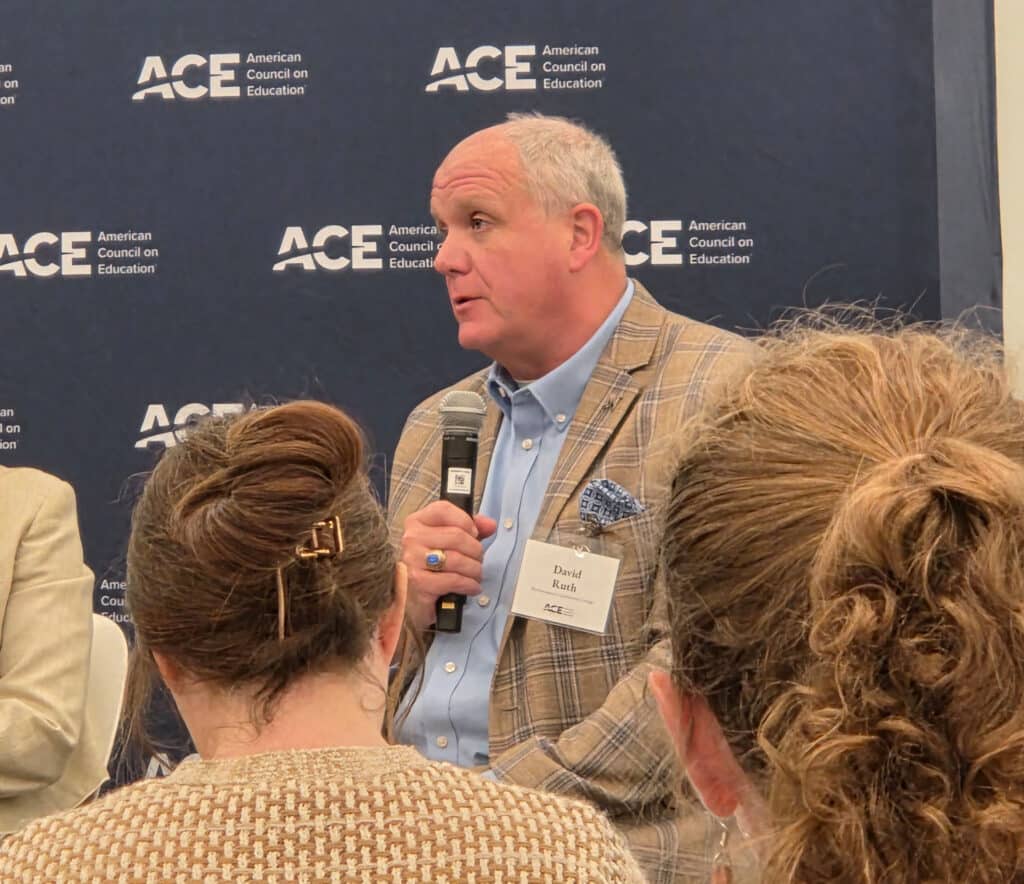
“More and more, higher education institutions are being held accountable for what happens to students once they leave college. Did they successfully transfer? Did they get a job with the greatest economic outcome? Getting to “yes” means building clear pathways. And for Northern Virginia Community College (NOVA) President Anne Kress, that means ensuring there are no “wrong doors.” The college has developed programs that support students, whether they are still in high school, are looking to transfer or are adult learners looking to quickly skill up or re-skill. Kress was part of a panel discussion on Tuesday during the American Council on Education’s Building Pathways Summit held in Arlington, Virginia. ‘Partnering to move forward’ NOVA also has built partnerships in the community to ensure program success. The college works closely with high schools for its dual-enrollment programs. And the ADVANCE program , in partnership with George Mason University (GMU), provides transfer students with targeted, personalized support to help them complete their bachelor’s degrees at GMU in a timely manner and save money. ADVANCE participants who transfer to GMU graduate with a bachelor’s degree at a higher rate than students who started their college education at GMU as freshmen. That’s because the pathway is “crystal clear,” Kress said. NOVA’s FastForward , a quick and affordable training program for in-demand industries, is reliant on local employer input. Workforce partnerships are, in fact, a necessity. Northern Virginia is responsible for 42% of Virginia’s GDP, so building the region’s workforce is “critical to the state,” Kress said. One of NOVA’s big business partners is Inova Health, a five-hospital system that employs about 26,000 people. “Our needs are significant,” said Raj Chand, president of Inova Fair Oaks Hospital. He also serves on NOVA’s college board. Related article: Strengthening the workforce pipeline Besides educating new healthcare workers, NOVA is vital in helping entry-level employees upskill. Inova offers paid externships to NOVA healthcare students, and staff serve on a college advisory committee. Inova also is an advocate for NOVA at the regional and state level. Kress’ “wishlist” for employer partners is that they come to table with a solid understanding of the skills employees need and can communicate what makes a successful employee in their industry. In addition, employers should be prepared to make an investment of time, money and resources. “It’s not about transactions,” Kress said. “It’s about partnering to move forward.” On the employee side, for Chand, sustaining and meaningful communication is necessary for a strong partnership. Simplifying processes Creating clearer pathways also involves simplifying processes. When asked about the public’s increasing distrust of higher education, ACE President Ted Mitchell said the problem is not in the overall structure, but rather in the “plumbing.” People are upset about the complexity of admissions processes, the financial aid process and the transfer process, he said. Kress noted that when the FAFSA process was simplified, NOVA saw a 20% increase in the number of students who received aid, and a 20% increase in the amount of aid they received. In addition, NOVA’s ADVANCE program is intentionally made simple so more people can access it. To participate, students need a 2.0 GPA. The application takes about five minutes to complete, and students hear back within five days – and 100% of participants’ in-program credits transfer for GMU. “We need to make sure the door of opportunity can swing wide,” Kress said. Clearing pathways also can mean taking cues from students, said Summit participant Paula Robinson, associate director of student success opportunities and engagement at the State Council of Higher Education for Virginia. “Look at the pathways that students create for themselves,” she said. “They figure out faster routes. Match those pathways.” Removing barriers despite challenges Funding for higher education has been flat in Pennsylvania, even as businesses costs, such as health insurance, have increased. That means colleges like Northampton Community College (NCC) have had to make hard decisions about what to cut and what to keep. Northampton Community College President David Ruth “We need state lawmakers to talk to students,” NCC President David Ruth said during a panel discussion. In addition, federal cuts to programs such as Child Care Access Means Parents in School Program and Work-Study are hampering student success, he noted. Despite that, NCC is dedicated to removing barriers for students and putting them on the right pathway. The college has more than 100 signed transfer agreements with four-year universities, so pathways are aligned and the transfer process is smoother. For students looking to enter the workforce right away, they can “come get a skill, get a job, and come back and get a degree,” Ruth said. “Our biggest job is to be a cheerleader,” he said. The return-on-investment is high for the community: about 94% of those who attend NCC will stay in the region upon leaving the college. ACE’s May 26 summit capped a year-long series of state-focused convenings, held in Michigan, Pennsylvania and Virginia. The series, funded by Imaginable Futures, brought together higher education institutions, state leaders, employers, students and community organizations to advance student success by elevating state-led priorities and providing national insights and resources. The post Ensuring there are ‘no wrong doors’ first appeared on Community College Daily .
Original story
Continue reading at Community College Daily
www.ccdaily.com
Summary generated from the RSS feed of Community College Daily. All article rights belong to the original publisher. Click through to read the full piece on www.ccdaily.com.

