
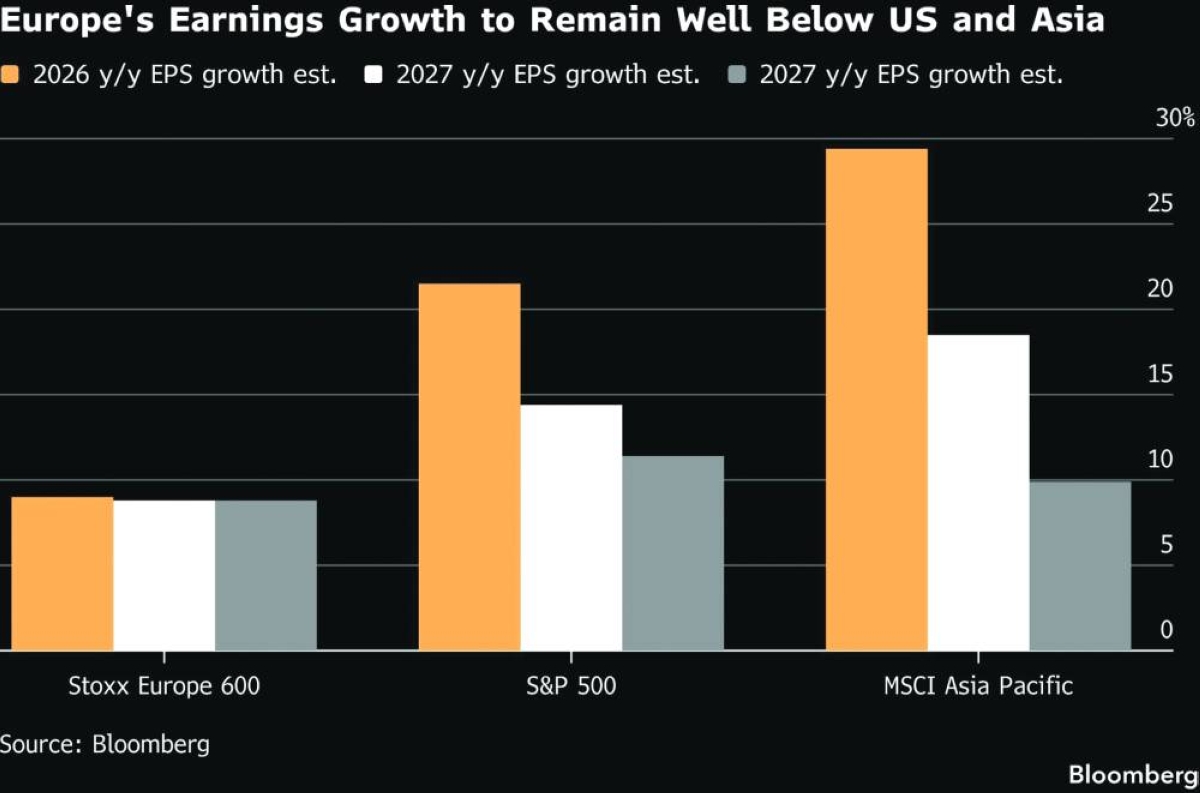
“The equity story that powered European stocks has unraveled as investors seek shelter from a global energy shock and buy into the artificial intelligence frenzy. European stocks had been zooming higher prior to the Middle East war as investors diversified out of the US and piled into the region’s much cheaper stocks. But that narrative has given way to new realities: Europe’s economy is exposed to inflation and supply chain disruptions caused by the conflict, and it’s home to almost none of the companies at the heart of the AI boom. The Stoxx Europe 600 is now a laggard. The tailwinds that investors were betting on, such increased spending on infrastructure and defence, and advantageous monetary policy, have faded. Skepticism has returned. Inflows to European equity-focused funds have been completely erased as of this week, according to Bank of America Corp strategists citing EPFR Global data. Europe is “a region without a theme, with no memes and with too little growth,” said Bobby Molavi, a partner and head of EMEA execution services at Goldman Sachs Group Inc. The US has hyperscalers, while Asia is home to leading chipmakers and other firms essential to the AI build out. Europe, by comparison, has little to offer investors who want in on the technology trade. The continent hosts heavyweight chip equipment maker ASML Holding NV, and a handful of other AI-related companies including Aixtron SE and STMicroelectronics NV. But their combined weight in the region’s benchmark is not significant enough to offset the massive industrial, consumer and defensive complex that investors have shunned this year. Technology stocks account for roughly 8% of the Stoxx Europe 600, compared with 42% for the S&P 500. Semiconductors in particular make only 3.5% of the European benchmark versus about 18% for both the S&P 500 and the MSCI Asia Pacific. At the index level, equity investment is about earnings growth. This year is shaping up to be solid for the Stoxx Europe 600, with analysts expecting an expansion of 11%. Yet that is only half of what’s forecast for the S&P 500 and roughly a third of growth seen for the MSCI Asia Pacific. What’s more, earnings growth in Europe is likely to be downgraded later this year as the energy shock bites. “The continent is grappling with a systemic lack of AI exposure, which leaves European indexes largely on the sidelines of the most significant investment cycle of the recent past,” said Stephan Kemper, chief investment strategist at BNP Paribas Wealth Management. At the same time, the Middle East war has delivered a harsh reminder to investors: Europe’s economy is highly vulnerable to energy shocks. The European Union imports 57% of the energy it needs, and over 90% of the oil and gas it consumes. The US, by contrast, is a net exporter of oil and fuel, a status that helps shield its economy when global energy supplies tighten. “As long as there is no clear normalization of shipping through the Strait of Hormuz, Europe should carry a higher risk premium given its greater exposure to imported energy and renewed inflation pressure,” said Andrea Gabellone, head of global equities at KBC Securities. Monetary policy is also in focus. Last year, stocks got a boost when the European Central Bank slashed interest rates more aggressively than the Federal Reserve. That dynamic may now reverse, with traders expecting the ECB to hike borrowing costs three times this year while the Fed keeps rates steady. There’s a risk that inflation and higher rates combine to hit economic growth, which had been expected to pick up from relatively low levels on increased spending from Germany’s €500bn infrastructure fund, as well as European Union outlays on defense and the bloc’s recovery from Covid. “The widening ‘growth gap’ between Europe and its global peers is increasingly seen as structural rather than cyclical,” said Kemper. The rallies in the US and Asia have been narrow, with the most impressive gains coming from a small number of AI-related stocks. By contrast, the European market is more diversified, with a broader sector exposure that could play in its favor if there’s a reversal in the tech frenzy. European stocks are also cheap. Yet those arguments don’t appear to be swaying investors. For HSBC Holdings Plc chief multi-asset strategist Max Kettner, heavy concentration in tech stocks isn’t a problem. The exposure indicators he tracks are still far away from sending a sell signal. Meanwhile, Europe is firmly on the sidelines. “I think it’s an everywhere story, except Europe,” he said. “The problem with Europe right now, at least tactically, is you’re sitting in the middle like ‘I really need Hormuz to reopen, I really need this Middle East conflict to end, then I can buy banks again, maybe some of the cyclicals, maybe even consumer stocks.’” When it comes to valuations, European stocks are trading at a discount to US peers both broadly, and within specific sectors. With a forward price-to-earnings ratio below 15, the Stoxx Europe 600 offers a 30% discount to the S&P 500. That compares with a 20% average discount over the past 20 years. One potential explanation for why European stocks appear inexpensive is that headwinds are already factored into prices. “This argument seems to be missing the point as Europe lacks the earnings velocity found in the US. Without a sector catalyst like AI to drive multiple expansion, low valuations are reflecting long-term stagnation rather than a buying opportunity,” said Kemper of BNP Paribas. The lack of enthusiasm leaves European stocks as a way to gain some portfolio diversity, and regional companies as potential M&A targets given their lower valuations. For Molavi, there is at least one silver lining. “Things are getting so bad that Europe might, as a construct, wake up and start to move fast and break things,” he said.
Original story
Continue reading at Gulf Times Qatar
www.gulf-times.com/qatar
Summary generated from the RSS feed of Gulf Times Qatar. All article rights belong to the original publisher. Click through to read the full piece on www.gulf-times.com/qatar.