
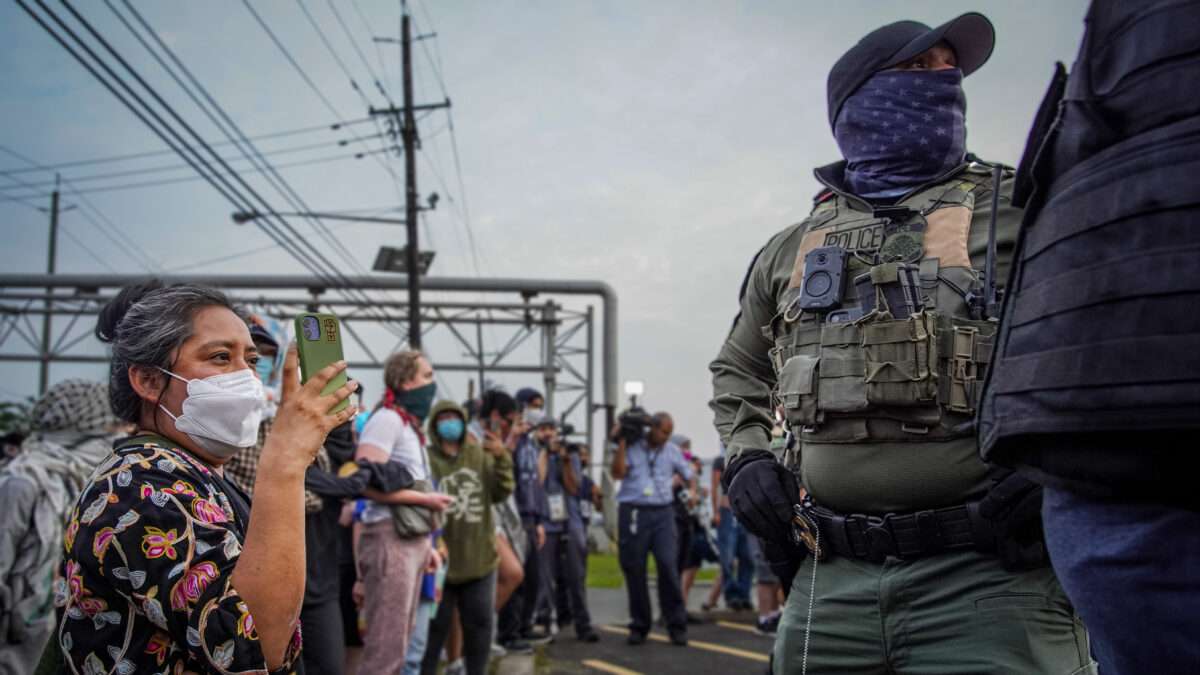
“Renée Good had just died. Hours after Immigration and Customs Enforcement (ICE) agent Jonathan Ross fatally shot the Minneapolis protester on January 7, Kristi Noem, then the secretary of homeland security, said Good had been engaged in "domestic terrorism." She had "weaponize[d] her vehicle," Noem claimed, and "attempted to run a law enforcement officer over." President Donald Trump soon chimed in, averring that Good "violently, willfully, and viciously ran over the ICE Officer" and that "it is hard to believe he is alive." A couple of weeks later, a U.S. Border Patrol agent and a Customs and Border Protection (CBP) officer fatally shot another Minneapolis protester, Alex Pretti. Noem promptly claimed that Pretti had been "brandishing" a gun and had "attacked those officers." A statement from the Department of Homeland Security (DHS) portrayed him as a would-be murderer who "wanted to do maximum damage and massacre law enforcement." Sen. Markwayne Mullin (R–Okla.), who would later replace Noem as DHS secretary, echoed that assessment the day of the shooting, describing Pretti as "a deranged individual" who "came in to cause max damage." Both of those narratives quickly collapsed under the weight of video evidence. Cellphone footage of Good's encounter with Ross did not definitively confirm that she "clipped" him (as the New York Post put it ). But it showed she did not actually run him over and suggested she was not trying to do so, since she was steering her car away from him and the other officers at the scene when he shot her. In Pretti's case, the videos showed he never "attacked" the officers or drew his holstered pistol, which he was licensed to carry. The officers did not see the weapon until after they tackled Pretti, and he had been disarmed by the time the shooting started. Those episodes highlighted the crucial role that bystander video can play in resolving questions about the use of force by law enforcement officers—a benefit that was already clear from nationally notorious incidents such as the 1991 beating of Rodney King in Los Angeles and the 2020 murder of George Floyd in Minneapolis. Such documentation is not just useful but constitutionally protected: Most federal appeals courts, including all that have squarely addressed the issue, have held that the First Amendment encompasses the freedom to record the public conduct of on-duty police officers. That does not mean those officers are always inclined to recognize that right. A decade and a half after Radley Balko wrote a Reason story chronicling the war between camera-wielding observers and camera-shy cops, the latter are still threatening , assaulting , arresting , and forcibly interfering with the former. The people in charge of law enforcement agencies are not necessarily any more enlightened. Noem maintained that "videotaping" ICE officers is a form of "violence." Her underlings, who frequently reacted to cellphones as if they were dangerous weapons , seemed to be taking their cues from her. Even after Noem was fired on March 5, DHS harassment of observers recording immigration enforcement operations persisted. According to a lawsuit that the American Civil Liberties Union (ACLU) filed on May 13, members of the Memphis Safe Task Force, which includes ICE agents, CBP officers, and U.S. marshals as well as Tennessee Highway Patrol (THP) officers, have systematically tried to deter activists from documenting their public conduct. The ACLU's complaint , which describes incidents extending beyond Noem's tenure, says the intimidation tactics include photographing activists and their license plates, calling them out by name, using vehicles to box them in, surveilling their homes, shining bright lights at their phones and cameras, detaining and grilling them without reasonable suspicion, and threatening them with arrest. In one case, the ACLU says, a THP officer tackled an observer and arrested her, after which she spent 27 hours in jail. Noem's equation of peaceful recording with violent aggression was no more accurate than the stories she told about Good and Pretti. But until the Supreme Court definitively upholds the right to record armed agents of the state as they earn their taxpayer-funded paychecks, law enforcement officers will have a license to continue treating that right as a crime. 'The Right to Gather Information' The first circuit court victory for the right to record the police was also a defeat. James and Barbara Smith complained that cops in Cumming, Georgia, had prevented them from videotaping public police activity, thereby violating their First Amendment rights. U.S. District Judge Julie Carnes granted summary judgment for the city and its police chief, concluding that the right asserted by the Smiths did not exist. In the 2000 case Smith v. City of Cumming , the U.S. Court of Appeals for the 11th Circuit disagreed. It nevertheless sided with the defendants. "We agree with the Smiths that they had a First Amendment right, subject to reasonable time, manner and place restrictions, to photograph or videotape police conduct," the 11th Circuit said. "The First Amendment protects the right to gather information about what public officials do on public property, and specifically, a right to record matters of public interest." In support of that proposition, the three-judge panel cited prior decisions by the 11th Circuit and other courts upholding the right to film public meetings or "matters of public interest" and recognizing that the right applies to all Americans, not just professional journalists. "The district court erred in concluding that there was no First Amendment right," the 11th Circuit said. But "although the Smiths have a right to videotape police activities," the panel added, "they have not shown that the Defendants' actions violated that right." Exactly why the 11th Circuit reached the latter conclusion is not clear from the four-page opinion, which is short on details. The appeals court noted the skimpiness of the Smith panel's reasoning 21 years later in Crocker v. Beatty , which involved a Florida man who was taking pictures of a fatal car crash while standing in the median of Interstate 95. Martin County Deputy Sheriff Steven Beatty grabbed James Crocker's cellphone and told him to leave, which Crocker refused to do until he got his phone back. As punishment for Crocker's disobedience, Beatty arrested him for "resisting an officer" and "left him in a hot patrol car for about 30 minutes." Although Beatty showed little respect for the right that the 11th Circuit had recognized two decades earlier, the appeals court held that he was protected by qualified immunity, a doctrine that shields police officers from federal civil rights claims unless the plaintiff alleges a violation of "clearly established" law. " Smith 's declaration of a right to record police conduct came without much explanation," the appeals court said. "The dearth of detail about the contours of the right announced in Smith undermines any claim that it provides officers 'fair warning' under other circumstances." As that case illustrates, vindicating "the right announced in Smith " can be a challenge even in circuits where that right has been acknowledged. But Smith , despite its "dearth of detail," started a trend. By 2023, eight of the 12 regional circuit courts had recognized a First Amendment right to record police. 'You Have Taken Enough Pictures' Just as Beatty did not like it when Crocker took pictures of a car crash, Boston cops did not like it when Simon Glik recorded an arrest. But unlike Crocker and the Smiths, Glik got a green light to sue the officers who were vexed by his videography. On a Monday evening in October 2007, Glik was walking by the Boston Common when he saw three police officers arresting a young man. Glik stopped, he said, because he heard a bystander remark that the officers were hurting the arrestee. He began recording video of the encounter with his cellphone from about 10 feet away. After the suspect was in handcuffs, one of the cops turned to Glik and said, "I think you have taken enough pictures." Glik corrected him: "I am recording this. I saw you punch him." When Glik confirmed that he was recording audio as well as video, the cops arrested him for violating a Massachusetts law against "wiretapping." Since that law applied only to surreptitious recordings, a municipal judge dismissed the charge, along with a charge of disturbing the peace. The fact that the officers "were unhappy they were being recorded during an arrest," the judge noted, "does not make a lawful exercise of a First Amendment right a crime." But was Glik exercising a First Amendment right? Yes, a federal judge ruled after Glik sued the cops who had arrested him on bogus charges. In the 1st Circuit, U.S. District Judge William G. Young said, "this First Amendment right publicly to record the activities of police officers on public business is established." The U.S. Court of Appeals for the 1st Circuit agreed. "Is there a constitutionally protected right to videotape police carrying out their duties in public?" the appeals court asked in the 2011 case Glik v. Cunniffe . "Basic First Amendment principles, along with case law from this and other circuits, answer that question unambiguously in the affirmative." The Supreme Court had made it clear that the First Amendment "encompasses a range of conduct related to the gathering and dissemination of information," the 1st Circuit noted. In the 1978 case Houchins v. KQED , for instance, the justices said "there is an undoubted right to gather news 'from any source by means within the law.'" As the 1st Circuit saw it, "the filming of government officials engaged in their duties in a public place, including police officers performing their responsibilities, fits comfortably within these principles." That conclusion was consistent with the 1st Circuit's 1999 ruling in Iacobucci v. Boulter , which involved a journalist who was arrested for filming in the hallway outside a public meeting of the Pembroke, Massachusetts, Historic District Commission. Although that case hinged on other legal issues, the decision noted that the videographer was exercising "his First Amendment rights." Glik also cited "the decisions of numerous circuit and district courts" recognizing "a right to record matters of public interest," including "what public officials do on public property." Like the 11th Circuit in Smith , the 1st Circuit said "the right to film is not without limitations" and "may be subject to reasonable time, place, and manner restrictions." But unlike the 11th Circuit in Crocker , the 1st Circuit said that right was clearly established, giving the officers who had arrested Glik "fair warning" that their conduct was unconstitutional. In fact, it said, "the brevity of the First Amendment discussion" in Iacobucci and other appeals court decisions recognizing the right to record public officials "implicitly speaks to the fundamental and virtually self-evident nature of the First Amendment's protections in this area." 'Retaliation by Officers' Glik's experience illustrated the threat that wiretapping laws could pose to people who record the police. Unlike the Massachusetts statute under which he was wrongly charged, Illinois had a law that criminalized audio recordings, surreptitious or not, without the consent of all parties. The ACLU of Illinois, which planned to record on-duty officers as part of a "police accountability program," challenged that law in federal court. Although U.S. District Judge Suzanne Conlon did not perceive a relevant constitutional right, the U.S. Court of Appeals for the 7th Circuit did. "The Illinois eavesdropping statute restricts a medium of expression commonly used for the preservation and communication of information and ideas, thus triggering First Amendment scrutiny," the appeals court said in the 2012 case ACLU v. Alvarez . "The Illinois eavesdropping statute restricts far more speech than necessary to protect legitimate privacy interests; as applied to the facts alleged here, it likely violates the First Amendment's free-speech and free-press guarantees." Five years later, the U.S. Court of Appeals for the 5th Circuit considered a First Amendment claim by Phillip Turner, who was arrested in 2015 after two officers saw him recording video of a Fort Worth police station while standing on the sidewalk across the street. In the 2017 case Turner v. Driver , the appeals court ruled that the officers were protected by qualified immunity because the right to record them was not clearly established in the 5th Circuit at the time of Turner's arrest. But it also said that would no longer be true going forward: "First Amendment principles, controlling authority, and persuasive precedent demonstrate that a First Amendment right to record the police does exist, subject only to reasonable time, place, and manner restrictions." Three months later in Fields v. Philadelphia , the U.S. Court of Appeals for the 3rd Circuit noted that observers like Turner were still being harassed by police. The opinion opened by citing George Holliday's momentous 1991 video of Rodney King's encounter with Los Angeles cops. Such recordings "have both exposed police misconduct and exonerated officers from errant charges," the appeals court noted. Yet "despite the growing frequency of private citizens recording police activity and its importance to all involved, some jurisdictions have attempted to regulate the extent of this practice. Individuals making recordings have also faced retaliation by officers, such as arrests on false criminal charges and even violence." The incidents at the center of that case were especially striking because they involved cops in Philadelphia, where the police department had recognized that "private individuals have a First Amendment right to observe and record police officers engaged in the public discharge of their duties." Despite that acknowledgement, an officer forcibly prevented Amanda Geraci, a member of the police watchdog group Up Against the Law, from recording an arrest during a 2012 anti-fracking protest at the Philadelphia Convention Center. Another officer likewise flouted department policy in 2013, when Temple University student Richard Fields used his iPhone to photograph police as they broke up a house party. Although Fields was standing across the street at the time, the officer who confiscated his phone arrested him for "obstructing" a "public passage." The 3rd Circuit noted that "every Circuit Court of Appeals to address this issue" had "held that there is a First Amendment right to record police activity in public." The court joined that "growing consensus," ruling that "the First Amendment protects the act of photographing, filming, or otherwise recording police officers conducting their official duties in public." It rejected U.S. District Judge Mark Kearney's assumption that such conduct is protected only when it includes an "expressive" intent. The issue, it said, was not whether Geraci and Fields "expressed themselves through conduct" but "whether they have a First Amendment right of access to information about how our public servants operate in public." That right, the 3rd Circuit duly noted, is "subject to reasonable time, place, and manner restrictions." But it said there was no need to "address at length the limits of this constitutional right" because the defendants "offer nothing to justify their actions." The 3rd Circuit nevertheless granted the officers qualified immunity. Although the Philadelphia Police Department had "adopted official policies recognizing the First Amendment right of citizens to record police in public," the commissioner's policy adviser testified that "officers didn't understand that there was a constitutional right." And since the 3rd Circuit had not specifically upheld that right prior to this case, the appeals court said, "we cannot say that the state of the law" in 2012 or 2013 "gave fair warning so that every reasonable officer knew that, absent some sort of expressive intent, recording public police activity was constitutionally protected." 'Clearly Established Law' While the 3rd Circuit saw no need to address the question of which restrictions on the right to record are "reasonable," that issue was at the center of a case that the U.S. Court of Appeals for the 9th Circuit decided in 2018. The dispute involved two activists who were detained by CBP officers because they were taking pictures near ports of entry in California. In both cases, the officers deleted the photos, ostensibly for security reasons. The 9th Circuit ruled that U.S. District Judge Thomas Whelan had improperly dismissed the resulting lawsuit. Because "the First Amendment protects the right to photograph and record matters of public interest," it said in Askins v. DHS , the government "had the burden of demonstrating that its restrictions on speech were the least restrictive means necessary to serve a compelling government interest." The appeals court remanded the case for further consideration of the facts necessary to determine whether the government could meet that test. No such analysis was necessary when the U.S. Court of Appeals for the 10th Circuit decided Irizarry v. Yehia in 2022. That case involved Abade Irizarry, "a YouTube journalist and blogger" who ran into trouble while recording a DUI stop in Lakewood, Colorado, early on a Sunday morning in May 2019. Officer Ahmed Yehia, evidently displeased, stood in front of Irizarry, obstructing his view. When Irizarry and another reporter objected, Yehia aimed a flashlight at Irizarry's camera and "then drove his police cruiser at the two journalists." Because Irizarry's lawsuit "alleged a First Amendment retaliation claim under clearly established law," the appeals court held, "Officer Yehia is not entitled to qualified immunity." Although the 10th Circuit "has not recognized a First Amendment right to film the police performing their duties in public," it said, "we recognize that the right exists and was clearly established when the incident occurred." In reaching that conclusion, the court relied on the prior decisions recognizing that right in other circuits, a 10th Circuit precedent noting that "an individual who records a police encounter" is "creating speech," and the Supreme Court's rulings regarding newsgathering. The following year, by contrast, the U.S. Court of Appeals for the 4th Circuit granted qualified immunity to Myers Helms, a Winterville, North Carolina, police officer who tried to prevent motorist Dijon Sharpe from livestreaming his own traffic stop. Helms claimed he was enforcing a town policy aimed at protecting officer safety. "Creating and disseminating information is protected speech under the First Amendment," the 4th Circuit noted in the 2023 case Sharpe v. Winterville Police Department , "and other courts have routinely recognized these principles extend the First Amendment to cover recording—particularly when the information involves matters of public interest like police encounters." The 4th Circuit embraced that view, ruling that "livestreaming a police traffic stop is speech protected by the First Amendment." It overturned a lower court's contrary conclusion and remanded the case for further consideration of Winterville's justification for restricting that right. But the court dismissed Sharpe's claim against Helms, noting the lack of precedents recognizing the specific right to livestream your own encounter with police. By the beginning of 2012, Thomas A. Perez, the assistant attorney general in charge of the Justice Department's Civil Rights Division, thought it was already clear that "private citizens have a First Amendment right to record police officers in the public discharge of their duties." At that point, just two federal appeals courts had explicitly recognized that right. The six decisions since then add further weight to Perez's conclusion that such conduct is "unquestionably protected by the First Amendment." During the Biden administration, the Justice Department reiterated that "the First Amendment protects the right to record police officers performing their duties in public, subject to reasonable time, place and manner restrictions." That right, it noted, had been upheld by "every court of appeals" that had addressed the issue. The Trump administration's lawyers, by contrast, have not shown much interest in defending the right to record law enforcement officers. To the contrary, they have questioned whether protesters who object to the administration's immigration crackdown can assert such a right. In response to Tincher v. Noem , a lawsuit alleging that DHS employees retaliated against Minnesota protesters for constitutionally protected conduct, the Justice Department said that claim "fails at the threshold because the Eighth Circuit has not recognized a ' First Amendment right to observe police officers.'" That was a reference to Molina v. Book , a 2023 decision by the U.S. Court of Appeals for the 8th Circuit, which includes Minnesota. But as U.S. District Judge Katherine Menendez noted when she granted the Tincher plaintiffs a preliminary injunction in January, Molina merely addressed the question of whether, for purposes of qualified immunity, the right to record police officers was clearly established in the circuit as of 2015. "Whether a right was clearly established is a separate inquiry from whether a right is constitutionally protected," she wrote. Menendez ruled that "the First Amendment protects a right to peacefully observe and/or record law enforcement officers who are engaged in their official duties in public." In support of that conclusion, she cited several 8th Circuit precedents that she deemed relevant and noted the consensus among other appeals courts that have considered the question. 'You're Not Free To Record' Outside court, the Trump administration has shown even less regard for the First Amendment rights of protesters who record immigration agents. In a 2025 bulletin , the Federal Protective Service, a division of the DHS, described "surveillance" of law enforcement officers (LEOs), including the production and sharing of videos, as a "tactic" used by "demonstrators" and "violent offenders" who were fomenting "unlawful civil unrest." The bulletin also cited "livestreaming LEO interactions" as a "common method" of "threatening LEOs." Noem employed similar rhetoric at a July 2025 press conference. "Violence is anything that threatens [ICE agents] and their safety," she told reporters, "so it is doxing them, it's videotaping them where they're at when they're out on operations, encouraging other people to come and to throw things, rocks, bottles." A couple of months later, Tricia McLaughlin, then the assistant DHS secretary for public affairs, likewise described "videotaping ICE law enforcement and posting photos and videos of them online" as a form of "doxing." The government, she added, "will prosecute those who illegally harass ICE agents to the fullest extent of the law." In January, McLaughlin told Wired that "videoing our officers in an effort to dox them and reveal their identities" is "a federal crime and a felony." During a hearing in February, Sen. Rand Paul (R–Ky.), chairman of the Senate Homeland Security Committee, wondered how that could be true. He noted that Pretti was "filming in the middle of the street" immediately before his deadly encounter with immigration agents. "Is filming of ICE or Border Patrol either an assault or a crime in any way?" Paul asked CBP Commissioner Rodney Scott and Todd Lyons, then the acting ICE director. "No, sir," they both replied. CBP and ICE employees often seem to disagree with that assessment. In Illinois last November, David Brooks was recording an immigration arrest when a Border Patrol agent turned to face him and said, "Get back, or I'm going to shoot you." The agent, who refused to give his name or badge number, then drew his pistol and aimed it at Brooks. "Shame on you," Minnesota protester Abigail Salm tells an ICE agent in a video posted on X a few days after Good's death. "Listen," he replies, "have y'all not learned from the last couple of days?" When Salm wonders "what's our lesson here," he grabs her phone. The agent then "told me I needed to leave," according to a declaration that Salm submitted in support of the Tincher plaintiffs. When she refused to leave without her phone, she says, he "grabbed me, slammed me down on the hood of my car, and handcuffed me." A declaration that Minnesota protester Ann Kreitman submitted in the same case includes video stills showing an ICE agent grabbing a woman by the arm and shoving her into a snowbank. Kreitman says the woman, who "had her phone out like she was recording or attempting to record," was not "doing anything violent or aggressive." In a video posted on X in January, an ICE agent in Minneapolis approaches a man who is standing in the street, holding up his cellphone, and shoves him to the pavement. A cellphone-wielding protester in St. Paul got a similar reaction from an ICE agent, who told him to "get back," shoved him, ran after him, and tackled him. Yet another video shows an ICE agent telling a driver who is holding a cellphone to stop recording, saying, "You're detained right now, so you're not free to record." When the driver disagrees, saying "we're not detained," the agent reaches into the car to grab the phone, then opens the door, precipitating a struggle. "Give me your phone," he says. These videos do not necessarily show the full context of what happened, but they do suggest that DHS employees precipitously resorted to the use of force because they were angry at protesters. DHS officials encouraged such hotheaded reactions by describing peaceful recording of immigration agents as "violence" and felonious "doxing." Although it is no doubt irritating to be scolded for doing your job, such speech is indisputably protected by the First Amendment, and so is the "surveillance" that the DHS views as contributing to "unlawful civil unrest." Constitutional issues aside, this sort of harassment is apt to have a chilling effect on the DIY documentation that can be crucial in uncovering the truth about government violence. "There's an element of necessity here for accountability," Will Creeley, legal director at the Foundation for Individual Rights and Expression, noted the day after Pretti's death. "If we didn't have video footage of what happened to Mr. Pretti yesterday, what would the government tell us? What would we know about it?" The post Filming Cops Is a First Amendment Right. The Feds Keep Harassing People for It Anyway. appeared first on Reason.com .
Original story
Continue reading at Reason
reason.com
Summary generated from the RSS feed of Reason. All article rights belong to the original publisher. Click through to read the full piece on reason.com.
