
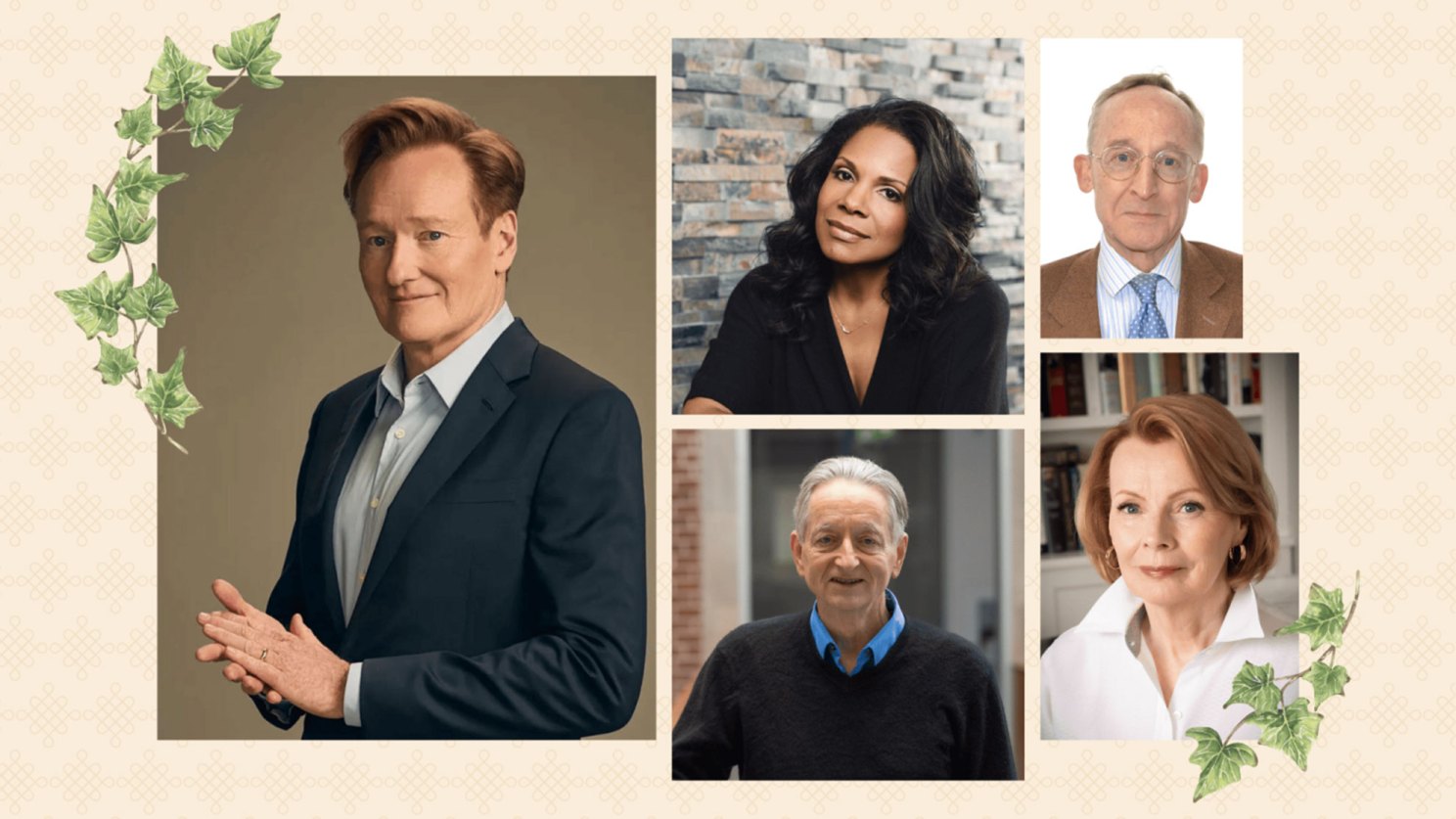
“Campus & Community Five recognized with honorary degrees Conan O’Brien (clockwise from left), Audra McDonald, Noel Malcolm, Peggy Noonan, and Geoffrey Hinton. Photo illustration by Liz Zonarich /Harvard Staff Lucia Huntington Harvard Correspondent May 28, 2026 long read Recipients chosen for their lifetime contributions and transformative achievements Part of the Commencement 2026 series A collection of features and graduate profiles covering Harvard’s 375th Commencement. The University will confer five honorary degrees during Thursday’s Commencement ceremony. Geoffrey Hinton Doctor of Science The man who has been twice dubbed the Godfather — of both AI and deep learning — earned his Ph.D. in artificial intelligence two decades before most people had personal computers, and more than 10 years before the internet became a go-to for news, email, and chat rooms. But though he helped bring AI to the fore, Geoffrey Hinton has now become its prognosticator, speaking out about the dangers of deliberate misuse, technology-driven unemployment, and the existential risk of overdependence on artificial intelligence, rather than human brains. And despite many honors, including a Turning Award and a Nobel Prize in physics, he has said that a part of him regrets his life’s work. Hinton was educated at King’s College, Cambridge, graduating with a B.A. in experimental psychology. He earned his Ph.D. in AI at the University of Edinburgh, was the first director of University College London’s Gatsby Charitable Neuroscience Unit, did postdoctoral work at the University of California San Diego, and spent five years on the Computer Science faculty at Carnegie-Mellon University. He joined the University of Toronto in 1987, and is now University Professor emeritus there. According to the Royal Society of London, where he was a fellow, “Hinton is distinguished for his work on artificial neural nets, especially how they can be designed to learn without the aid of a human teacher. This may well be the start of autonomous intelligent brain-like machines.” His other expertise lies in deep learning algorithms, and he is noted for co-inventing the Boltzmann machine, a system that “pretrains” backpropatation methods. (Asked by New York Times reporter Cade Metz what that means, Hinton quoted Richard Feynman: “Buddy, if I could explain it in a couple of minutes, it wouldn’t be worth the Nobel Prize.”) After years in academia and as a Google vice president, Hinton resigned from the latter position to “freely speak out about the risks of AI.” In 2023 he told Metz, “It is hard to see how you can prevent the bad actors from using it for bad things,” and warned that AI becomes more dangerous the smarter it grows. “The idea that this stuff could actually get smarter than people — a few people believed that,” he said. “But most people thought it was way off. And I thought it was way off. I thought it was 30 to 50 years or even longer away. Obviously, I no longer think that.” Upon receiving the Nobel Prize, Hinton called for urgent research into AI safety and the establishment of safety guidelines to learn how to control it. He told Metz, “I don’t think they should scale this up more until they have understood whether they can control it.” Noel Malcolm Doctor of Laws Among the powers — and responsibilities — of the press are its duty to disseminate accurate information and its role as a watchdog, checking the actions of every branch of government and holding them accountable. It is perhaps then in his position as political columnist and foreign editor of Spectator magazine from 1987-1992 that Sir Noel Malcolm made his greatest mark. Albin Kurti certainly thought so. The longtime Kosovar politician and current prime minister said that when the Balkan war started in the late 1990s, Malcom — Margaret Thatcher’s adviser on the Balkans in that time, president of the Anglo-Albanian Association, a member of the Academies of Sciences of Albania and Kosovo, and then at Harvard — was a crucial voice. “At the outset of the war in Kosova in 1998, he published the most important international historical account of the country,” Kurti said. “His work was timely, as propaganda was being used to justify genocide, and it documented the systemic discrimination of Albanians. “He set the record straight at a moment when distorted history was being weaponized, so that the truth of the past could shape a more just future.” There is no doubt Malcolm knows the truth of the past. He studied history and English literature at Peterhouse, Cambridge, England, and was a fellow of Gonville and Caius College, also in Cambridge. In 1999 he was a visiting scholar at Harvard, and he gave the Carlyle Lectures at Oxford and the Trevelyan Lectures at Cambridge in 2001 and 2012, respectively. He has been a senior research fellow at All Souls College, Oxford, since 2002. His notable books include the definitive “Bosnia: A Short History” and “Kosovo: A Short History,” which challenged nationalist myths in the Balkans; the “Correspondence of Thomas Hobbes”; the intellectual histories “Useful Enemies: Islam and the Ottoman Empire in Western Political Thought, 1450-1750” and “Agents of Empire,” which focused on Venetian-Albanian relations; and “Human Rights and Political Wrongs,” in which he wrote that human rights “are concerned not with everything that is morally important, but rather with essential limits on the use of state power.” A fellow of the British Academy and a fellow of the Royal Society of Literature, at Cambridge he is an honorary fellow of Peterhouse, Trinity, and Gonville and Caius. The late Queen Elizabeth II knighted Malcolm in 2014 in recognition of his work in scholarship, journalism, and European history. Audra McDonald Doctor of Arts Along with an Emmy and two Grammys, Audra McDonald has 11 Tony nominations and no less than six wins, making her the most-awarded performer in Broadway history — and the only actor ever to win in all four acting categories, lead or featured actor in a musical or play. A Juilliard School graduate, McDonald made her stage debut in “The Secret Garden” in 1992. Two years later she won her first Tony for her role in “Carousel,” followed closely by a winning turn in “Master Class”; her other winning stage roles were “Ragtime” (1998); “A Raisin in the Sun” (2004); “Porgy and Bess” (2014), which before it hit Broadway was an A.R.T. production that sparked controversy by reimagining the opera as a musical; and “Lady Day at Emerson’s Bar & Grill” in 2014. “I’m somewhere in the middle between opera, musical theater, and I’m loving being there,” she told American Masters in 2000. On TV, she made an early appearance as a daughter in “The Cosby Show” pilot, but gave it up for the stage. She had a breakout year in 1999 with roles in “Having Our Say: The Delaney Sisters’ First 100 Years,” “Annie,” and “Homicide: Life on the Street,” and she won an Emmy in 2015 for hosting “Live from Lincoln Center.” In the studio, the classically trained soprano was recognized with two Grammys, best opera recording and best classical recording, for her work on Kurt Weill’s “Rise and Fall of the City of Mahagonny” in 2008. McDonald is also known for her advocacy work, saying, “Maybe it’s because my uncle and my parents were always very involved with the Civil Rights Movement, so I just grew up and I was raised that you have to speak out and look out for your fellow man, woman, and child.” She helped found Black Theatre United, telling The New York Times in 2007, “I refuse to be stereotyped. If I think I am right for a role I will go for it in whatever way I can. … I can’t control what a producer will do or say but I can at least put myself out there.” She is on the board of Covenant House International, an organization that fights human trafficking and supports homeless young people, and a prominent advocate for LGBTQIA+ rights, recognized with the PFLAG National Straight for Equality in Entertainment award, the Human Rights Campaign’s Ally for Equality award, the National Equality Award, Broadway Impact and Freedom to Marry. She also took part in “Singing You Home,” a bilingual children’s album that supports charities for families separated at the border. Peggy Noonan Doctor of Laws In addition to her many awards (including a Pulitzer, in 2017), honorary degrees (UPenn, Notre Dame, her own Fairleigh Dickinson University), and New York Times bestsellers (five), Peggy Noonan is a Literary Lion of the New York Public Library, an award that honors outstanding achievements — in her case, her “Declarations” column in The Wall Street Journal, which has run weekly for 26 years, and her 2017 essay collection, “The Time of Our Lives.” Noonan began her career working at CBS Radio for Dan Rather, did a stint as a newswriter at WEEI Radio in Boston, and worked as an adjunct professor of journalism at New York University. She had a notable career as a speechwriter, contributing to Ronald Reagan’s addresses marking the 40th anniversary of the Normandy Invasion, the loss of the Space Shuttle Challenger, and his “shining city on a hill” Farewell Address. For George H.W. Bush, she created the catchphrases “kinder, gentler nation” and “a thousand points of light,” which urged Americans to solve problems through community service. Raised a Democrat, Noonan grew disenchanted with the student counterculture and anti-war movements of the 1960s, later writing, “My generation, faced as it grew with a choice between religious belief and existential despair, chose marijuana.” She became a prominent Republican in 1984. Noonan has written 11 books on U.S. politics, culture, and religious faith, including the critically lauded “What I Saw at the Revolution,” which Time magazine called “A love letter to the American political process,” and her most recent, “A Certain Idea of America.” In 2024, she described America as “Big, raucous, troubled, frayed.” She is one of 10 writers and historians who contributed essays on the presidency to “Character Above All,” which profiled presidents from FDR to Bush. Noonan has said that, “Democracy involves that old-fashioned thing called working it out” — courteously. “You don’t tell people who disagree with you they’d be better off somewhere else. And you don’t reduce them to stereotypes; you address them as fully formed people worthy of respect. You try to persuade them.” Conan O’Brien Doctor of Arts On April 25, the Harvard Lampoon celebrated its 150th anniversary. It was only right that longtime late-night host Conan O’Brien — who served as a two-term president of the third-longest continually running humor magazine — would return to the Castle to mark the occasion. On May 28, he’ll be back for another reason: The Class of 1985 alumnus and Bay State native will come home to address this year’s graduates as their Commencement speaker. Again, it’s only right: O’Brien made his bones at Harvard and The Lampoon. “Legend has it that O’Brien spent a night in jail following a stunt he pulled as an undergraduate. (On ‘advice of counsel,’ O’Brien declined to comment.) Having procured a jack-hammer as well as several hard hats and other construction-related paraphernalia, he and a group of fellow students cordoned off a section of street in downtown Boston and went to work, as it were, tearing up the pavement,” Harvard Magazine reported in 2004. O’Brien allegedly followed up with two calls, one to the Boston police to complain about College students ripping up the street, the other to state police to say that construction workers trying to do their job were being harassed by students posing as Boston cops. O’Brien went on to wider audiences. He was a writer on the sketch show “Not Necessarily the News,” and later joined “Saturday Night Live.” As a writer and producer on “The Simpsons” he was responsible for the fan favorite episodes “Marge vs. the Monorail” and “Homer Goes to College.” But he found his metier as a television host when he took over the “Late Night” chair from David Letterman. He hosted the show for 16 years, earning an Emmy in the process, and at one point joining Jon Stewart and Stephen Colbert for a “ Late Night fight .” (O’Brien’s best move: a two-for-one punch worthy of the Three Stooges. Runner-up: the dance-off.) In 2009, O’Brien left “Late Night” after a conflict with NBC. From 2010 to 2021 he hosted “Conan” on TBS, and since 2018 he has run the podcasts “Conan O’Brien Needs a Friend” (the first one to visit was Will Ferrell) and the spin-off travel show “Conan O’Brien Must Go.” Other hosting stints have included the Emmy Awards twice, the White House Correspondents’ Dinner, and two Oscar ceremonies (with a third set for next year). He was inducted into the Television Academy Hall of Fame in 2025, and received the Mark Twain Prize for American Humor the same year. Recognizing that “Your path at 22 will not necessarily be your path at 32 or 42.” O’Brien has also noted that, “Nobody in life gets exactly what they thought they were going to get. But if you work really hard and you’re kind, amazing things will happen.” And finally, “When all else fails there’s always delusion.”
Original story
Continue reading at Harvard Gazette
news.harvard.edu
Summary generated from the RSS feed of Harvard Gazette. All article rights belong to the original publisher. Click through to read the full piece on news.harvard.edu.

