
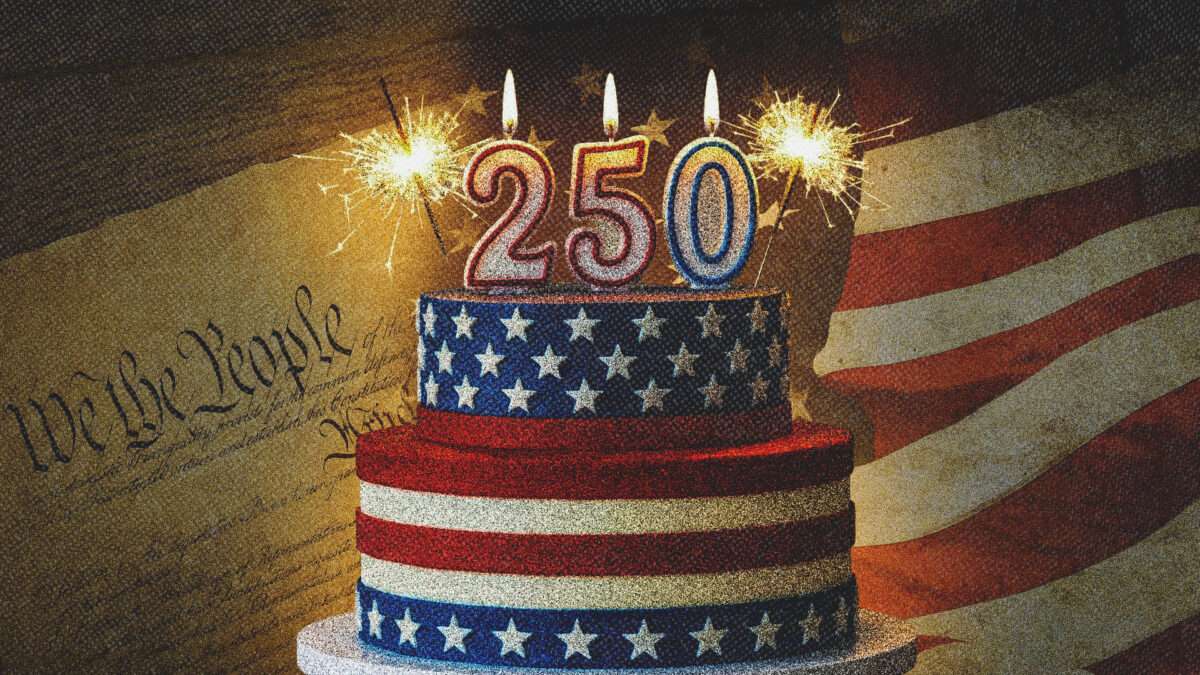
“I was 10 years old in 1976, when the United States celebrated its bicentennial. I remember fireworks, lots of patriotic bunting, and commemorative packaging galore, but what really caught my eye was the privately organized American Freedom Train rolling museum, which toured the country with exhibits about the nation's history. My parents were too busy to transport me—actually, in those free-range days I may not have even asked. I rode my bicycle several miles into Tarrytown, New York, and bought a ticket to tour the train. I'm not sure many kids could do that these days without raising eyebrows. A Muted National Birthday The loss of youthful independence is not all that has changed in the years leading to the 2026 semiquincentennial (yeah, I had to look that up). The Freedom Train project for this year was canceled after failing to gather enough support. Awareness of and feelings about the year are sufficiently muted that you could be forgiven for forgetting 2026's historical significance. The sad fact is that you'd be hard pressed to scare up an enthusiastic national birthday party in much of the country these days. Many Americans are glum about the country's prospects, and they're not particularly enthused about their role in it or the simple existence of many of their neighbors. "Ahead of the United States' 250th anniversary, 59% of Americans say the country's best years are behind us, while 40% say its best years are ahead," Pew Research's Blen Wondimu reported earlier this month. "Americans are also much more pessimistic (44%) than optimistic (28%) when asked to think about what things will be like in the U.S. 50 years from now." Ouch. But it gets worse. In a New York Times /Siena poll published last October , 64 percent said America is "too politically divided to solve its problems." Thirty-two percent thought calling the U.S. "a free country" described it "not too well" or "not at all well." Forty-one percent said the same of calling it "a democratic country." Asked to name the most important problem faced by the country, Democrats' first choice was President Donald Trump and Republicans; Republicans' second choice (after the economy) was Democrats. Unsurprisingly, political polarization/division was the overall second choice for "most important problem" and the first pick for independents. Organizing a community-wide party to celebrate the country's 250th birthday would be a challenge right now. If you got everybody together, the shindig would more than likely degenerate into a screaming match. You might also run up against a shortage of enthusiasm. "A record-low 58% of U.S. adults say they are 'extremely' (41%) or 'very' (17%) proud to be an American, down nine percentage points from last year," Gallup found last summer. That's way down from the 91 percent who expressed pride in 2002 and 2004. Interestingly, Democrats' sense of pride in being American has become extremely partisan, plummeting to 42 percent in 2020, the last year of the Republican Trump's first term, before rising again to a high of 64 percent under Democrat Joe Biden. It's now at 36 percent. Republicans never dropped below 84 percent, even during the " Let's Go Brandon " days of Biden's term. Their pride is now at 92 percent. But it's not just about political identity. "There are clear generational differences in American pride, with each new generation significantly less likely than the previous one to say they are extremely or very proud to be an American," adds Gallup's Jeffrey M. Jones. Intrusive adult supervision might not be all that would keep a modern 10-year-old from pedaling a bicycle across town to see a train full of patriotic exhibits these days. Many kids simply wouldn't be interested. But the U.S. has been through challenging times before in its history, including a civil war. It's worth looking at that past not just for patriotic purposes, but for lessons as to how to live in a fractious nation. The Many Americas of Modern America Perhaps more than at any time since 13 very different colonies banded together to win independence from England, there's not one America, but several Americas. Their differences are apparent in the mutual loathing that has Republicans and Democrats pointing to each other as problems for the country. But the Americas are also, helpfully, sorting themselves into increasingly like-minded communities. "Our analysis suggests partisanship itself, intentional or not, plays a powerful role when Americans uproot and find a new home," Ronda Kaysen and Ethan Singer reported for The New York Times in 2024. "In all but three states that voted for Mr. Biden in 2020, more Democrats have moved in than Republicans. The reverse is true for states Mr. Trump won — in all but one, more Republicans moved in," they added, building on research that dates back at least to Bill Bishop's 2008 book The Big Sort . Further research finds that even when Americans go on vacation, "individuals traveling from counties with strong political leanings are more likely to visit politically congruent areas, regardless of whether the origin county is liberal or conservative," according to a paper published in January of this year. Some of this sorting is intentional. But a lot of it happens because partisan identity is strongly connected to lifestyle differences. Democrats and Republicans who like to live and recreate in different ways—urban walkability vs. rural open space—move to their preferred environments when the opportunity arises and reinforce political separation as a result. Bring Back Decentralization, for the Sake of the Country It makes sense that people who think differently and live in contrasting ways should and can be governed differently, largely in accord with their desires. At least, they can be governed more in accord with their desires than if governed centrally through policies inflicted by a victorious faction on the nation at large. People who don't like local governance can move to a friendlier community that better suits them. That's how the U.S. federal system was originally conceived, with power divided and most decisions made closer to individuals by state and local authorities. That made policies easier to escape for people who preferred something else. "In the compound republic of America, the power surrendered by the people is first divided between two distinct governments, and then the portion allotted to each subdivided among distinct and separate departments. Hence a double security arises to the rights of the people," as argued in Federalist No. 51 . We've lost much of our original federalism, and its ability to prevent friction, by centralizing so much government far from individuals who are affected and might prefer something else. Forced to live by rules that don't suit them according to the outcome of the last election, half the country is constantly at the other half's throat. This centralization has been a huge mistake with dire results as seen in the divided country of today and muted enthusiasm for its 250th year in existence. There's a tricentennial coming up in 50 years. Checking out old historical exhibits for a hint as to how federalism worked, and then implementing those lessons, might let the various Americas enjoy a shared celebration in 2076. Maybe there will even be support for another traveling museum. The post For America's 250th Birthday, Give Us the Gift of Renewed Federalism appeared first on Reason.com .
Original story
Continue reading at Reason
reason.com
Summary generated from the RSS feed of Reason. All article rights belong to the original publisher. Click through to read the full piece on reason.com.

