
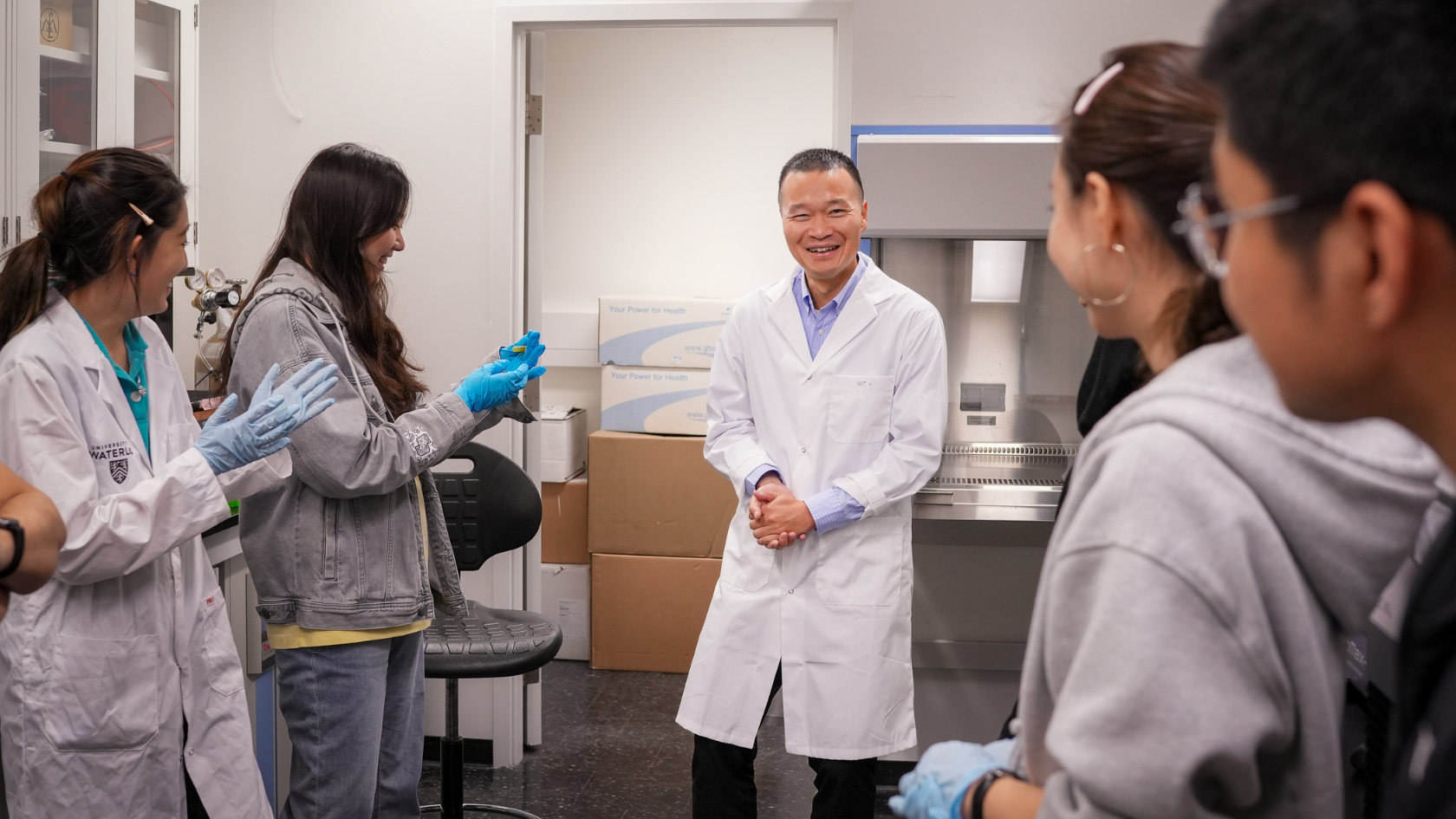
“Share Reimagining DNA beyond genetics is revealing powerful new tools that could shape tomorrow’s technologies and scientific discoveries Every big breakthrough starts with a single idea. The desire to find out how. The determination to find out why. In chemistry professor Dr. Juewen Liu’s lab, this is at the heart of everything they do. As one of Clarivate’s most highly cited researchers, the exploratory work in his lab has influenced thousands of researchers and advanced the field of DNA research outside of genetics. In biology, DNA’s job is to store genetic information. It’s also very stable, which can make it useful for other things too. Liu sees DNA as a chemical tool with untapped potential, and his team has been pushing boundaries by exploring DNA as a material, not just a biological molecule. In the last five years, his lab has created more than 100 aptamers, short DNA sequences that bind to specific molecules. These aptamers act like molecular velcro, latching onto targets ranging from amino acids and drugs to metal ions and metabolites like lactate and citrate. “We repurpose DNA as a chemical tool that can recognize and bind to other molecules, enabling new ways to detect diseases, deliver drugs, and build molecular sensors,” Liu explains. “Once we have a DNA sequence that can bind to a particular molecule, it can be used for real-world applications like therapeutics and biosensors. For example, we found a DNA sequence that binds to the cornea, which could allow eye medications to stay in place longer than regular eye drops and help patients with dry eye disease.” Liu and his team develop the molecular tools that others can use to build biosensors, diagnostics, and therapeutics. Understanding what DNA can do, how it behaves, and its limits, has built a strong foundation that could lead to incredible breakthroughs, and that’s what inspires them to keep exploring. “Our focus is on the front end of the research flow,” Liu says. “Engineers, biomedical scientists, and environmental researchers take it from there.” And that’s exactly what they’ve done. Researchers worldwide have built on Liu’s aptamers, citing his work thousands of times. Companies in the U.K. and the U.S. have approached the lab about licensing its patented lactate aptamer. On campus, Liu collaborates with colleagues in engineering and environmental science on projects ranging from mercury detection to microplastics. With 13 papers already published from his lab in 2026, it’s clear that Liu’s lab team isn’t slowing down. With rotating visiting experts from around the globe, nine graduate students, multiple postdocs, and 10-15 undergraduate students, the lab is always busy and filled with collaboration at all levels. Everyone in his lab is an important part of the team and pushes the work forward. With foundational science like Liu’s, the reach is never known, but the potential is always there. His work on aptamers could be linked to medical treatments, environmental sensors, or food safety tools down the line. “DNA work appealed to me at first because it was interesting, but the more I’ve learned about what it can do outside of its biological role, the more amazed I am,” he says. “Its impact will be shaped by how scientists build on the foundation we laid. It’s rewarding to know that our work is just the beginning of a chain of innovations that could benefit society.” Science Health Futures Societal Futures Share
Original story
Continue reading at University of Waterloo News
uwaterloo.ca/news
Summary generated from the RSS feed of University of Waterloo News. All article rights belong to the original publisher. Click through to read the full piece on uwaterloo.ca/news.