
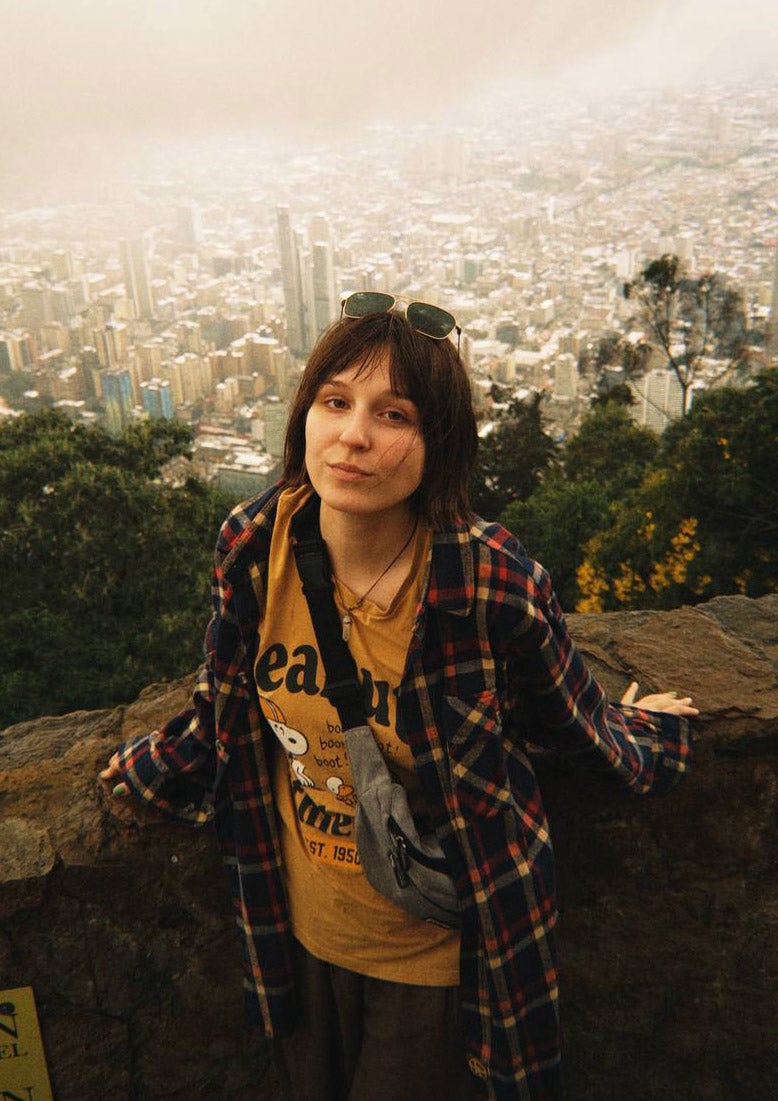
“Share After fleeing Ukraine, Marianna Iovenko turned displacement into survivor advocacy studying wartime justice, care and recovery for survivors of conflict-related sexual violence When Marianna Iovenko began her graduate studies at the University of Waterloo, she carried with her the emotional weight of fleeing Ukraine after Russia’s full-scale invasion in 2022. This included her daily worry for family members still living through the war. But Iovenko also experienced a growing determination to use her research to help others. “My research has helped me stay connected to Ukraine and to the people living through this war,” she says. Now graduating from Waterloo’s MA in Sociology and Legal Studies program, Iovenko is examining how survivors of conflict-related sexual violence (CRSV) in Ukraine experience justice, care and recovery during wartime - work shaped profoundly by both her academic background and lived experience. At Waterloo, she found a research community that helped transform personal loss and displacement into purpose. “I had a lot to learn from my supervisor, and she completely shaped me as a researcher and helped me find new ways of expressing myself,” Iovenko says. “I’m extremely grateful.” Finding purpose through research Before the war, Iovenko was studying law in Ukraine while working full-time as a paralegal in criminal law. But on February 24, 2022, everything changed. When her father called around 5 a.m. to tell her Russia had invaded, the reality of the moment was difficult to comprehend. “I honestly thought that I must be having a fever,” she says. “It was so surreal.” As explosions echoed across Kyiv and air raid alarms sounded outside, Iovenko packed a suitcase with food and water before fleeing the city with her family. She would later leave Ukraine with her younger brother and eventually continue her studies abroad. While completing her undergraduate law studies in Canada, Iovenko began exploring questions surrounding gender-based violence, international justice and survivor advocacy. During that time, she encountered the work of Waterloo professor Dr. Rashmee Singh, whose scholarship helped shape the direction of her future research. “That paper really influenced my decision to work on my current research,” she says. “Back then, I began having these ideas of the importance of researching wartime sexual violence in Ukraine because it is such an underdeveloped topic.” At Waterloo she found an interdisciplinary environment that allowed her to combine a legal studies education with sociological approaches to justice, gender and conflict. Researching justice beyond the courtroom Iovenko’s graduate research focuses on the experiences of survivors of conflict-related sexual violence in Ukraine, particularly how survivors navigate justice systems and support services during wartime, such as frontline NGOs and survivor-led networks. “Importantly, I was not interested in purely legal aspects of responsibility and just the process for the Russian perpetrators who commit wartime sexual violence against Ukrainians,” she says. “Instead, I wanted to fill the gap regarding actual views of survivors on the pathways to justice.” Iovenko’s research explores the legal, psychological and social barriers survivors face while seeking support and recognition. Her findings challenge traditional international justice frameworks that often prioritize legal evidence and prosecution over long-term survivor care — highlighting grassroots initiatives that are reshaping how care, resilience and accountability are understood in post-war contexts. “Ultimately, I hope my work shows that rebuilding after conflict requires us to stop treating survivors only as evidentiary instruments for trials and instead recognize them as the primary architects of their own recovery and justice processes.” Looking ahead Iovenko plans to continue her work at the University of Waterloo as a PhD student, further exploring survivor-led advocacy networks and their role in shaping post-war justice and recovery efforts. She hopes her research will contribute not only to academic conversations, but also to policy development and international approaches to survivor care. “Globally, I want to challenge how international tribunals and donors engage with post-war recovery,” she says. “Historically, international justice mechanisms have been highly extractive, taking survivor testimonies for prosecution while leaving their immediate psychosocial and economic needs unaddressed.” For Iovenko, continuing her research is about more than academic achievement. It is a way to remain connected to Ukraine, advocate for survivors and ensure their voices continue to be heard. “One of my dissemination goals,” she says, “is to show the world even more about the war — not only from the academic side of things, but also just to make people think a bit deeper.” Arts Research Share
Original story
Continue reading at University of Waterloo News
uwaterloo.ca/news
Summary generated from the RSS feed of University of Waterloo News. All article rights belong to the original publisher. Click through to read the full piece on uwaterloo.ca/news.
