
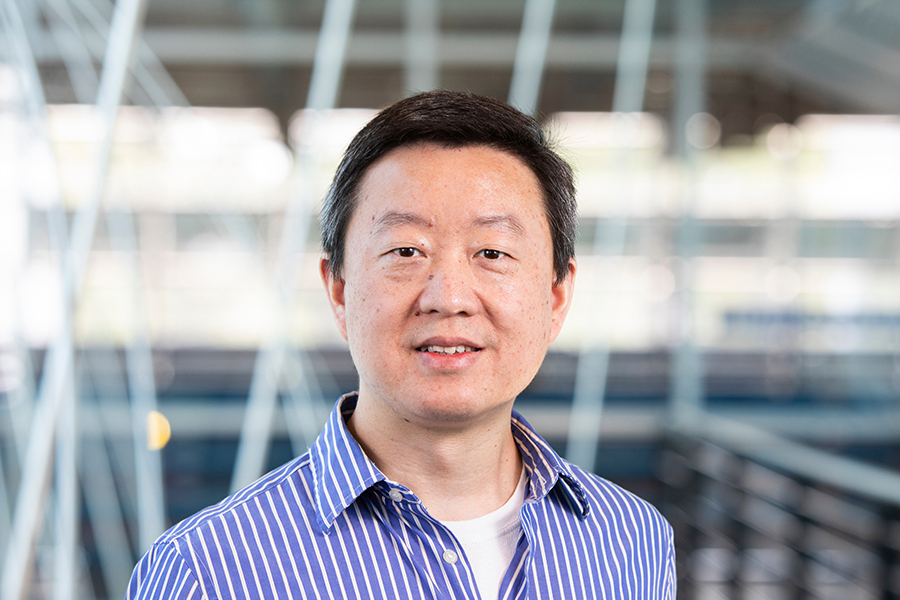
“FAMU-FSU College of Engineering researchers contribute to landmark study demonstrating ultra-low noise levels in innovative qubit platform Florida State University and FAMU-FSU College of Engineering faculty members Wei Guo and Xianjing Zhou are part of a multi-institution research team whose latest findings advance one of the most promising platforms in quantum computing. A new qubit, the fundamental building block of quantum information processing, invented at the U.S. Department of Energy’s Argonne National Laboratory exhibits noise levels thousands of times lower than those of most traditional qubits. The study was published in Nature Electronics . Noise refers to disturbances in the environment that diminish a qubit’s performance. The platform is built by trapping single electrons on the surface of frozen neon gas, and the recent findings position it as a strong contender in the field of high-performance quantum technologies. The new study was jointly led by Argonne and the University of Notre Dame. Faculty at Florida State University, the University of Chicago, Harvard University and Northeastern University collaborated on the research. “One of the biggest obstacles in quantum computing is finding a material environment that is quiet enough for qubits to survive, yet practical enough for building larger systems,” said Guo, a professor in the Department of Mechanical Engineering at the FAMU-FSU College of Engineering and researcher at the National High Magnetic Field Laboratory . “This study shows that solid neon offers a very compelling combination of cleanliness, stability and resilience. That is exactly the kind of foundation we need if we want quantum hardware to become more robust and scalable.” Quantum computing: Potentially transformative, but challenged by noise Today’s computers and smartphones run on bits, which are tiny switches that can be either 0 or 1. Quantum computers use a special kind of bit known as qubits that can be 0 and 1 at the same time. What’s more, the state of one qubit can instantly affect another qubit’s state, even if they are on opposite sides of the planet. The remarkable properties of qubits can endow quantum computers with exponentially greater computational power than that of classical computers. This opens the door to solving challenging problems like inventing disease-curing drugs, advancing materials design, enabling secure communication and optimizing complex supply chains. Yet quantum computers are still an emerging technology. Qubits are extremely sensitive to noise — tiny disturbances in the environment such as electromagnetic fields, heat and particle vibrations. As a result, qubits tend to have short coherence times, meaning they can only retain information for a fraction of a second. Most of today’s chip-based qubits are made of semiconducting or superconducting materials. But these qubits are often challenged by noise from material defects, embedded charges and fabrication variability. The electron-on-neon qubit has the potential to address these limitations. An electron (represented by the ball) is controlled by a resonator (red wires) above a solid neon surface (the transparent square piece under the ball). Noise (disturbances) in the environment (represented by the distortion) becomes quiet around the electron and neon (clear area). (Image by Xu Han/Argonne National Laboratory.) Solid neon is less noisy In 2022, Argonne scientists at the Center for Nanoscale Materials (CNM) , a DOE Office of Science user facility, invented a fundamentally new type of qubit made by freezing neon gas into a solid and spraying electrons from a light bulb filament onto the solid. A special electrode traps a single electron just above the neon’s surface. The electron serves as the qubit, with the electron’s motion in space representing the qubit’s 0 and 1 states. In this platform, electrons reside in a vacuum just above the neon surface rather than deep inside a conventional solid, which means they are naturally less exposed to the defects and fluctuating environments that often limit qubit performance in other solid-state platforms. Earlier studies had already shown that electrons on solid neon could function as qubits and achieve remarkably strong coherence under highly protected conditions. This new work takes an important next step by showing that the platform remains quiet and functional under less ideal conditions more relevant to future quantum hardware. Testing for resilience The study evaluated the platform’s quietness with a systematic noise characterization. Rather than testing the device only under its most protected operating condition, the team examined how the qubit behaved away from the charge-insensitive “sweet spot” and at elevated temperatures, where environmental disturbances become more consequential, allowing researchers to probe the practical resilience of the platform under realistic operating conditions. The study team found that the noise in the neon qubit platform is 10 to 10,000 times lower than that in most semiconducting qubits and rivals the lowest semiconductor noise records. The researchers also found that the qubits can maintain coherence times above 1 microsecond at temperatures up to 400 millikelvins, a noteworthy result because quantum devices generally become more vulnerable to decoherence as temperature rises. “Our work shows that solid neon is not only an exceptionally clean host for trapped-electron qubits, but also a surprisingly robust one,” said Xianjing Zhou, assistant professor in the Department of Mechanical Engineering at the FAMU-FSU College of Engineering and a corresponding author of the paper. “That is exciting because reducing noise and relaxing temperature constraints are both essential for pushing quantum devices beyond carefully protected laboratory demonstrations toward more realistic technologies.” That temperature robustness could prove especially valuable for scaling. Quantum processors typically operate at extremely low temperatures, where cooling power is limited and system engineering becomes increasingly difficult. A qubit platform that remains coherent at higher temperatures could ease one of the major bottlenecks in building larger and more practical quantum systems. “By carefully characterizing the noise seen by the qubit, we can begin to understand why this platform performs so well and where further improvements can be made,” said Xu Han, scientist at Argonne National Laboratory and co-corresponding author of the study. “That insight is important as we work toward more advanced trapped-electron quantum devices.” A growing quantum hub in Tallahassee Guo’s and Zhou’s contributions to this research reflect a broader and growing investment in quantum science taking shape at FSU. Florida State University’s Quantum Initiative aims to advance quantum science and engineering and accelerate the development of technologies that could reshape computing, communication, sensing and understanding of the physical world. The FAMU-FSU College of Engineering, in partnership with Florida A&M University, is establishing the Center for Quantum Science and Engineering . Together, these institutional investments are helping build a strong regional ecosystem for quantum research and education, creating opportunities for students to engage in cutting-edge research, deepen their technical expertise and prepare for careers in the rapidly growing quantum workforce. The study’s authors included Xu Han and Yizhong Huang at Argonne, and Xinhao Li, who was at Argonne when this research was conducted; Yutian Wen and Dafei Jin at the University of Notre Dame; Christopher S. Wang and Brennan Dizdar at the University of Chicago; Wei Guo and Xianjing Zhou at FSU and the FAMU-FSU College of Engineering; and Xufeng Zhang at Northeastern University. The research was supported by DOE’s Office of Basic Energy Sciences, Argonne’s Laboratory Directed Research and Development program, Julian Schwinger Foundation for Physics Research, Air Force Office of Scientific Research, National Science Foundation, Gordon and Betty Moore Foundation, Office of Naval Research Young Investigator Program, and the France and Chicago Collaborating in the Sciences program. Guo’s research was additionally supported by an NSF grant through Florida A&M University and the National High Magnetic Field Laboratory and by the Gordon and Betty Moore Foundation Grant through Florida State University. The post FSU research: Solid neon gives quantum bits a quieter, tougher home appeared first on Florida State University News .
Original story
Continue reading at FSU News
news.fsu.edu
Summary generated from the RSS feed of FSU News. All article rights belong to the original publisher. Click through to read the full piece on news.fsu.edu.